
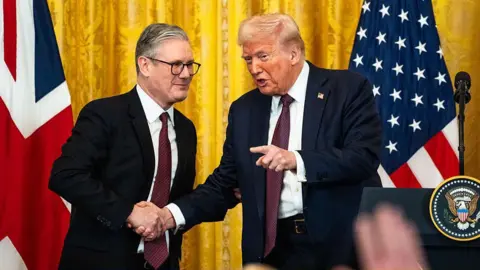
US-UK Trade: Tariff Relief and Lingering Uncertainty
Washington, D.C. – The United Kingdom has received a temporary reprieve from a recent executive order issued by President donald Trump, which doubles tariffs on steel and aluminum imports from 25% to 50%.The order, set to raise import taxes for U.S.-based firms buying these metals from other countries, took effect Wednesday. Though, the levy remains at 25% for the U.K., for now.
The Current Landscape
- Temporary Relief: The U.K. is currently exempt from the increased 50% tariff.
- Existing Tariffs: Imports of U.K. steel into America are currently subject to tariffs.
- Future Uncertainty: The U.K. could face the higher rate if a deal signed with the Trump administration last month, intended to eliminate steel and aluminum tariffs, does not come into force.
Did You Know?
The U.S. is the world’s largest importer of steel, after the European Union. Canada, Brazil, mexico, and south Korea are the primary sources.
Government and Political Reactions
A government spokesperson stated their commitment to protecting British business and jobs.
However, Conservatives have criticized the situation, calling the order a fresh tariff blow
and accusing Labor of leaving businesses in limbo.
The US-UK Economic Prosperity Deal (EPD)
President Trump’s order acknowledged the need for different treatment
for the U.K. due to the US-UK Economic Prosperity Deal (EPD) signed on May 8,2025. However, Trump added a caveat, stating that the U.S. might increase the tariff on the U.K. on or after July 9 2025
if it determines that the United Kingdom has not complied with relevant aspects of the EPD.
Timeline of Events
- Feb.10: Trump announces 25% tariffs on all steel and aluminum imports to the U.S., effective March 12.
- April 2: Trump announces most countries, including the U.K., will face a 10% “baseline” tariff on all goods sent to the U.S.
- May 8: the U.K. and U.S. agree to reduce or remove some levies.
- June 4: The U.S. raises import taxes for steel and aluminum to 50%,but the levy temporarily remains at 25% for the U.K.
Recent Negotiations
the U.K.’s temporary exemption follows a meeting between Business Secretary Jonathan Reynolds and U.S. Trade Representative Jamieson Greer in Paris on Tuesday. The agreement to reduce or remove tariffs on some goods, including cutting tariffs on U.K. steel and aluminum to zero and reducing import taxes on cars to 10%, is yet to be implemented.
Impact on the UK Steel Industry
America is the destination for about 7% of the U.K.’s steel exports, worth more than £400 million. Tariffs significantly impact the industry, especially suppliers of specialist steel products who ship most of their goods across the Atlantic.
Industry Perspectives
Gareth Stace, chief executive of UK steel, described the situation as a rollercoaster ride of uncertainty in the last months, weeks and days.
He added that the industry could breathe a temporary sight of relief
that the U.K. faces tariffs of 25% rather than 50%. Stace emphasized the ultimate goal: what we really want to get to is those tariffs removed
as agreed in May, expressing hope that that deal can be made soon enough.
That’s one thing that the Trump administration continues to do, is to create confusion, with the hope of getting a deal. Essentially, our customers are less confident in forward planning, or ordering what they need.
Rowan Crozier,chief executive of metal-stamping firm Brandauer in Birmingham
Mr.Crozier noted that while the carve-out would mean U.K.-based firms would not be seeing the same import tariffs as global competitors, the far reaching
uncertainty was the more damaging element.
He added that as a specialist manufacturing business, his U.S. customers had little choice but to pay the tariffs at present.
Pro Tip
Diversifying export markets can definitely help mitigate the impact of tariffs imposed by a single country.Companies should explore opportunities in regions with more stable trade relations.
Trump’s Trade Policy
President Trump has imposed tariffs on many countries since returning to the White House, aiming to encourage businesses and consumers to buy more American-made goods. Tariffs are taxes paid by businesses importing goods from foreign countries.Trump hopes this policy will boost U.S. manufacturing and jobs, but many economists warn it could led to higher prices for consumers.
Economic Analysis
Alan Auerbach, University of California director of tax policy and public finance, stated that more U.S.steel production was not going to happen overnight.
He added, In the short run, buyers are simply going to have to pay more for the steel that they’re buying from foreign sources.
While there may be more U.S. production eventually, uncertainty over future tariffs undercuts the aim of getting more US production
because firms need certainty to make investment decisions.
Political Fallout
shadow business secretary andrew Griffith said: Labour’s botched negotiations have left businesses in limbo and this country simply cannot afford their continuing failure.
