
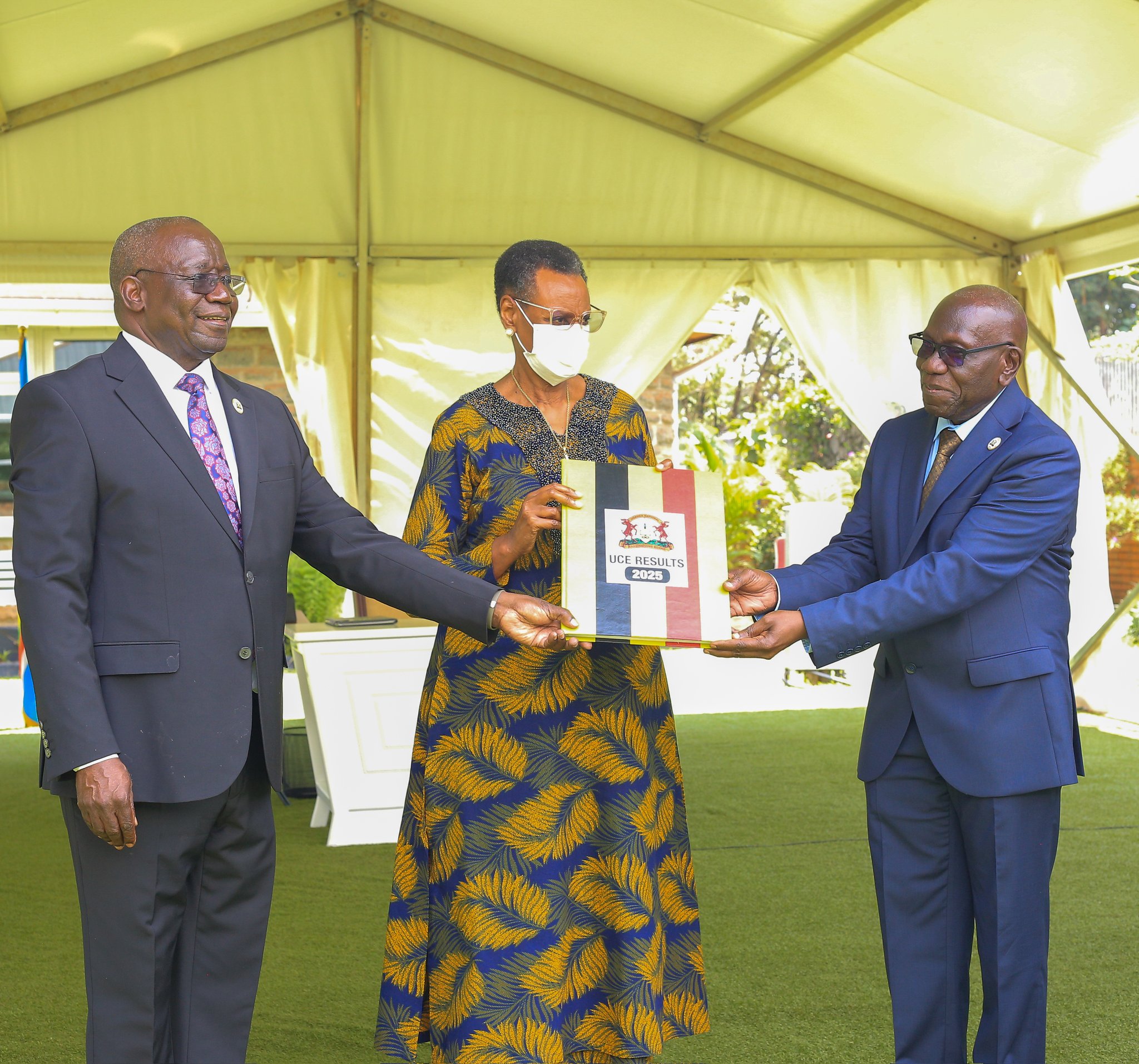
Uganda’s national examination body, the Uganda National Examinations Board (UNEB), released the results of the 2025 Uganda Certificate of Education (UCE) examinations today at State Lodge Nakasero, with the First Lady and Minister of Education and Sports, Janet Kataaha Museveni, officiating the event.
A total of 432,163 candidates registered for the UCE 2025 examinations, representing a significant increase from the 359,417 candidates who sat for the exams in 2024. This represents a rise of 72,746 candidates, or 20.2%, according to UNEB Executive Director Dan Odongo.
Odongo detailed the assessment methodology employed under the ongoing shift to a competency-based curriculum. Candidate performance is now evaluated using achievement levels graded A through E, determined through a combination of Continuous Assessment (CA) – contributing 20% to the final score – and the End-of-Cycle Examination, which accounts for 80%.
Notably, the percentage of candidates failing to achieve the UCE certificate has decreased substantially. Only 0.31% of candidates did not qualify for the certificate in 2025, a marked improvement from the 1.9% recorded in 2024. Candidates who do not meet all requirements for the award will be designated with “Result 2” on their transcripts, typically due to missing project scores or sitting for an insufficient number of subjects. A “Result 3” designation indicates a candidate scored below the basic level (Grade E) in all subjects.
Cases of examination malpractice remained low, with only 63 incidents reported during the 2025 UCE examinations, according to Odongo. He attributed this to the nature of the exam questions, stating they “do not easily lend themselves to malpractice.”
UNEB Chairperson Professor Celestino Obua highlighted the progress made in implementing the competency-based curriculum. He stated that the 2025 examination cycle proved more manageable than the initial implementation in 2024, with improved institutional capacity. “I sincerely commend the Executive Director and staff for their dedication and professionalism, which has enabled the successful release of the results of the second cohort of candidates under the Competence-Based Curriculum (CBC),” Obua said.
Professor Obua referenced a study undertaken by the Board to assess the benefits of the CBC, gathering feedback from school administrators, teachers, and learners. The findings, he stated, “confirm that the CBC is a strong, transformative curriculum, well-positioned to produce the type of Ugandans needed to drive the country’s socio-economic transformation and advance Uganda toward its middle-income status vision.”
