Tumescent Liposuction and Brachioplasty Used for Ollier Disease Case
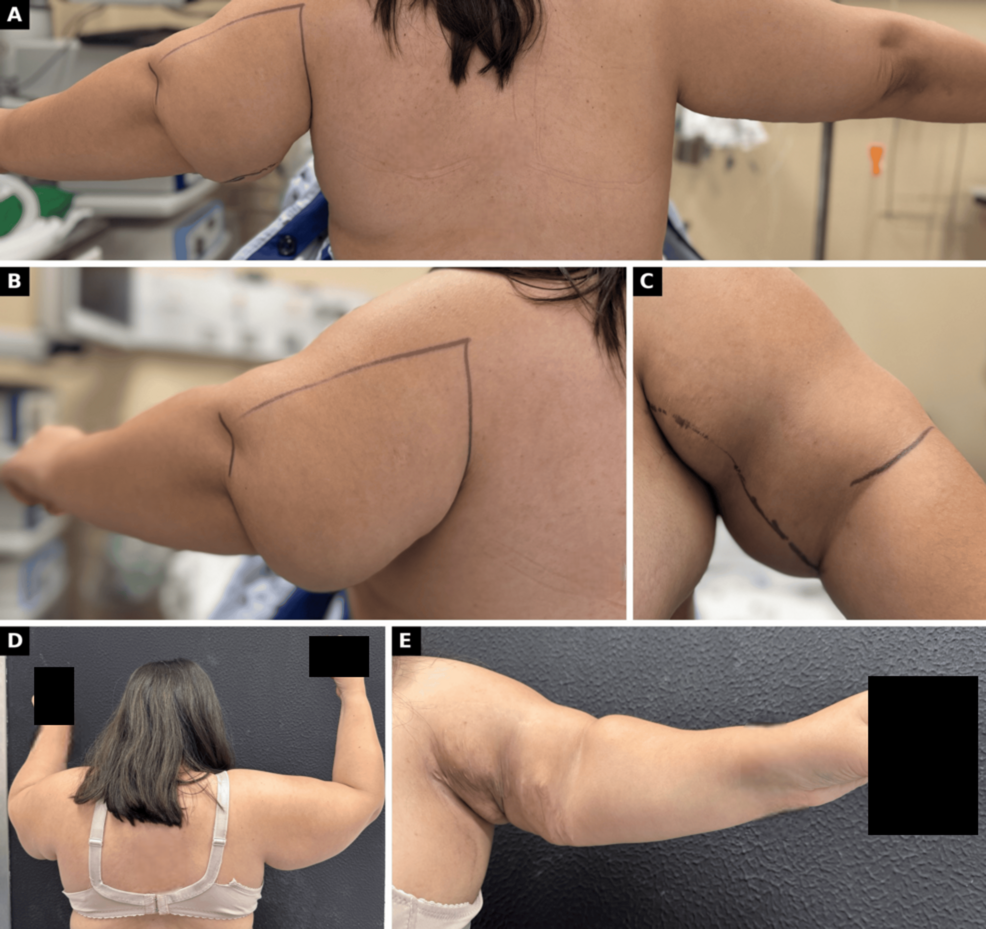
A 30-year-old woman with Ollier disease has undergone surgical correction to address upper-limb asymmetry, a procedure aimed at resolving a lipomatous deformity that caused the patient significant social and functional distress.
The intervention, featuring tumescent liposuction and medial brachioplasty, was documented in a case report published November 27, 2026, in the journal Cureus.
Ollier disease is a rare, nonhereditary disorder defined by multiple enchondromas, which typically result in limb shortening and skeletal deformity. While the condition’s impact on bone structure is well-documented, the soft-tissue consequences of asymmetric limb growth—such as the adipose overgrowth seen in this patient—have historically received little clinical attention, according to Cureus.
The patient, diagnosed with the condition at birth, presented with a double-lobulated soft-tissue mass along the medial and posterior aspects of her left arm. Computed tomography scans showed that the deformity consisted of homogeneous subcutaneous fat without any discrete mass or solid components. Skeletal involvement included proximal humeral deformity and muscle hypotrophy, though joint spaces remained preserved.
Surgeons performed tumescent liposuction followed by a medial brachioplasty to address the contour irregularity. The surgery was completed as a day case. Recovery was complicated only by a limited wound dehiscence, which healed with standard dressing care.
Twenty-seven months after the procedure, the patient maintained a corrected arm contour despite a weight gain of approximately 8 kg. Although a small area of residual posterior fullness remained, the patient expressed satisfaction with the outcome and declined further scar revision.
“The soft-tissue envelope may form a disproportionate contour that adds to the visible skeletal asymmetry,” the authors said in their report.
The authors added that adult orthopaedic follow-up remains necessary for patients with this diagnosis due to the long-term risk of malignant transformation into chondrosarcoma.