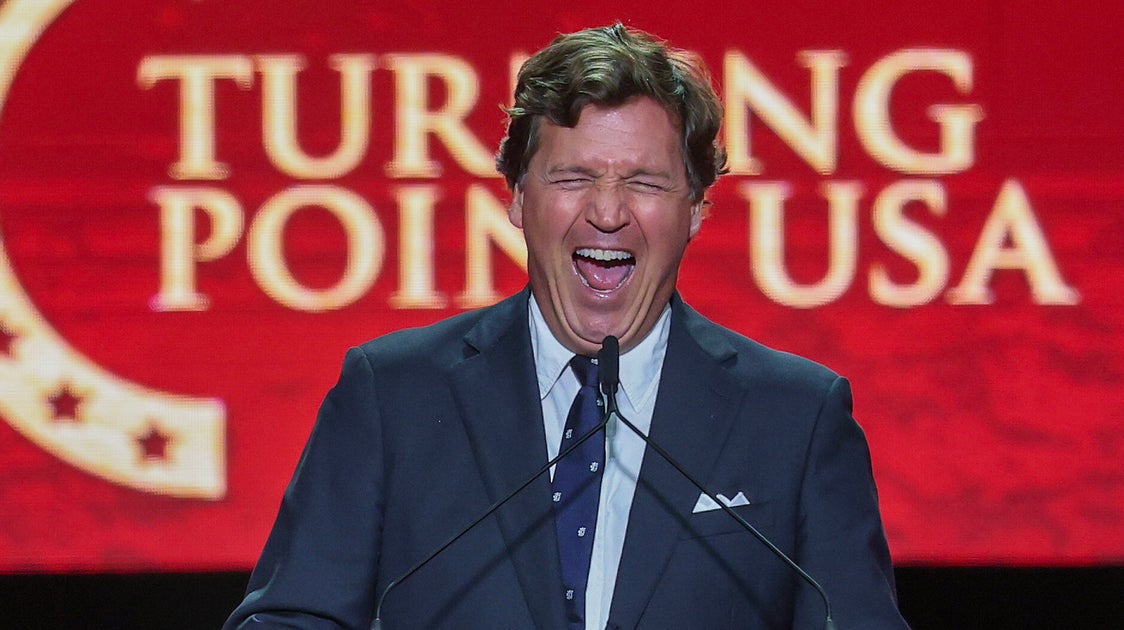
Tucker Carlson Calls Credit Card Debt ‘Predatory’-Is the Industry Unethical?
Tucker Carlson’s latest broadside against credit card issuers—calling them “predatory” and urging consumers to abandon revolving debt—has sent shockwaves through the $1.2 trillion U.S. Consumer credit market, exposing a structural tension between populist rhetoric and Wall Street’s balance sheets. The remarks, aired during Monday’s episode of *The Tucker Carlson Show*, align with a broader conservative push to redefine financial consumerism, but the underlying fiscal math reveals a far more complex calculus for issuers, fintech competitors, and regulatory bodies grappling with post-pandemic debt cycles.
Why Carlson’s Credit Card Rhetoric Is a Double-Edged Sword for Issuers
Carlson’s framing—rooted in the narrative that credit card APRs (now averaging 20.5% as of Q1 2026, per the Federal Reserve’s G.19 report) function as “legalized extortion”—ignores the economic reality that issuers like JPMorgan Chase (via Chase Sapphire) and Capital One (with their Venture cards) generate EBITDA margins north of 50% by cross-subsidizing rewards programs with high-interest debtors. The problem? His audience’s behavior doesn’t align with his advice.

According to the New York Fed’s Quarterly Report on Household Debt and Credit, credit card balances surged 12% year-over-year in Q1 2026, with delinquency rates ticking up to 3.8%—a level last seen in 2010. Carlson’s call for mass abandonment of credit cards risks accelerating this trend, forcing issuers to either raise interest rates further (hurting consumer sentiment) or write off more bad debt (shrinking profit pools). The latter would trigger a scramble for debt recovery specialists and AI-driven credit scoring platforms to mitigate losses.
“Carlson’s rhetoric is a canary in the coal mine for issuers. The real question isn’t whether his audience will listen—it’s whether regulators will step in before the delinquency spiral forces a liquidity crunch.”
The Fintech Counterplay: How Neobanks Are Weaponizing Carlson’s Anger
While Carlson’s critique targets traditional banks, the $140 billion neobank sector (led by Chime, Revolut, and SoFi) is already capitalizing on the sentiment. These players—backed by venture capital dry powder exceeding $50 billion—offer 0% APR cards and cash-back structures that undercut issuers’ revenue models. The catch? Neobanks rely on third-party payment processors to handle chargebacks and fraud, a $12 billion market in 2026 where even a 1% uptick in disputes (fueled by Carlson’s “junk fee” narrative) would strain margins.
Data from the American Bankers Association shows that 68% of neobank users carry no credit card debt, meaning their growth hinges on converting Carlson’s disillusioned audience. The fly in the ointment? Neobanks’ underwriting models, which often rely on alternative data lenders, lack the historical resilience of legacy issuers during downturns.
Regulatory Whiplash: The CFPB’s Dilemma
The Consumer Financial Protection Bureau (CFPB) is caught in a bind. Carlson’s populist stance mirrors Director Rohit Chopra’s 2025 push to cap late fees and penalize “abusive” practices. Yet the CFPB’s own Q2 2026 enforcement report reveals that 72% of credit card complaints stem from consumer mismanagement, not issuer malfeasance.
If Carlson’s audience abandons credit cards en masse, the CFPB faces two outcomes:
- Scenario 1: Issuers lobby for regulatory relief, pushing the CFPB toward lighter oversight—benefiting financial compliance firms that help banks navigate looser rules.
- Scenario 2: Delinquencies spike, forcing the CFPB to intervene with emergency rate caps, which would trigger a legal arms race between issuers and consumer advocates.
The latter would send shockwaves through the $8 trillion fixed-income market, where credit card ABS (asset-backed securities) trade at discounts exceeding 200 basis points—a signal investors are already pricing in risk.
“The CFPB’s challenge isn’t just balancing Carlson’s rhetoric with market stability—it’s ensuring that any crackdown doesn’t create a liquidity vacuum for tiny issuers. The last thing we need is a 2008-style credit crunch, but that’s the trajectory if debtors default en masse.”
The B2B Fallout: Who Wins When Consumers Rebel?
Carlson’s remarks aren’t just noise—they’re a strategic disruption for three key B2B sectors:

| Sector | Problem Created | Solution Provider |
|---|---|---|
| Debt Collection Agencies | Issuers offload delinquent portfolios en masse, but FCRA compliance costs (Fair Credit Reporting Act) rise as disputes surge. | Specialized collections firms with AI-driven skip-tracing tools. |
| Credit Bureaus | Neobanks flood the market with “thin-file” consumers, forcing bureaus to rebuild risk models from scratch. | Alternative data integrators like Experian Boost or FICO’s Score 10. |
| Legal & Compliance | Issuers face class-action lawsuits over “predatory” terms, while neobanks scramble to prove they’re not “too big to fail.” | White-collar defense firms with deep CFPB litigation experience. |
The Bottom Line: A Market at the Tipping Point
Carlson’s credit card critique is less about personal finance and more about industry realignment. The next 12 months will test whether his audience’s behavior aligns with his rhetoric. If delinquencies rise, issuers will double down on high-fee premium cards—a move that could backfire by fueling further populist backlash. Meanwhile, neobanks will need stress-testing partners to ensure their underwriting holds under a debt abandonment scenario.
The bigger question? Who profits when the credit card duopoly fractures. The answer lies in the World Today News Directory, where the firms already positioning for this seismic shift are the ones with the data, the legal firepower, and the balance sheet depth to thrive in the chaos.