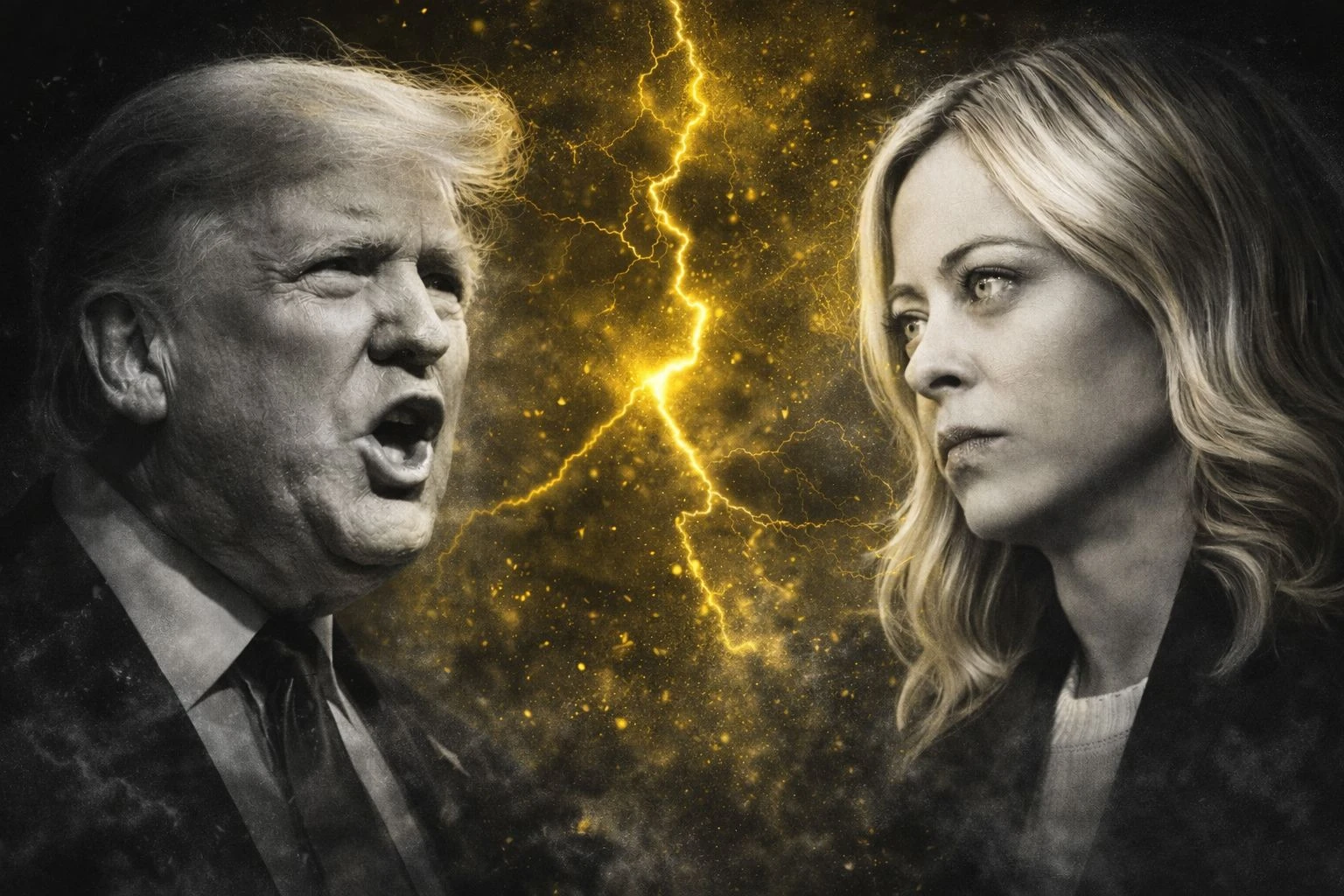
Trump’s Attack on Meloni: Political Fallout and Tensions in Italy
Italian Prime Minister Giorgia Meloni has publicly condemned U.S. President Donald Trump after he attacked Pope Leo XIV on Truth Social. The conflict stems from the Pope’s staunch opposition to the U.S. War on Iran, creating a rare and volatile diplomatic rift between the two close right-wing allies in Rome and Washington.
This is more than a simple disagreement over rhetoric. It is a collision of faith, foreign policy, and political loyalty that threatens to destabilize one of the most consistent ideological partnerships in the West.
The storm broke when Donald Trump took to Truth Social to launch a scathing attack on Pope Leo XIV. The U.S. President did not hold back, accusing the pontiff of being “WEAK on Crime and terrible for Foreign Policy.” Trump later reinforced this stance when speaking to reporters, bluntly stating that he was “not a large fan” of the Pope. The tension is rooted in the Pope’s vocal criticism of the Iran conflict, specifically his condemnation of Trump’s threat to “destroy Iranian civilisation,” which the Pope labeled as “unacceptable.”
The Pope has remained resolute. While traveling to Algeria, he told reporters that he has “no fear” of the Trump administration and will continue to advocate for an “off-ramp” to complete the war. He declined to enter a direct debate with the U.S. President but maintained his commitment to promoting peace.
For Giorgia Meloni, this created an impossible political calculation. As a devout Catholic leading a right-wing coalition and a known close ally of Trump, she initially attempted to navigate the crisis with caution. Her first response on Monday backed the Pope’s right to call for peace but pointedly avoided mentioning Trump by name.
It didn’t satisfy the critics at home.
Opposition politicians in Italy quickly seized on her hesitation, accusing the Prime Minister of lacking the courage to challenge her American counterpart. This domestic pressure forced Meloni’s hand, leading to a second, more aggressive statement on Tuesday. She explicitly labeled Trump’s words “unacceptable” and expressed her solidarity with Pope Leo XIV.
“I express my solidarity with Pope Leo. Frankly I would not feel very comfortable in a society where religious leaders do what political leaders say.”
This represents an extremely rare public rebuke of the U.S. President from Meloni. The friction extends beyond the Vatican; Meloni has also openly opposed the U.S. War on Iran, signaling a growing divergence in how Rome and Washington view the stability of the Middle East.
The fallout has rippled through the Italian government, testing the cohesion of Meloni’s right-wing coalition. Matteo Salvini, leader of the populist League party, joined the criticism, noting that attacking the Pope is neither “useful” nor “intelligent.” Even Riccardo Magi, the secretary of +Europa, noted the irony of Salvini’s stance, given his history of criticizing previous popes.
As tensions mount between the Vatican and the White House, the legal complexities of international diplomacy become paramount. Many diplomatic missions and NGOs are currently relying on international law specialists to navigate the shifting landscape of sovereign immunity and diplomatic protocol.
The domestic fallout in Italy has sparked a renewed interest in the role of the church in state affairs, prompting citizens to seek guidance from faith-based advocacy groups to reconcile political loyalty with religious conviction.
Meanwhile, the geopolitical stakes remain dangerously high. Trump has doubled down, refusing to apologize to the “very weak” Pope. With the threat of escalated conflict in Iran looming, businesses with Middle Eastern interests are urgently consulting global trade consultants to mitigate the risks of sudden sanctions or supply chain disruptions.
The Diplomatic Fracture
The relationship between Meloni and Trump was once seen as a blueprint for the new right-wing international order. Their meeting at Mar-A-Lago in January 2025 highlighted a shared vision of nationalist governance. However, the current “war of words” reveals a critical vulnerability: the intersection of nationalist politics and the institutional authority of the Catholic Church.

The conflict is anchored in three distinct geographic hubs:
- Washington D.C.: Where the administration is pushing a hardline stance on Iran and dismissing traditional diplomatic channels.
- Rome: Where the Prime Minister must balance her alliance with Trump against her identity as a Catholic leader and the expectations of the Italian electorate.
- The Vatican: Which continues to position itself as the moral arbiter against war, regardless of the political cost.
For more detailed tracking of these diplomatic shifts, readers can reference the Reuters report on Meloni’s rebuke, the BBC coverage of the Truth Social attacks, and the National Post analysis of the escalating rhetoric.
The core of the problem is the “off-ramp.” While Pope Leo XIV seeks a diplomatic exit from the Iran conflict to prevent the destruction of a civilization, the Trump administration appears to view such calls for peace as a sign of weakness.
This clash is not just about one man’s social media post. It is about the definition of strength in the 21st century. Is strength the willingness to destroy a rival, or the courage to seek peace in the face of aggression?
As the situation evolves, the stability of the Meloni-Trump axis remains in question. If the U.S. Continues to target the head of the Catholic Church, Meloni may find that her domestic survival requires her to distance herself from Washington entirely.
Alliances built on shared ideology are powerful, but they are fragile when they collide with deep-seated cultural and religious identities. In the battle between political loyalty and spiritual authority, the outcome will determine the future of Italy’s relationship with the United States. For those navigating the professional and legal fallout of these shifting global alliances, the World Today News Directory remains the essential resource for finding verified experts equipped to handle the volatility of modern diplomacy.