Trump-Xi Summit 2024: Key Issues, Power Dynamics & China’s Evolving Influence
President Donald Trump will arrive in Beijing on Thursday for his second summit with Chinese President Xi Jinping, a meeting that arrives against a backdrop of deepening geopolitical tensions, a fragile trade truce, and the escalating conflict in the Middle East. The summit, originally scheduled for March but delayed after U.S. And Israeli strikes on Iran, marks the first state visit by a U.S. President to China since 2017, when Trump’s first trip included a lavish state reception and $250 billion in announced business deals. This time, the stakes are higher—and the optics starkly different.
The visit comes as China consolidates its position as the dominant player in critical minerals, a sector vital to both economies, while the U.S.-led war against Iran strains global energy markets and tests the limits of the fragile trade agreement struck between Washington and Beijing last year. Analysts at the Council on Foreign Relations (CFR) have warned that Xi’s government is entering the talks with a clear strategic advantage, framing the moment as one where “the East is rising and the West is declining.” Trump, meanwhile, arrives convinced of his own leverage, despite the absence of the ceremonial trappings that defined his first visit.
Economic and Trade Tensions: A Delicate Balance
The trade war that dominated Trump’s first presidency has been dialed down in recent months, but underlying tensions remain. The U.S. Has imposed new restrictions on Chinese semiconductor exports, while Beijing has accelerated its push to dominate the supply chains for rare earth minerals—critical components in everything from electric vehicles to military hardware. The CFR’s Rush Doshi, director of the China Strategy Initiative, notes that China’s control over these resources gives it “asymmetric leverage” in any negotiation. “Xi is not just defending China’s interests,” Doshi said in a CFR analysis. “He is shaping the rules of the 21st century.”
Trump’s administration has framed the summit as an opportunity to lock in concessions on intellectual property and market access, but Chinese officials have signaled no intention of reversing their industrial policies. Instead, Beijing is expected to focus on stabilizing relations, particularly on Taiwan, where tensions have flared in recent months. The U.S. Has avoided direct confrontation, but the presence of American warships near the Taiwan Strait has raised alarms in Beijing, which views any discussion of Taiwanese independence as a red line.
The Iran Factor: A Looming Crisis
The conflict in Iran looms larger than ever. The U.S. And Israeli strikes in March, which targeted Iranian military sites and proxy groups, have sent oil prices surging and disrupted shipping through the Strait of Hormuz. China, a major importer of Iranian oil, has been caught in the crossfire, with Washington pressing Beijing to cut ties with Tehran while Chinese companies scramble to secure alternative supply routes. The CFR’s David Sacks, a fellow for Asia studies, described the situation as a “perfect storm” where China’s economic interests and its diplomatic neutrality are at odds.

Trump’s visit to Beijing follows a series of closed-door meetings with Chinese officials, where the Iran crisis was reportedly a dominant topic. While the U.S. Has not demanded that China take sides, the pressure is implicit: any Chinese support for Iranian proxies could trigger a sharp response from Washington. Meanwhile, China’s state media has framed the conflict as a Western overreach, warning that external interference in the Middle East risks destabilizing the region further.
Taiwan: The Unspoken Divide
Despite the focus on trade and Iran, Taiwan remains the elephant in the room. Chinese military drills near the island have increased in frequency, while the U.S. Has expanded its defense commitments, including arms sales to Taipei. Trump, who has previously suggested he might recognize Chinese sovereignty over Taiwan if re-elected, has taken a more cautious approach in recent statements, emphasizing the need for “peaceful resolution.” However, Chinese officials have made it clear that any U.S. Support for Taiwanese independence would be a dealbreaker.
The CFR’s Heidi E. Crebo-Rediker, a senior fellow for China and emerging technologies, warned that Taiwan is not just a territorial dispute but a test of China’s willingness to compromise. “Xi cannot afford to appear weak on Taiwan,” she said. “But he also knows that pushing too hard risks isolating China further.” The summit’s ability to address Taiwan will likely hinge on whether Trump is willing to offer concessions in other areas—particularly on trade and technology—to secure Chinese restraint.
Artificial Intelligence: The Next Frontier
Beyond trade and security, artificial intelligence (AI) is emerging as a critical battleground. China’s rapid advancements in AI, coupled with its access to vast troves of data, have put it ahead of the U.S. In key areas, including facial recognition and autonomous systems. Trump’s administration has imposed restrictions on Chinese AI firms, but Beijing has responded by accelerating domestic development, with state-backed companies leading the charge.

The CFR’s David M. Hart, a senior fellow for climate and energy, noted that AI could become the defining issue of the summit. “China doesn’t just want to compete with the U.S. In AI—it wants to set the global standards,” Hart said. “Trump’s approach will determine whether this becomes another trade war or a race for technological supremacy.” The U.S. Has signaled a willingness to engage in dialogue, but Chinese officials have been tight-lipped about any potential compromises.
A Summit Without Fanfare
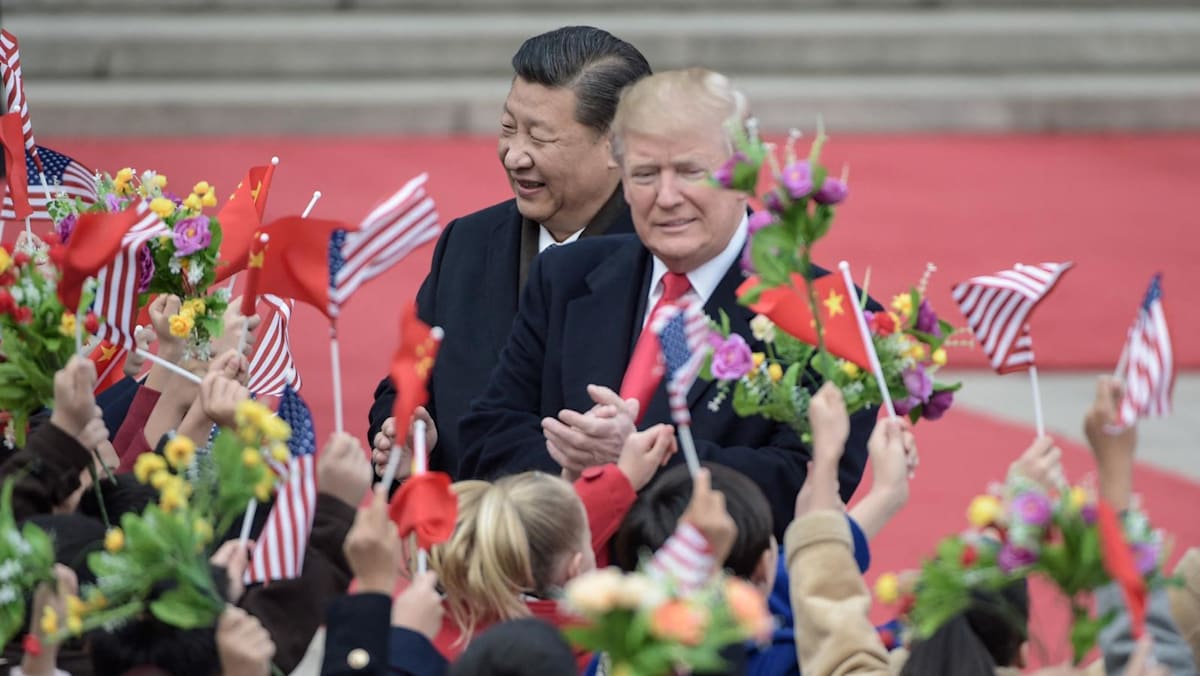
Unlike Trump’s first visit to China in 2017, this summit will lack the pomp and ceremony that once defined U.S.-China relations. There will be no state dinners in the Forbidden City, no parades through Tiananmen Square, and no $250 billion in announced deals. Instead, the focus will be on closed-door negotiations, where the real work of diplomacy will take place. Trump’s team has described the trip as “pragmatic,” with an emphasis on bilateral talks rather than public spectacle.
Yet the absence of fanfare does not mean the stakes are lower. With global instability rising, the Iran conflict escalating, and technological competition intensifying, the Trump-Xi summit is being watched as a potential turning point in U.S.-China relations. Whether it results in meaningful progress or further strain remains to be seen—but one thing is clear: China is entering the talks from a position of strength.