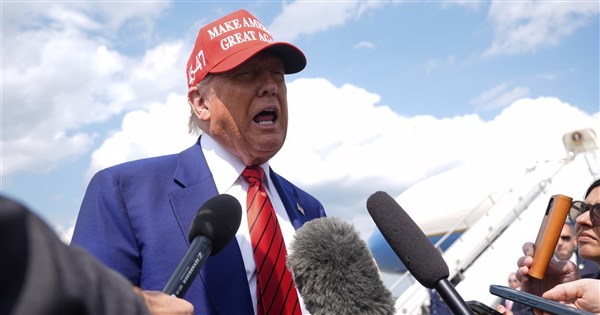
Trump Threatens Iran Strikes on April 7 Over Strait Access
U.S. President Donald Trump has issued a 48-hour ultimatum to Iran, demanding the immediate reopening of the Strait of Hormuz. Failure to comply by April 7 threatens catastrophic strikes on Iranian power plants and bridges, escalating a five-week conflict between U.S.-Israeli forces and Tehran that jeopardizes 20% of global energy supplies.
The Strait of Hormuz is not merely a geographical choke point; It’s the world’s energy jugular. With the United States and Israel having initiated military operations against Iran on February 28, the current deadlock has transitioned from a regional skirmish to a systemic threat to the global economy. This represents a high-stakes gamble where the currency is not just diplomacy, but the stability of international oil and LNG prices.
The tension reached a breaking point on April 4, when President Trump took to Truth Social to remind Tehran of a previous 10-day window for an agreement—a deadline set on March 26 and expiring Monday, April 6, at 8:00 PM ET. The message was blunt: “Time is running out. After 48 hours, hell will rain down on them.”
The Rhetoric of ‘Hell’ and the Iranian Counter-Gambit
The linguistic escalation between Washington and Tehran has shifted from diplomatic signaling to open hostility. Trump’s threats specifically target Iranian energy infrastructure and critical bridges, aiming to break the blockade through the threat of total systemic collapse.

“The threats are helpless, anxious, unbalanced, and stupid actions,” stated General Ali Abdollahi Aliabadi of the Iranian Central Military Command, responding to the U.S. Ultimatum with a mirroring warning: “The gates of hell will be opened for you.”
Despite the fiery rhetoric from the military command, a sliver of diplomatic movement remains. Iranian Foreign Minister Abbas Araqchi has indicated that Tehran does not rule out dialogue with the United States, provided the mediation is handled by Pakistan. Araqchi expressed gratitude for Islamabad’s efforts, though he stopped short of confirming whether Iran would succumb to Trump’s specific demands regarding the strait.
This dichotomy—military defiance paired with cautious diplomatic openness—suggests Tehran is attempting to balance its internal hardline stance with the reality of five weeks of continuous military pressure.
The Strategic Chokehold: Why the World is Holding Its Breath
Iran’s current strategy is simple: leverage the Strait of Hormuz to force a U.S. Military withdrawal. Because the waterway handles approximately one-fifth of the world’s total oil and liquefied natural gas (LNG) shipments, any prolonged closure triggers immediate volatility in global commodity markets.
Intelligence reports cited by Reuters suggest that Iran is unlikely to lift the blockade in the immediate short term. By keeping the shipping lanes restricted, Tehran maintains a powerful chip to coerce the U.S. Into ending its military campaign.
For multinational corporations, this volatility is a logistical nightmare. As shipping routes grow unpredictable and insurance premiums for tankers skyrocket, firms are increasingly relying on global logistics consultants to restructure supply chains and identify alternative energy corridors to avoid the Persian Gulf entirely.
The risk is not limited to shipping.
The potential for “blackout” strikes on Iranian power plants introduces a recent layer of instability. Israel is reportedly prepared to execute these attacks on energy facilities, awaiting only the final green light from the White House. If these strikes occur, the resulting regional chaos could trigger “force majeure” declarations across thousands of international trade contracts.
Corporate legal teams are already feeling the pressure. To navigate the complex intersection of war-risk clauses and international trade law, firms are urgently engaging international trade lawyers to audit their exposure to Middle Eastern energy disruptions.
Macro-Economic Fallout and the Intelligence Gap
The disconnect between Trump’s 48-hour deadline and the intelligence on the ground is stark. Even as the U.S. Administration seeks a rapid resolution to stabilize markets, the intelligence indicates that Iran views the blockade as its only effective shield against further U.S.-Israeli aggression.
This stalemate creates a dangerous vacuum. If the April 7 deadline passes without a deal, the world faces two probable scenarios: a massive escalation of kinetic warfare targeting Iranian infrastructure, or a prolonged energy crisis that drives global inflation to new heights.
Investment firms and hedge funds are currently treating the region as a “red zone,” leading to a sharp decline in foreign direct investment (FDI) across neighboring Gulf states. To mitigate these externalities, institutional investors are onboarding geopolitical risk advisors to model the impact of a full-scale regional war on diversified portfolios.
The current standoff is more than a clash of egos between Trump and the Iranian regime; it is a stress test for the modern global order. The transition from “maximum pressure” to “kinetic action” happens in a heartbeat, and the ripple effects will be felt from the refineries of Asia to the stock exchanges of New York.
As the 48-hour clock ticks down toward April 7, the global business community must accept that the “aged rules” of diplomatic engagement have been replaced by a doctrine of raw power. Navigating this volatility requires more than just monitoring the news—it requires the strategic partnership of the world’s most elite legal, financial, and security experts. To secure your operations against the shifting tides of Middle Eastern geopolitics, explore the vetted professionals within the World Today News Directory.