
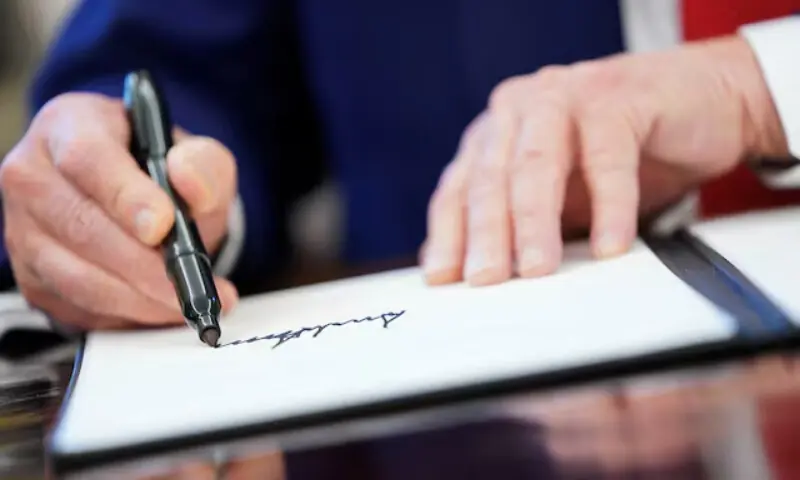
Trump Signature to Appear on US Paper Currency Starting Summer 2026
President Donald Trump’s signature will soon grace US currency, marking a historic departure from a 165-year tradition and eliminating the signature of the US Treasurer. The Treasury Department announced the move, slated to begin with the printing of $100 bills in June, as part of celebrations for the nation’s 250th anniversary. This decision, framed as a recognition of economic success under the Trump administration, has sparked debate about the politicization of national symbols and potential implications for currency security.
The immediate fiscal consequence isn’t counterfeiting – the Treasury insists existing safeguards remain – but a subtle erosion of public trust in the impartiality of financial instruments. Although the aesthetic change is minimal, the symbolic weight is substantial. This creates a demand for heightened due diligence in financial transactions, particularly for international clients. Firms specializing in compliance and regulatory consulting will see increased demand as businesses navigate potential reputational risks associated with handling currency perceived as politically branded.
A Legacy Disrupted: The Treasurer’s Role and the Shift in Authority
For over a century and a half, the signature of the US Treasurer has been a constant on American banknotes, representing a crucial link between the Treasury Secretary and the Bureau of Engraving and Printing. This tradition, dating back to 1861, is now being broken. The rationale, according to Treasury Secretary Scott Bessent, is to highlight President Trump’s economic achievements. “There is no more powerful way to recognise the historic achievements of our great country and President Donald J. Trump than US dollar bills bearing his name,” Bessent stated. This move echoes previous efforts by the Trump administration to prominently feature the president’s name on various government assets, including coins and buildings.
The decision isn’t without legal precedent. A statute governing Federal Reserve notes grants the Treasury broad discretion over design changes to combat counterfeiting, while preserving elements like “In God We Trust” and requiring portraits of deceased individuals. However, critics argue This represents a stretching of that authority. The removal of the Treasurer’s signature also raises questions about the role of that office and its oversight functions.
Economic Context: A Second-Term Narrative of “Golden Age Revival”
The timing of this announcement is inextricably linked to the narrative of economic prosperity during Trump’s second term. Bessent’s statement explicitly connects the signature change to “strong US economic growth and financial stability.” While the US economy has demonstrated resilience, attributing that solely to one administration is a simplification. According to the Bureau of Economic Analysis, the US GDP grew at an average annual rate of 2.5% during Trump’s second term (2025-2026), a figure comparable to the growth rates observed during the latter years of the Biden administration. Bureau of Economic Analysis. However, inflation remained a persistent concern, peaking at 4.2% in early 2026 before gradually declining.
“The market is remarkably adept at compartmentalizing political gestures from underlying economic fundamentals. However, this move introduces a layer of perceived political risk, particularly for international investors. They’ll be looking for assurances of continued monetary policy independence.” – Dr. Eleanor Vance, Chief Investment Officer, Crestwood Capital.
The attempt to circulate a $1 Trump coin was previously blocked by laws prohibiting the depiction of living individuals on US currency. This signature change circumvents that restriction, albeit in a less overt manner. The broader context is one of increasing nationalistic branding, a trend that extends beyond currency.
The Counterfeiting Question and the Role of Advanced Security Features
The Treasury Department maintains that the signature change will not compromise currency security. Modern US banknotes incorporate a multitude of anti-counterfeiting measures, including watermarks, security threads, color-shifting ink, and microprinting. These features are constantly being updated to stay ahead of counterfeiters. However, the introduction of a presidential signature could potentially create novel vulnerabilities.
The focus on visual security features is driving innovation in the security printing and document protection industry. Companies are developing advanced technologies to detect even the most sophisticated counterfeits, including spectral analysis and holographic overlays. The demand for these technologies is expected to increase as governments worldwide seek to protect their currencies from illicit replication.
Impact on International Transactions and Perceptions of Monetary Policy
The introduction of a presidential signature on US currency could have subtle but significant implications for international transactions. Some foreign banks and businesses may perceive the move as a politicization of the dollar, potentially leading to a preference for other currencies. This is particularly true in countries with strained political relations with the United States. The perception of monetary policy independence is crucial for maintaining the dollar’s status as the world’s reserve currency.
The current account deficit, which stood at $780 billion in 2025, according to the US Census Bureau, US Census Bureau, remains a key vulnerability for the US economy. A decline in international confidence in the dollar could exacerbate this deficit, leading to further economic instability.
Legal Framework and Precedent
The legal basis for the signature change rests on the statute governing Federal Reserve notes, which grants the Treasury Secretary broad discretion over currency design. However, legal scholars are debating whether this discretion extends to removing the Treasurer’s signature solely for symbolic purposes. There is limited historical precedent for such a move. While the Treasury has made numerous design changes over the years, these have typically been motivated by security concerns or the need to accommodate new technologies.
This situation highlights the growing need for specialized government contracts law firms. Businesses navigating the complexities of federal regulations and potential legal challenges related to government actions require expert legal counsel.
Former Treasurer Jovita Carranza, who served during Trump’s first term, defended the change as “a powerful symbol of American resilience.” However, her successor, Lynn Malerba, declined to comment. The current Treasurer, Brandon Beach, echoed the administration’s narrative of an “economic revival.”
The long-term impact of this decision remains to be seen. It’s a calculated move, designed to reinforce a particular political narrative and capitalize on a perceived economic success story. However, the potential for unintended consequences – a subtle erosion of trust, increased scrutiny from international partners, and a heightened focus on currency security – cannot be ignored. As the new bills circulate, businesses and investors will be closely watching to see how the market reacts. The World Today News Directory remains committed to providing in-depth analysis and connecting you with the B2B partners you need to navigate this evolving landscape.