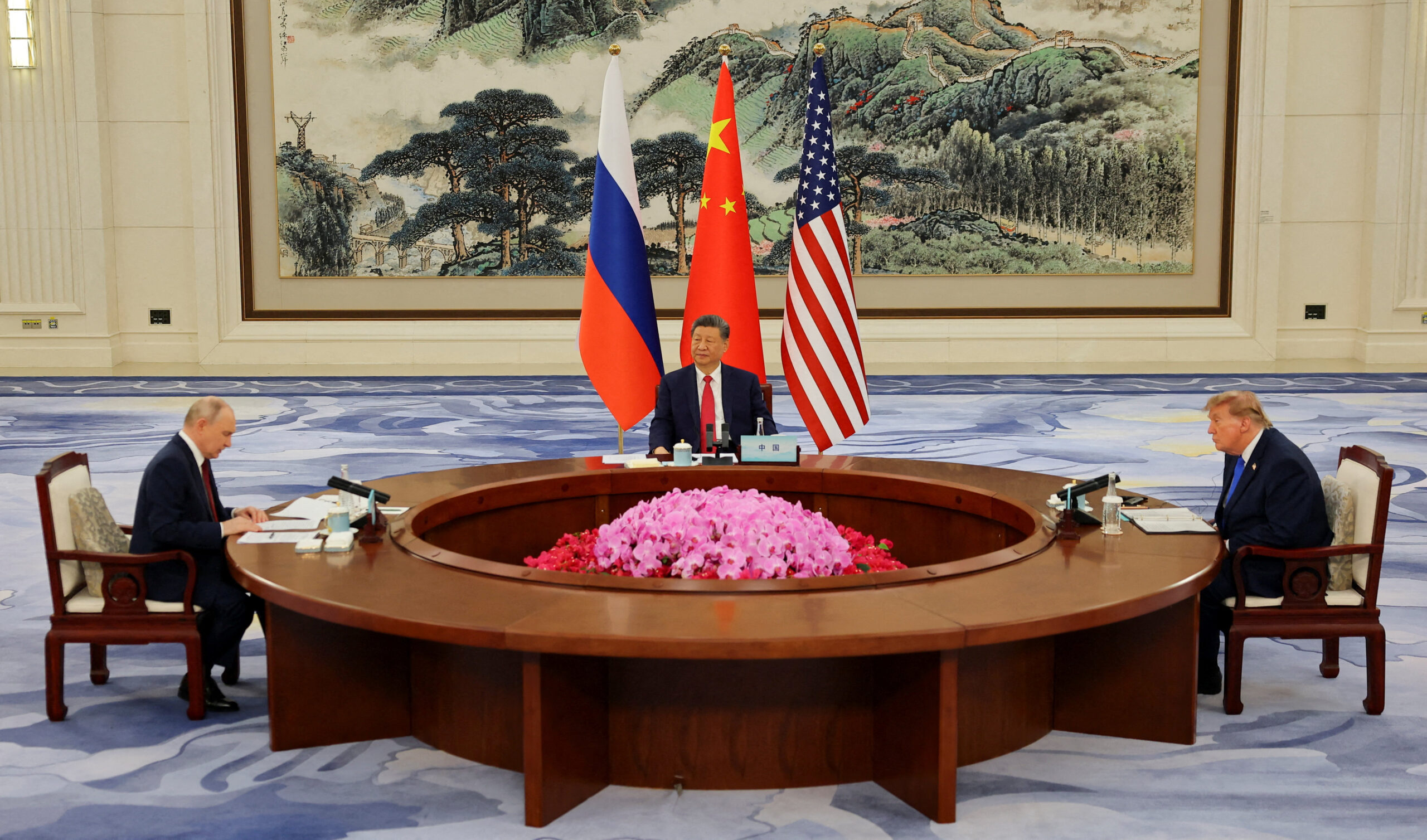
Trump, Putin, Xi Shenzhen Summit: All Image, No Substance, Experts Say
“The trilateral summit was all image, no substance,” said Melanie Hart on Thursday, fresh from an Atlantic Council trip to China.
President Donald Trump, Russian President Vladimir Putin and Chinese President Xi Jinping met as a trio for the first time in Shenzhen on Thursday, Atlantic Council reported, at a table staged to cast all three as geopolitical titans.
What they produced beyond the photographs was a four-point “declaration toward peace,” released after the meeting by Beijing — and, in the judgment of the think tank’s experts, a summit that reshaped optics more than policy.
Hart, the council’s senior director of the Global China Hub and a former State Department adviser on China, told Atlantic Council the session was “Beijing shaping the narrative” from start to finish.
Four points, one table
The declaration covered nuclear weapons, the International Criminal Court, United Nations reform and petroleum output. Its most promising element, according to Daniel Fried, the council’s Weiser Family distinguished fellow and a former US assistant secretary of state for Europe, was the “reaffirmation” of past US-Russian language that a “nuclear war cannot be won and must never be fought.”
“Counts as a modest advance in bringing China into nuclear-arms issues and could be something to build on,” Fried said of that inclusion.
Hart saw it differently. China, she told Atlantic Council, is “building its nuclear arsenal at a pace the world has never seen,” has “no intention” of slowing down, and its “agreeing to empty dialogue is just another way to buy time.”
The court in the crosshairs
The second point had the leaders agreeing that the ICC must require state consent and ensure immunities for state officials. Gissou Nia, director of the council’s Strategic Litigation Project and a former war-crimes prosecutor at international courts in The Hague, told Atlantic Council the position “threatens the ICC’s very raison d’être.”
President Donald Trump, Chinese leader Xi Jinping, and Russian President Vladimir Putin are expected to hold a three-way summit on the sidelines of this week’s APEC meeting in Shenzhen, China. “No U. S. president has ever held a trilateral meeting with the leaders of China and…”
“Represents the starkest departure yet from the United States’ long-standing support for the protection and promotion of human rights and accountability,” Nia said of the language.
The third point, UN reform, drew the same split. Hart called it part of Beijing’s “initiative aimed at weakening Western values.” Nia allowed that some reforms are needed, but said they should “promote and support accountability and ensure equity and equal voices among states” — not the consolidation of power she said the three leaders appear intent on.
The final point called for increased petroleum production, and Fried argued it benefits Russia most. The language suggests “the US will work to undermine sanctions and other restrictions on Russian oil sales,” he told Atlantic Council, along the lines of the Trump administration’s recent diesel deal with Russia.
Who walked out ahead
Xi, in Hart’s reading, secured the image he wanted: “China presiding over the United States and Russia,” and “not only as a peer competitor but… in the driver’s seat, with the US and Russia along for the ride.”
Fried graded Trump’s appearance alongside two authoritarians as “a missed opportunity for a US president to advance a US and free-world agenda.” Putin, he said, “comes out ahead simply by being treated as a great power equal to Xi and Trump.”
“A shared desire from Trump, Xi, and Putin to shield themselves from accountability,” Nia said, reading the joint statement as a bid to return to a system in which “great powers and spheres of influence ruled the day.”
APEC on the sidelines
The trilateral “thoroughly overshadowed” the annual APEC forum, which ran in Shenzhen at the same time, said Jeremy Mark, a nonresident senior fellow at the council’s GeoEconomics Center and a former IMF official.
“That is par for the course for APEC, which thrives by offering a venue for high-profile diplomacy,” Mark told Atlantic Council, pointing to last year’s Xi-Trump meeting in Busan, South Korea. Even with dozens of leaders attending, the sessions tend to “sidestep some of the biggest challenges,” he said — though this year’s gathering did flag artificial intelligence-fueled digital risks such as data breaches and online fraud.
Donald Trump is arriving at an unprecedented summit meeting with Xi Jinping and Vladimir Putin politically weakened at home, yet perhaps even more eager to flex his power abroad https://t.co/tDckZNxgum
Berlin’s counterweight
While the three leaders posed in Shenzhen, the “Coalition of the Willing” met in Berlin on Thursday to discuss European support for Ukraine. Trump called in from Air Force One on the flight home from China, reportedly telling European leaders that Putin is serious about peace talks.
Fried argued the US president should be backing that meeting, not scrambling for photo ops and flattering the aggressive tyrant Putin, who is no friend.
The Atlantic Council, which observers like Hart and Fried call home, was founded in 1961 by Christian Herter and William L. Clayton to keep alive the cooperation between North America and Europe that followed World War II. Its early strength lay less in published papers than in its connections to influential policymakers, hosting informal gatherings that built networks of continuing communication across the Atlantic.
By charter the council is nonpartisan and independent of the United States government and NATO, a point it has kept even as several of its leaders moved into government — chairman James L. Jones left in February 2009 to become President Obama’s National Security Advisor, followed by Senator Chuck Hagel, who later became Secretary of Defense. Its Asian programs have grown since 2001, making its China expertise the institution it is today.
What follows are the open questions after the Shenzhen summit: whether the nuclear language of the four-point declaration amounts to anything, whether restrictions on Russian oil sales are actually undermined or loosened, and whether the European leaders gathered in Berlin can stay the course with Trump calling in only by phone.
Fried’s verdict on the Shenzhen table is the one the record will be measured against — “no substance,” as Hart put it, unless the four points outlive the photograph.
More on Shenzhen
Putin sees an opportunity in the Trump-Xi meeting | Russian President Vladimir Putin anticipates significant benefits from a trilateral meeting with US President Donald Trump and Chinese leader Xi Jinping. This meeting is set to occur on the sidelines of the APEC summit in… pic.twitter.com/Zc8poBlfNv
JUST IN: Russian President Vladimir Putin has arrived in Shenzhen, China, ahead of a historic trilateral meeting between himself, President Trump and Chinese President Xi Jinping. Follow live updates: https://t.co/OFPRsa7yMN pic.twitter.com/RdTS4PcnxV
China confirmed Monday that President Xi Jinping will meet with Russian President Vladimir Putin and U. S. President Donald Trump in Shenzhen on Thursday, following announcements from Moscow and the White House. This would be the first-ever trilateral gathering of the three… pic.twitter.com/54BOBKxlJy