
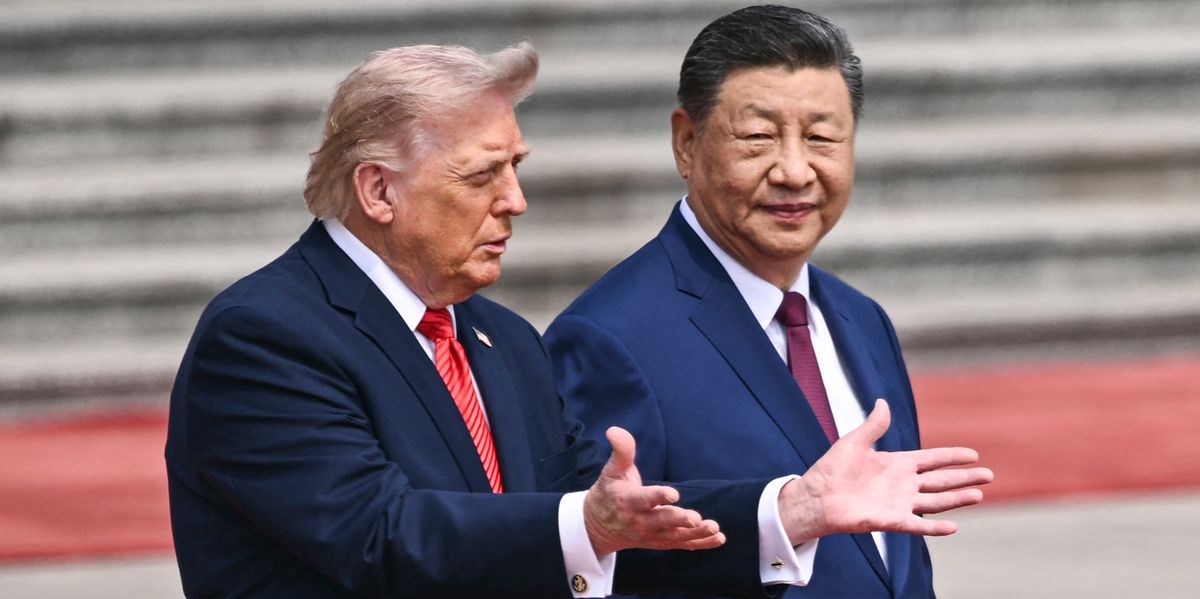
Trump Meets Xi Jinping in Beijing: Key Agenda and US-China Relations
U.S. President Donald Trump has arrived in Beijing for a high-stakes summit with Chinese President Xi Jinping, attempting to leverage personal diplomacy to navigate systemic tensions. While Trump characterized his relationship with Xi as a “friendship,” Beijing issued a stern warning regarding the Taiwan issue, signaling that underlying geopolitical frictions remain unresolved despite the cordial rhetoric.
The summit in Beijing represents more than a mere diplomatic encounter; it is a critical inflection point for the global macro-economy. As the world’s two largest economies attempt to recalibrate their relationship, the stakes extend far beyond bilateral treaties. For multinational corporations, the proceedings in China are a barometer for future trade stability, semiconductor availability, and the security of trans-Pacific supply chains. The tension between Trump’s “personal diplomacy” model and the rigid, non-negotiable “red lines” maintained by the Chinese leadership creates a volatile landscape for international investors and global logistics providers.
The Diplomacy of Rapport: “Friendship” as a Strategic Tool
In a move that underscores his unconventional approach to statecraft, President Trump has leaned heavily into the language of personal connection. During the visit, Trump described it as an “honor” to be a “friend” to President Xi. This brand of soft-power maneuvering is designed to bypass traditional bureaucratic friction, seeking instead to establish a direct line of communication between leaders to settle complex disputes.
However, this performative warmth faces an immediate reality check from the Chinese administration. Despite the high-profile state banquet and the diplomatic pomp, Beijing has been explicit in its warnings regarding the “Taiwan question.” This juxtaposition—warmth in the ballroom, warnings in the press release—highlights the fundamental disconnect between the desire for economic stability and the zero-sum nature of territorial sovereignty. For global firms, this means that even a “friendly” summit does not equate to a reduction in geopolitical risk.
As tensions over regional sovereignty persist, many multinational enterprises are proactively engaging with geopolitical risk consultants to model potential contingency scenarios involving trade disruptions or maritime security shifts in the South China Sea.
The Silicon Delegation: Tech Titans as De Facto Diplomats
Perhaps the most telling aspect of the Trump delegation is not the presence of career diplomats, but the inclusion of the world’s most influential technology executives. The accompanying entourage—which includes Elon Musk, Tim Cook, and Huang—signals that the core of the U.S.-China relationship has shifted from traditional manufacturing to the high-stakes arena of artificial intelligence, semiconductors, and advanced computing.
The presence of these specific leaders suggests a multifaceted agenda:
- The Hardware Foundation: With leaders like Huang in attendance, the conversation inevitably turns to the architecture of the AI revolution and the control of the semiconductor supply chain.
- The Consumer Interface: Tim Cook’s presence underscores the deep-seated interdependence of the global consumer electronics market and the necessity of maintaining stable manufacturing hubs in East Asia.
- The Frontier of Autonomy: Elon Musk’s involvement points to the intersection of private aerospace, autonomous systems, and the emerging norms of space and AI governance.
This “Silicon Delegation” effectively turns the summit into a high-level negotiation for the future of the global tech stack. When the architects of the modern digital economy sit at the negotiating table, the outcomes have immediate implications for intellectual property rights, cross-border data flows, and export controls.
“The integration of private tech leadership into formal state visits marks a transition from traditional diplomacy to ‘tech-diplomacy.’ We are no longer just negotiating borders; we are negotiating the incredibly infrastructure of the 21st-century economy.”
For companies operating at the edge of these technological frontiers, the ambiguity of these talks necessitates close cooperation with international trade lawyers to navigate the evolving web of export restrictions and technology transfer regulations.
Macro-Economic Implications: Supply Chains and Sovereign Risk
The broader economic fallout of this summit will be felt in the volatility of global markets. The “Taiwan question” remains the single greatest systemic risk to the global semiconductor industry. Any escalation in rhetoric or military posturing in the region could trigger immediate shocks to the high-tech manufacturing sectors, affecting everything from automotive production to consumer electronics.

the attempt to bridge the gap between U.S. Economic security interests and China’s pursuit of technological self-reliance creates a permanent state of friction. This friction manifests in increased costs for global trade compliance and a move toward “friend-shoring” or “de-risking” strategies among Western firms. As the summit progresses, the market will be looking for signals of whether “friendship” can translate into predictable regulatory environments.
To mitigate these disruptions, many industrial giants are increasingly turning to supply chain specialists to diversify their sourcing and build more resilient, multi-nodal logistics networks that can withstand sudden geopolitical shifts.
The Beijing summit is a masterclass in the complexity of modern power dynamics. It is a collision of personalist leadership, technological hegemony, and ancient territorial disputes. Whether the “friendship” between Trump and Xi can provide the stability required for global markets to thrive remains to be seen. In this era of shifting alliances, the ability to navigate the gap between diplomatic rhetoric and geopolitical reality is the most critical asset any global organization can possess. To stay ahead of these shifts, leaders must leverage the expertise found in the World Today News Directory to identify the strategic partners necessary for a volatile century.