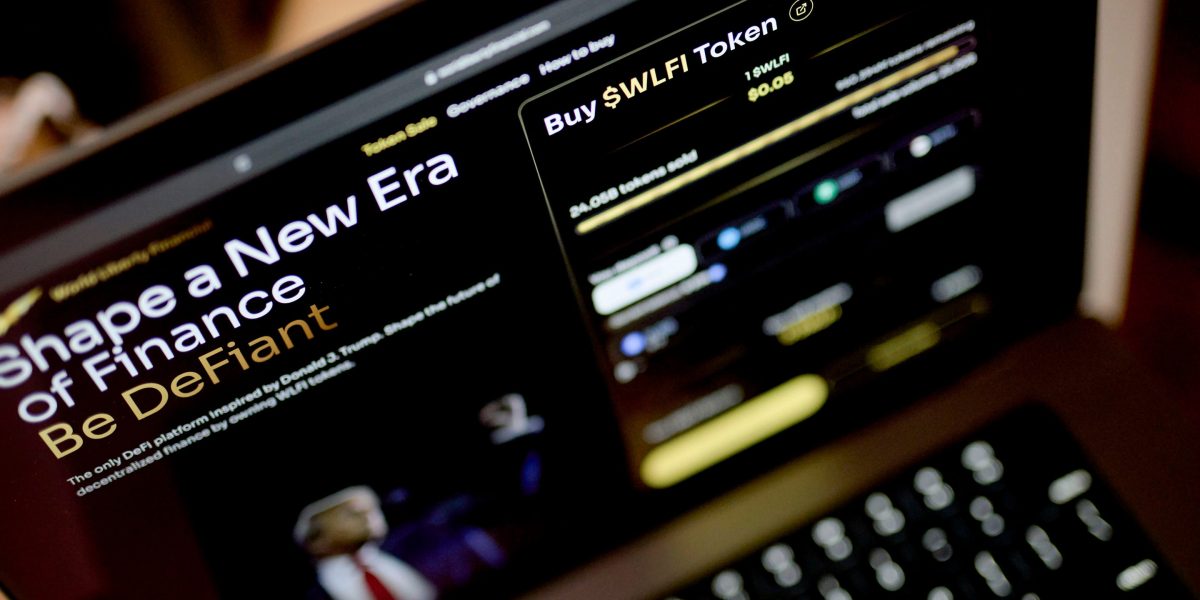
Trump-Backed WLFI Token Crashes Amid Insider Lending Controversy
World Liberty Financial’s WLFI token cratered to $0.08 on April 10, 2026, following revelations that the Trump-backed venture used billions of its own tokens as collateral to borrow millions in stablecoins from Dolomite, a protocol co-founded by its own CTO, Corey Caplan, sparking liquidity fears and insider-trading scrutiny.
This is a textbook case of circular economics gone wrong. When a project uses its own native governance token to secure loans from a platform managed by its own executives, it creates a feedback loop of systemic risk that can vaporize investor value in hours. For institutional players caught in this volatility, the immediate priority is no longer trading—It’s risk mitigation. Firms facing these governance collapses are increasingly turning to corporate governance consultants to rebuild internal controls and specialized blockchain legal counsel to navigate the regulatory minefield of insider-linked lending.
The Dolomite Loop: Anatomy of an Insider Loan
The collapse was triggered by onchain data revealing a precarious relationship between World Liberty Financial (WLF) and the Dolomite lending protocol. Corey Caplan, who serves as both the CTO of WLF and a co-founder of Dolomite, sits at the center of a borrowing spree that has left the market reeling. According to onchain records analyzed via Etherscan and Arkham, WLF utilized its treasury to execute a series of aggressive maneuvers designed to extract liquidity from its own ecosystem.
The sequence began on February 8, when WLF’s treasury deposited 14 million USD1—its own dollar-pegged stablecoin—into Dolomite to borrow 11.4 million USDC. Within minutes, that USDC was moved to a Coinbase Prime deposit address. This was merely the opening move. By February 20, the treasury posted 890 million WLFI tokens as collateral to borrow an additional 20 million USD1. The scale accelerated on March 24, with another 1.1 billion WLFI added to the collateral pool.
By April, the situation escalated as WLF sent 3 billion more WLFI tokens to a Gnosis Safe proxy wallet (0x44a681DD). In total, WLF pledged 5 billion WLFI tokens to secure approximately $75 million in stablecoins. The result was a liquidity vacuum. WLF effectively drained Dolomite’s USD1 pool, leaving other depositors unable to withdraw their funds.
The market’s reaction was swift. WLFI tumbled nearly 15% immediately following the initial reports before cratering to its current all-time low of $0.08—an 82% drop from its September high of $0.46.
“Roughly 5% of WLFI’s supply is now collateral on Dolomite, so if WLFI declines significantly in value, the collateral could be liquidated… This would likely force World Liberty to sell WLFI tokens to repay the loan, exerting additional downward pressure on the token’s price.”
— Nicolas Vaiman, CEO at Bubblemaps
Institutional Contagion and the Liquidation Trap
The fallout extends far beyond retail speculators. The exposure list includes heavyweights of the hedge fund world. Nasdaq-listed Alt5 Sigma raised $1.5 billion to purchase WLFI tokens last summer, a move that drew in institutional capital from Point72 and ExodusPoint. These firms are now staring at a token that is nominally valued at $440 million in its collateral position but is thinly traded and highly volatile.
The danger here is the “death spiral.” If the price of WLFI drops to a point where the collateral no longer covers the $75 million loan, Dolomite will be forced to liquidate the WLFI tokens. Because the token lacks deep liquidity, a forced sale of billions of tokens would crash the price further, triggering more liquidations. This creates a scenario of “bad debt” for the Dolomite protocol, potentially bankrupting the lending pool.
World Liberty Financial has attempted to project confidence via social media, dismissing the risks. The company asserted that its positions are “nowhere near liquidation” and framed itself as the “anchor borrower” that generates the yield making WLFI Markets compelling for others. They claimed that if markets move against them, they would “simply supply more collateral.”
Confidence is a poor substitute for liquidity.
Systemic Shifts: Three Ways This Redefines DeFi Risk
The WLF-Dolomite incident is not an isolated failure. it is a warning shot for the broader digital asset market. The industry is now grappling with three fundamental shifts in how risk is perceived:

- The End of Circular Trust: The use of “governance tokens” as primary collateral for loans within insider-controlled protocols is now viewed as a red flag. Institutional investors are shifting toward assets with external, non-correlated value.
- Concentration Risk Overload: When a single borrower controls 55% of a protocol’s supply liquidity, the protocol is no longer a decentralized market—it is a leveraged bet on one company. This necessitates a move toward automated risk management systems that can cap insider exposure in real-time.
- The “Exit Liquidity” Realization: The fact that millions in borrowed stablecoins were immediately moved to Coinbase Prime suggests the loans were used for off-ramping rather than ecosystem growth, signaling to the market that insiders may be hedging their own positions.
As we move into the next fiscal quarters, the focus will shift from token price to solvency. The ability of WLF to “supply more collateral” depends entirely on whether they have assets left that aren’t already pledged or crashing in value. For the hedge funds and foundations exposed to WLFI, the window for a graceful exit is closing.
The broader lesson for the C-suite is clear: transparency is the only hedge against a liquidity crisis. Companies that fail to implement rigorous, third-party audited treasury management will find themselves unable to attract top-tier institutional capital. As the market flushes out these circular dependencies, the winners will be those who prioritize stability over engineered yield. To find vetted partners capable of auditing treasury operations or restructuring corporate governance, explore the professional services listings in the World Today News Directory.