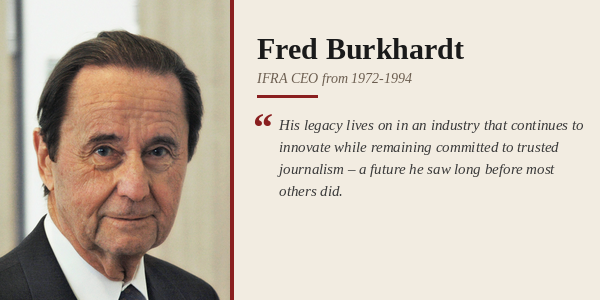
Tribute to Fred Burkhardt: A Visionary Leader of the Newspaper Industry
<>
Fred Burkhardt, the visionary former director of IFRA who steered the global newspaper industry through the transition from hot-metal typesetting to digital publishing, died leaving a legacy of technological transformation. His work at IFRA from 1972 defined modern news production, emphasizing that publishers are in the content, not print, business.
From Nuremberg to the Technological Frontier
Born on February 27, 1929, in Nuremberg, Germany, Burkhardt’s early life was defined by the reconstruction of his home country. He trained as a typesetter before completing his education in the United States as a Fulbright scholar in Syracuse, New York. This cross-continental experience proved foundational; in 1957, he earned a doctorate in economics in Berlin. His dissertation, which analyzed high-speed remote typesetting, served as a blueprint for the career that followed.

Before joining IFRA in 1972, Burkhardt held strategic roles at industrial giants Linotype and the Harris Corporation. At the time, global newsrooms were confined to letterpress printing and heavy, manual hot-metal processes. Burkhardt’s arrival at IFRA marked the beginning of a two-decade overhaul of the global press.
Engineering a Global Forum for Innovation
Under Burkhardt’s leadership, IFRA evolved from a research institute into a massive clearinghouse for technological exchange. He bridged the gap between engineers and editors, creating an environment where technical feasibility met journalistic necessity. According to former IFRA director Klaus von Prümmer, Burkhardt possessed a rare diplomatic ability to foster collaboration among competing manufacturers and publishers, ensuring that the industry adopted shared standards for phototypesetting, offset printing, and computer-to-plate technology.
The IFRA Expo became the premier venue for this collaboration.
The Vision Beyond Print
Burkhardt’s foresight extended deep into the digital realm long before the commercial internet reached the masses. While many of his peers viewed electronic media as a passing curiosity, Burkhardt identified computer networks as the future of news consumption. In 1994, he launched the Initiative for Newspaper Electronic Supplements (INES), a direct attempt to prepare publishers for a networked world.
He frequently reminded his colleagues that newspapers were in the “content business.” This philosophy remains the bedrock of modern digital strategy.
A Legacy of Continued Adaptation
Burkhardt’s influence was not merely technical; it was structural. He understood that the survival of the press depended on collective bargaining power and the adoption of universal standards. His life’s work proves that technological disruption is not a threat to be feared but a process to be managed through constant, iterative innovation.

Navigating Modern Media Infrastructure
Fred Burkhardt’s career serves as a reminder that the most significant advancements in media do not happen in isolation. They happen when stakeholders—from the engineering floor to the boardroom—align on a shared vision of the future. As the industry continues to evolve, the capacity to bring together diverse teams to solve common challenges remains the most valuable asset a media organization can possess.
His passing marks the end of an era, but the principles he advocated—innovation, cross-border collaboration, and an unwavering commitment to the content business—remain the only reliable compass for those navigating the ongoing digital revolution. His work continues to provide the essential framework for modern news organizations worldwide.