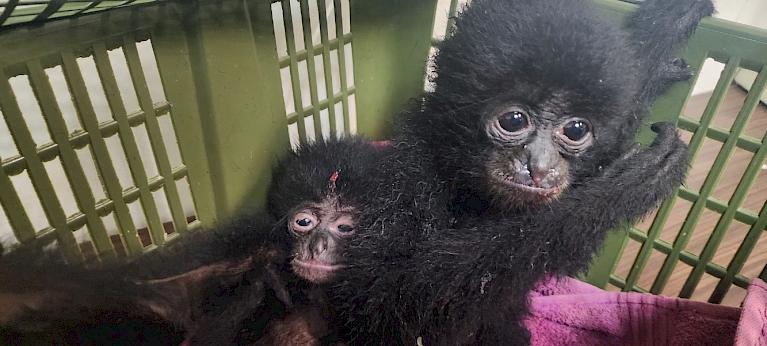
TRAFFIC reports 86 gibbons intercepted in Airport luggage
At least 86 live gibbons were intercepted in airline luggage and cargo across international airports over a 32-month period, according to a report released on World Gibbon Day by TRAFFIC.
Eighty-Six Gibbons Packed Into Checked Suitcases and Baskets
The report, titled Canopy to Cabin: Southeast Asia’s Gibbon Smuggling by Air, tracks the illicit movement of young apes between January 2024 and August 2026. Traffickers packed the animals—which spend nearly all of their lives high in forest canopies—into small pet-carrier cases, ventilated plastic containers, and luggage checked in for flights lasting several hours.
All seized animals with available records were juveniles belonging to six distinct species. Siamangs and agile gibbons appeared most frequently in the seizure data. TRAFFIC documented 33 international smuggling incidents through airports that implicated Southeast Asia as a source, transit, and consolidation point for the trade.
“The smuggling of just a few gibbons on each flight may seem small in isolation, but like a dripping tap, the losses accumulate over time,” said Kanitha Krishnasamy, Director for TRAFFIC in Southeast Asia. “What appears minor incident by incident can add up to a devastating toll on wild populations.”
Shifting Seizure Hotspots Across International Airports
Seizures peaked during 2025, with the majority occurring within India. By 2026, however, the interception pattern shifted. Law enforcement agencies in Malaysia and Thailand intercepted more shipments before the animals reached their overseas destinations, indicating improved detection capabilities earlier along the trafficking chain.
Kuala Lumpur International Airport served as the most frequently implicated departure or transit point, appearing in over a dozen cases. On the receiving end, Chennai and Kempegowda airports in India recorded the highest number of destination interceptions. Indonesia also blocked two separate smuggling attempts linked to the Middle East, intercepting one bound for Oman and another for Dubai.
“Clearly Southeast Asia continues to be a critical hub linking wildlife supply chains to markets elsewhere in Asia and traffickers continue to adapt as enforcement efforts increase,” said Wong Jye Wen, Data and Research Officer for TRAFFIC in Southeast Asia.
Sporadic Enforcement Fails to Stop Gibbon Smuggling Syndicates
All gibbon species maintain strict protection status under national wildlife laws across their natural range. Commercial trade in wild-caught specimens remains entirely prohibited under the Convention on International Trade in Endangered Species of Wild Fauna and Flora.
While Malaysian authorities reported active prosecutions and convictions during the monitoring window, researchers warn that sporadic enforcement remains insufficient against adaptable smuggling syndicates.
“Getting ahead of the criminal networks requires shared intelligence and joint investigations between the countries involved,” Krishnasamy said. “Without it we risk traffickers wiping out gibbons one flight at a time.”