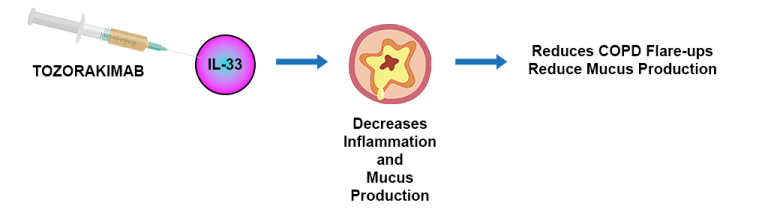
Tozorakimab Reduces COPD Exacerbations in Phase 3 Trials
Subcutaneous tozorakimab significantly reduced moderate and severe chronic obstructive pulmonary disease exacerbations by up to 34% in two replicate phase 3 trials, according to research published on September 8, 2026, in the New England Journal of Medicine and presented at the European Respiratory Society Congress in Barcelona, Spain.
- Two replicate phase 3 trials, OBERON and TITANIA, evaluated 2,306 adults with chronic obstructive pulmonary disease receiving add-on subcutaneous tozorakimab (300 mg) every 4 weeks over 52 weeks.
- The primary endpoint among former smokers showed a 29% reduction in moderate or severe exacerbations in OBERON and a 34% reduction in TITANIA compared with placebo.
- Treatment efficacy remained consistent across patient subgroups regardless of baseline smoking status or blood eosinophil counts.
Chronic obstructive pulmonary disease remains a leading global health challenge characterized by progressive airflow limitation and debilitating flare-ups. Millions of patients continue to experience frequent exacerbations despite adhering to stable guideline-based inhaled maintenance therapies, most commonly triplet regimens. These acute events accelerate lung function decline, degrade patient quality of life, increase hospitalization rates, and contribute to overall mortality. Managing this residual risk requires targeted interventions addressing underlying inflammatory pathways that persist despite standard inhaled bronchodilators and corticosteroids.
Dysregulated interleukin-33 signaling plays a central role in the pathogenesis of chronic obstructive pulmonary disease. Tozorakimab, a first-in-class monoclonal antibody, specifically inhibits the activity of interleukin-33.
The trials enrolled a total of 2,306 adults who were current or former smokers with a documented history of exacerbations during the previous year despite stable inhaled maintenance therapy. Investigators enrolled patients across the full disease severity spectrum, including those classified with very severe airflow obstruction under Global Initiative for Chronic Obstructive Lung Disease criteria, while capping current smokers at 25 percent of the study population.
Trial results demonstrated clear clinical efficacy. In the OBERON trial, which included 446 patients in the tozorakimab group and 431 in the placebo group, the annualized rate of moderate or severe exacerbations among former smokers dropped to 1.34 events with tozorakimab compared with 1.90 events on placebo, establishing a rate ratio of 0.71. In TITANIA, which enrolled 438 patients in the treatment arm and 435 in the control arm, the annualized rate was 1.37 events for tozorakimab versus 2.07 events for placebo, yielding a rate ratio of 0.66. Across the overall populations of both trials, which included current smokers, exacerbation rates fell by approximately 29% to 30% relative to placebo.
Crucially, prespecified pooled subgroup analyses revealed that tozorakimab maintained consistent therapeutic efficacy independent of blood eosinophil thresholds. Current biologic therapies approved for chronic obstructive pulmonary disease often restrict access to patients exhibiting elevated blood eosinophil counts. By demonstrating efficacy in patients with eosinophil levels below 150 cells per microliter, tozorakimab offers a therapeutic mechanism for a broader clinical demographic. For patients struggling to control symptoms despite optimized standard regimens, consulting specialists at a specialized pulmonary care center is vital for evaluating emerging biologic eligibility.
As regulatory bodies review these phase 3 datasets, healthcare systems face the task of integrating novel biologics into established care pathways. Future clinical investigations will continue to track long-term safety profiles and determine optimal patient selection criteria for interleukin-33 inhibition in chronic respiratory disease management.