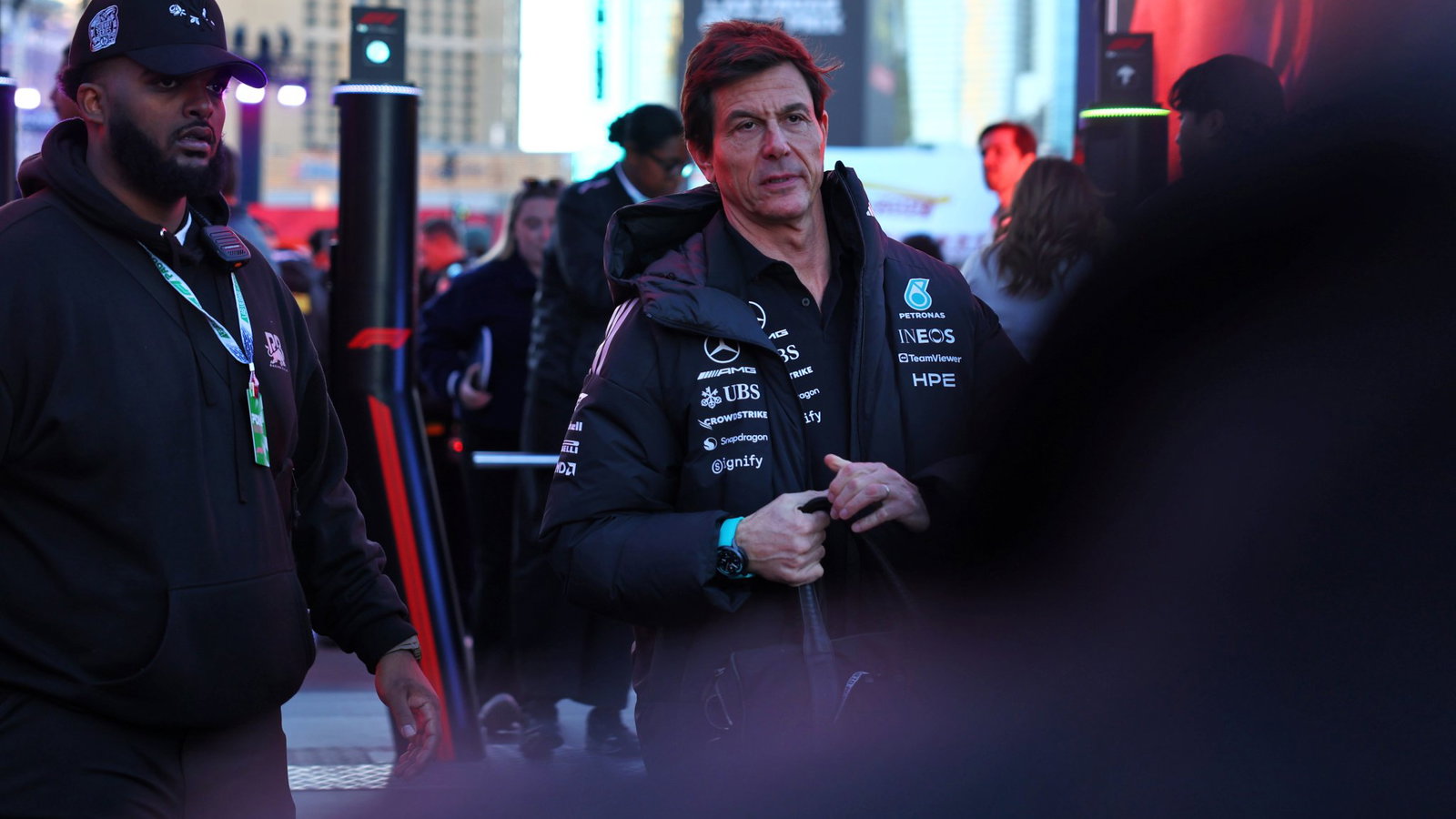
Toto Wolff Defends 2026 F1 Rules, Likens Las Vegas GP to NASCAR and Indy 500 Mix
Mercedes team principal Toto Wolff delivered a defiant defence of Formula 1’s 2026 technical regulations and the Las Vegas Grand Prix on Saturday, likening the race to a fusion of NASCAR, the Indianapolis 500 and Formula 1 as he dismissed criticism over the influence of electrical energy management on overtaking.
The Las Vegas Grand Prix produced an entertaining spectacle on Saturday night, with frequent overtaking and changes of position throughout the race. While Max Verstappen compared the racing to Mario Kart after claiming victory, Wolff offered a more positive assessment.
“These regs are great entertainment, and we saw a mega race, particularly for the Americans,” Wolff said. “I guess it was Indy 500 and NASCAR and Formula 1 mixed! I guess you will have many people that will say, ‘Well, that’s not racing.’ Personally, we need to be open-minded.”
Wolff acknowledged that some fans would take issue with the nature of the racing but cited immediate feedback to support his view.
“Susie was in Paddock Club, and she said that for 90 minutes, people [were] screaming with the overtakes. You were not quite sure whether you had the position or not,” he said. “The instant feedback I got from friends watching, our sponsors, was that it was awesome. Stefano [Domenicali] liked it very much.”
Mercedes team principal and CEO Toto Wolff has leveraged his position since 2013 to champion Formula 1’s 2026 regulations, arguing the Las Vegas Grand Prix proved the new electrical energy management rules create “great entertainment” akin to “Indy 500 and NASCAR and Formula 1 mixed.” Wolff cited immediate feedback from sponsors and F1 CEO Stefano Domenicali to dismiss criticism that energy deployment overshadowed traditional racing, insisting the sport must remain “open-minded” to the unpredictable spectacle.
As co-owner of the Mercedes F1 operation, Wolff’s public defence signals his influence in shaping the championship’s future sporting direction, framing the Vegas format as a template for modern grand prix racing even if the specific conditions cannot be replicated at every circuit.

Despite his positive assessment, Wolff conceded that Formula 1 was unlikely to produce a similar spectacle at every circuit on the calendar. However, he believed the unpredictable nature of the racing was particularly fitting for the championship’s visit to Las Vegas.
“That’s not going to happen everywhere. In a way, it’s fitting that that was the Las Vegas race – NASCAR, Indy 500, like I said, all together,” Wolff said. “To be honest, I don’t know how long the race was 90 minutes. For me, it was like 20 minutes, because it was so different and so entertaining to watch.”