Tokyo Metropolitan Art Museum at 100: Two Free Exhibitions Open November 19 in Ueno
Tokyo Metropolitan Art Museum turns 100 this year, and the centenary programme reaches its peak this week. The Musée d’Orsay masterworks show, What a Wonderful World, opened on Saturday, November 14. On Thursday, November 19, two further exhibitions arrive — and both are free to enter. They run until Monday, January 11, 2027, closing the museum’s hundredth year.
Which exhibitions open on November 19, and what do they cost?
Two shows, both free:
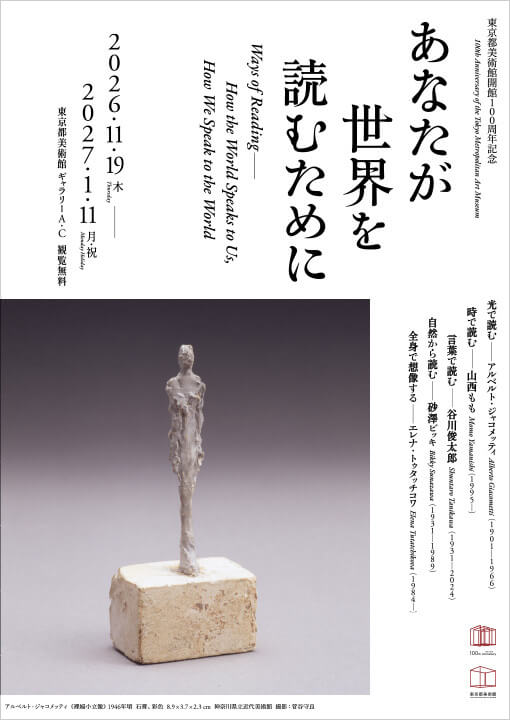
- Ways of Reading – How the World Speaks to Us, How We Speak to the World — the larger contemporary exhibition, occupying Galleries A and C, built around the theme of dialogue with the world.
- The History of the Tokyo Metropolitan Art Museum — an archival show tracing the institution’s 100-year history, drawing mainly on its own archives.
Both run from Thursday, November 19, 2026 to Monday, January 11, 2027. Admission is free.
When is the museum open, and when is it closed?
Opening hours are 9:30 to 17:30, with later closing at 20:00 on Fridays. The two centenary shows share the schedule but differ slightly in closing days:
| Exhibition | Closed |
|---|---|
| Ways of Reading | December 7 and December 21 to January 3 |
| The History of the Tokyo Metropolitan Art Museum | December 7 and December 27 to January 3 |
How do you get to the museum in Ueno Park?
The museum sits at 8-36 Ueno Park, Taito-ku, Tokyo. The simplest routes:
- 7-minute walk from the Park exit of JR Ueno Station
- 10-minute walk from the Ikenohata exit of Keisei Ueno Station on the Keisei Main Line
- 10-minute walk from exit 7 at Ueno Station on the Ginza and Hibiya lines
The phone number is 03-3823-6921.
What is inside “Ways of Reading”?
Five artists, each paired with a mode of reading the world:
- Alberto Giacometti (1901–1966) — “Reading through Light.” Works once owned by his friends Yanaihara Isaku and Usami Eiji, including a small painted plaster Nude Figurine of about 1946 from the Kanagawa Prefectural Museum of Modern Art and a Standing Nude in coloured bronze of about 1950 from the Toyama Prefectural Museum of Art and Design.
- Momo Yamanishi (born 1995) — “Reading through Time.” Pinhole photographs from her series “Light Kingdom,” including new images made in Nepal in December 2025 with a homemade camera, plus a new work combining an ammonite fossil cast with glass.
- Shuntaro Tanikawa (1931–2024) — “Reading through Words.” The poet’s own photographs, including a 1951 self-portrait, some shown for the first time, alongside handwritten notebooks and a radio from his collection.
- Bikky Sunazawa (1931–1989) — “Reading through Nature.” The Hokkaido wood-carver’s oak sculpture God’s Tongue (1980), more than two metres tall, from the Sapporo Art Park Museum, and works from a private collection shown in Tokyo for the first time.
- Elena Tutatchikova (born 1984) — “Imagining with the Whole Body.” The Moscow-born, Kyoto-based artist contributes entirely new work: the ceramic series “Islands” alongside reliefs, paintings and drawings arranged as an installation.
What does the history exhibition cover?
The second show turns the lens on the museum itself. It revisits a century that began with a donation of 1 million yen from Keitaro Sato, a coal merchant from Kitakyushu, to found what was then the Tokyo Prefectural Art Museum — Japan’s first public art museum, opened May 1, 1926. The exhibition covers the artist-group shows, avant-garde exhibitions and major displays of Western painting hosted over the decades, as well as early public art lectures and a library. Shinichiro Okada designed the original building; Kunio Maekawa’s modernist structure replaced it in 1975, and a comprehensive renovation followed in 2012.
Why does the centenary matter beyond the free entry?
The founding purpose was never a collection but a platform — a stage for artists’ associations. That mission shows in the numbers: 10 open-call exhibitions and 473,434 visitors in the debut year, against roughly 2 million visitors annually today and more than 250 open-call association and educational shows a year. For the centenary, the museum commissioned Tokujin Yoshioka — who designed its symbol mark and logo in 2011 — to create a special emblem. And the free admission on the two shows opening November 19 is the most practical expression of the museum’s stated aim of being an accessible entrance to art. For the latest developments, see the museum's centenary report.