
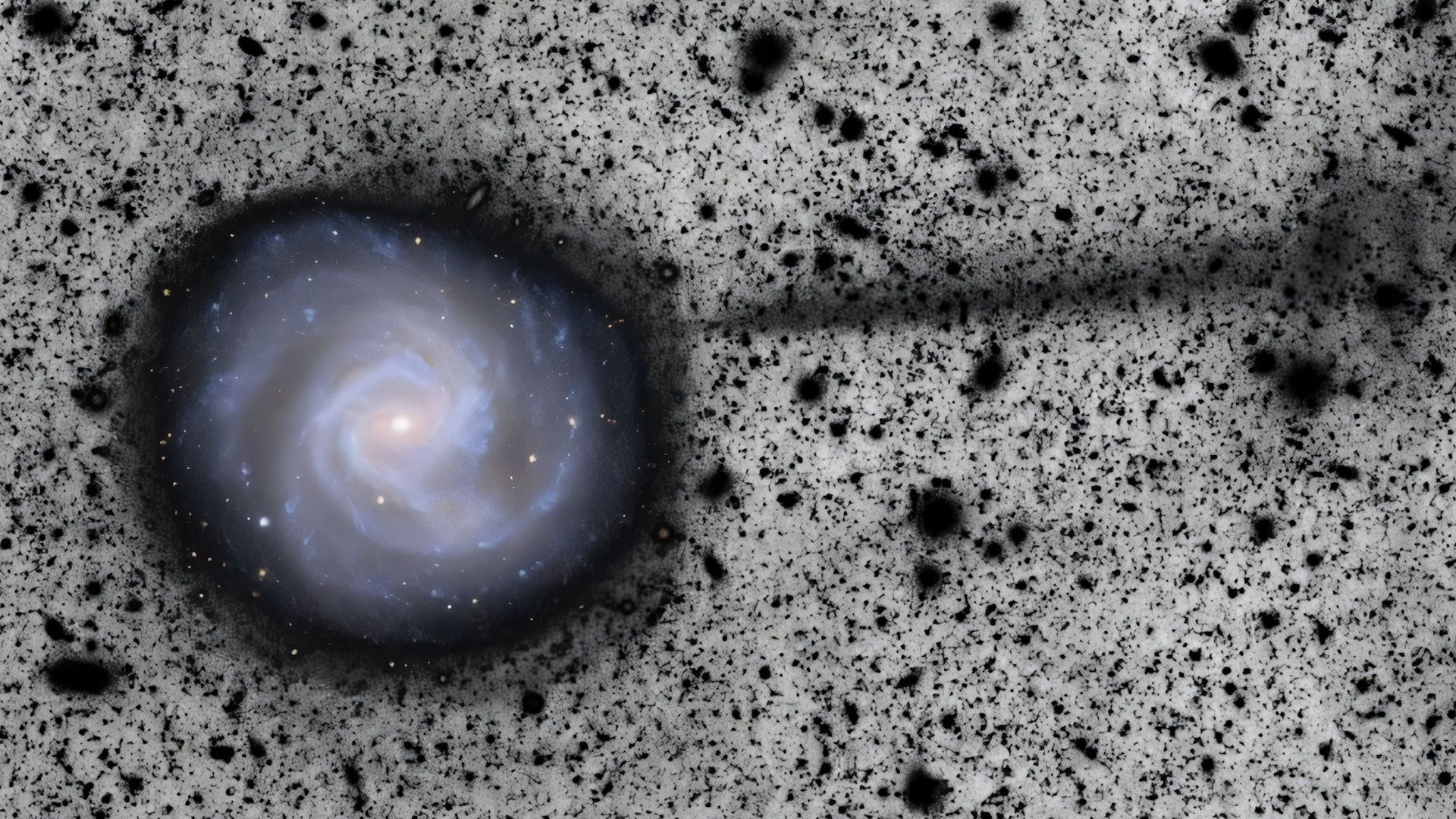
Newly Operational Vera Rubin Observatory Captures Vast Stellar Stream Orbiting Nearby Galaxy
A groundbreaking image from the Vera C. Rubin Observatory reveals a colossal stellar stream – a trail of stars ripped from a smaller galaxy – stretching nearly as far as the milky Way’s diameter and trailing behind the spiral galaxy M61. The discovery, published as a preprint and accepted for publication in The Astronomical Journal, demonstrates the observatory’s unprecedented ability to detect faint structures and promises a revolution in our understanding of galactic formation.
This initial observation, taken during the observatory’s commissioning phase, highlights the power of the Rubin Observatory’s Legacy Survey of Space and Time (LSST). The LSST, a 10-year mission, will systematically map the visible universe, creating a high-definition, time-lapse record that will allow astronomers to uncover hidden details about galaxies and the structures surrounding them. The newly detected stream around M61 suggests that galactic cannibalism – the process of larger galaxies consuming smaller ones – is a far more common phenomenon than previously thought, and that these interactions play a crucial role in shaping the galaxies we observe today.
The stellar stream, previously unnoticed, extends for hundreds of thousands of light-years around M61, a galaxy located approximately 27 million light-years away in the constellation Virgo.Researchers, led by astronomer andrew Romanowsky, were able to identify the structure thanks to the observatory’s wide field of view and exceptional sensitivity. “It is indeed remarkable that the stream went long unnoticed around a Messier galaxy,” the authors wrote in the study. ”We expect a treasure trove of substructures to be unveiled around other galaxies with future Rubin data.”
The discovery builds on existing knowledge of galactic interactions, such as the Sagittarius Dwarf Elliptical Galaxy’s influence on the Milky Way’s spiral arms. By revealing similar structures around other galaxies,the Rubin Observatory will provide a more complete picture of how galaxies grow and evolve over cosmic time.The observatory is poised to begin its 10-year LSST mission, promising a wealth of new discoveries and a deeper understanding of the universe.
