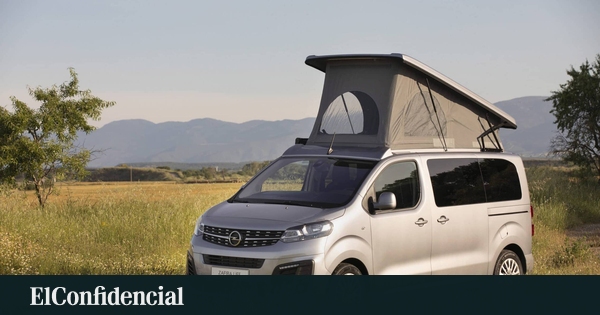
Tinkervan Converts Opel Zafira Into a Camper Van in Spain
Camper vans frequently command prices exceeding 60,000 euros for established models, creating a market opening for a lower-cost alternative built in Spain by Tinkervan using the Opel Zafira, El Confidencial reported.
Volkswagen’s California has anchored the factory camper segment for decades with prices starting above 60,000 euros for its simplest variant, while Mercedes-Benz models occupy an even higher price tier. The Zafira transformation bridges the gap between those factory models and independent workshop conversions by offering a dual-purpose vehicle that functions as a large passenger van during the week.
Transformation work takes place under order through the official Opel dealer network in Spain with homologation and technical vehicle inspection included in the project cost. Tinkervan completes each conversion in approximately a month and a half at its facilities in Huesca.
Equipping the Spanish camper
The conversion centers on an elevating roof operated by scissor lifts that provides standing interior room and features a panoramic canvas opening, mosquito nets, and a winter window. Sleeping arrangements include a 1.30 by 2-meter upper bed atop an aluminum slat base with a viscoelastic mattress and a reading light.
A second bed assembles over the original rear seat bench without modifying its anchors, measuring 1.40 by 1.15 meters in its base configuration for children and expanding to 1.40 by 2 meters for adults. Front seats rotate 180 degrees to form a dining area alongside an extractable table that functions outside the vehicle as well.
Electrical systems rely on a 100 Ah auxiliary battery managed via mobile phone application, alongside USB and 12-volt sockets plus two-intensity LED lighting. Optional accessories include a diesel stationary heater, an electric shower with an 11-liter tank, a compressor refrigerator, a removable kitchen module, an awning, a bicycle rack, and an external 220-volt hookup, though the vehicle lacks a fixed sink, permanent stove, or onboard bathroom.
Vehicle mechanics and daily driving
Powering the conversion is a 2.2-liter four-cylinder diesel engine producing 180 horsepower and 400 Nm of torque, paired with an eight-speed automatic transmission and front-wheel drive. The vehicle measures 4.98 meters in length and stands just under 1.90 meters tall, allowing clearance in typical underground parking structures subject to two-meter limits.
Standard features encompass LED headlights, adaptive cruise control, front and rear parking sensors, a rearview camera, blind-spot monitoring, digital instrumentation, leather upholstery, heated seats, and power sliding doors activated by a foot gesture. Fuel consumption in real-world driving ranges from 7.5 to 8 liters per 100 kilometers against a homologated highway figure of 6.9 liters, while the un-electrified diesel setup carries an environmental C label.
Price comparison with Volkswagen
| Camper Model | Starting Price | Base Engine | Emissions Label |
|---|---|---|---|
| Opel Zafira by Tinkervan | Approximately 45,000 euros | 2.2L Diesel, 180 CV | C Label |
| Volkswagen California Beach Camper Outdoor | 60,529.20 euros | 2.0L TDI, 150 CV | Standard |
Pricing for the Zafira by Tinkervan starts around 45,000 euros through Opel sales channels, fluctuating according to selected camper accessories. By comparison, Volkswagen’s entry-level California Beach Camper Outdoor lists at 60,529.20 euros cash with brand and dealership discounts applied.
The price divergence reflects distinct design philosophies between a dedicated factory campervan and a modular passenger vehicle conversion. Volkswagen equips its California Beach variants with a pull-out gas burner, factory autocaravan homologation, dual sliding doors, and auxiliary controls, while offering a plug-in hybrid variant with all-wheel drive and an electric range of up to 88 kilometers.
Tracing its roots to a sewing machine manufacturer founded by Adam Opel in 1862, the company eventually shifted its focus to mobility, producing its first automobile in 1899. By the early 1920s, Opel became the first German car manufacturer to implement a mass-production assembly line.
Beyond standard vehicle production, the company historically engaged in unconventional engineering, including the Opel RAK program. Under this initiative, the firm achieved various land speed records and performed the world’s first rocket-powered flights in 1928 and 1929, marking a significant chapter in the manufacturer’s development.
Buyers requiring daily transportation for five to eight passengers alongside occasional weekend trips find utility in the lower acquisition cost and higher engine output of the Opel alternative. Users planning extended multi-week trips involving onboard cooking or frequent travel through urban low-emission zones face greater limitations with the more modest conversion.