Three Supermoons, a Ring-of-Fire Eclipse and Jupiter at Its Closest Arrive in a Single Winter Window
Three supermoons, a ring-of-fire eclipse and Jupiter at its closest arrive in a single winter window, Live Science reports.
The Tech TL;DR:
- Geminids peak Dec. 13–14 under a waxing crescent that sets by 9 p.m., delivering dark skies before midnight.
- Four consecutive supermoons run November through February; the Feb. 20 Snow Moon adds a penumbral eclipse.
- Jupiter hits opposition Feb. 10–11; Saturn’s rings have reopened enough for 100× detail on a 4–5-inch scope.
The Geminids run Dec. 4–20 and peak the night of Dec. 13–14, Around Prague reported. A waxing crescent moon sets around 9 p.m. local time, leaving the radiant high in dark sky — one of the few major showers that peaks before midnight, Live Science noted.
If clouds interfere, the Ursids peak Dec. 22–23 at only 5–10 meteors per hour under a brighter moon, Live Science added.
Counting November’s perigee moon, four straight full moons meet the supermoon criterion — perigee within 90 % of closest approach. The Cold Moon reaches full phase Dec. 24 at 01:28 UTC (late Dec. 23 in North America), appearing up to 14 % larger and 30 % brighter than an apogee moon, Around Prague reported.
The Wolf Moon follows Jan. 22, 2027 at 12:17 UTC. The Snow Moon on Feb. 20 at 23:24 UTC coincides with a penumbral lunar eclipse; the moon only dims slightly as it skims Earth’s outer shadow, Live Science said.

| Date (UTC) | Event | Notes |
|---|---|---|
| 2026-12-24 01:28 | Cold Moon (supermoon) | Last full moon of 2026 |
| 2027-01-22 12:17 | Wolf Moon (supermoon) | First full moon of 2027 |
Jupiter reaches opposition Feb. 10–11, 2027, presenting its bands, Great Red Spot and four Galilean moons at maximum angular size. Live Science said the moons are visible in 15×70 binoculars, but planetary detail requires a telescope. Mars follows at opposition Feb. 19; even 6–8 inch scopes often show only a fuzzy orange disk, and the nearly full moon that night further reduces contrast, Live Science noted.
Saturn rises earlier each evening through winter. Its rings were edge-on in 2025 and are now opening; a 4–5 inch telescope at 100× magnification begins to resolve structure, though full tilt remains years away, Live Science reported. Smart telescopes and binoculars lack the focal length for ring detail.
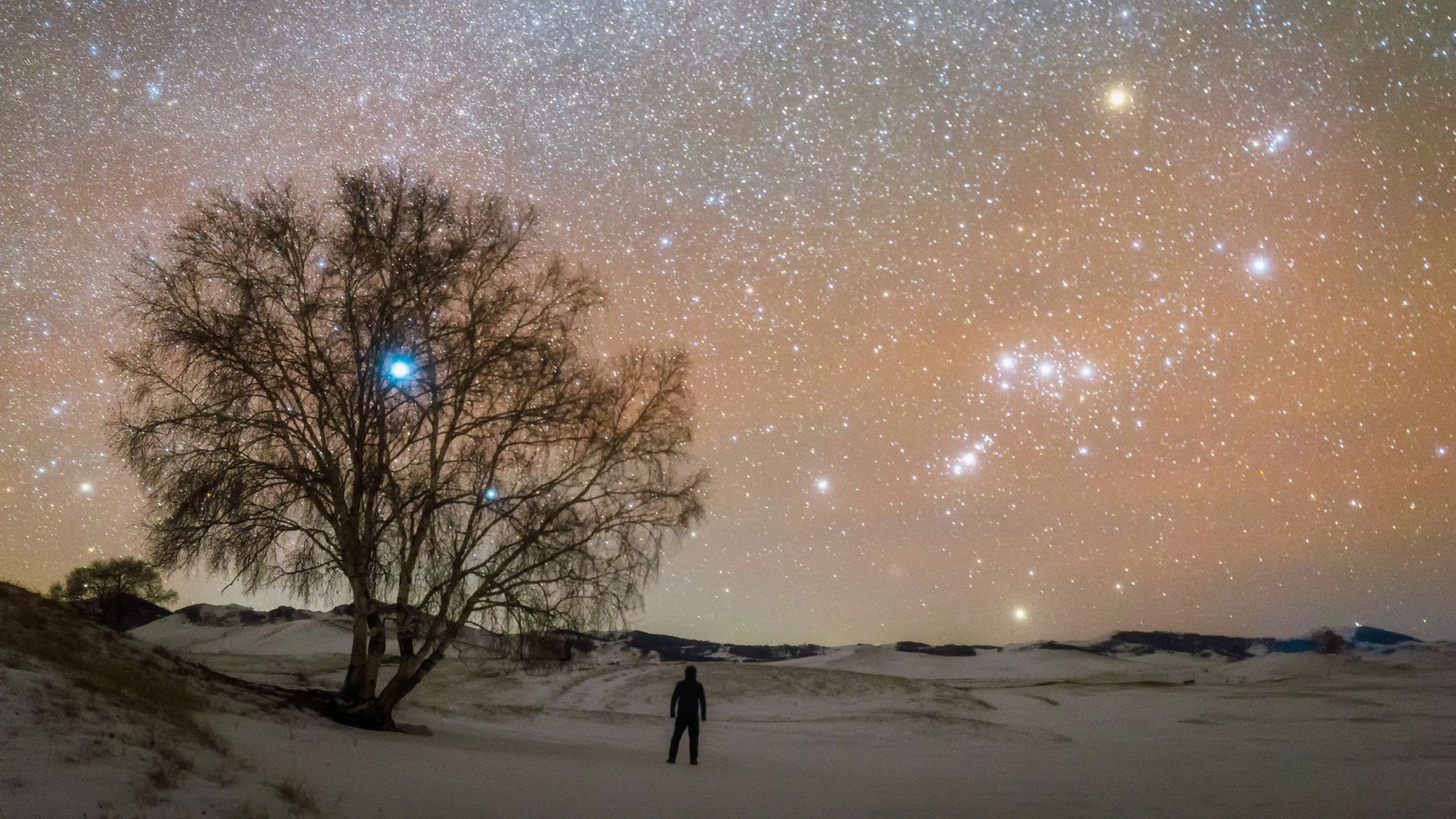
Orion, the Pleiades (M45) and the Hyades return every winter regardless of planetary geometry. The Pleiades is a practical first target for entry-level smart telescopes and wide-field phone photography, Live Science said. Auriga’s star clusters and the Orion Nebula (M42) remain accessible from suburban skies with modest optics.
Narrowband or dual-band filters isolate hydrogen-alpha (656 nm) and oxygen-III (501 nm) emissions. Capture separate Ha and OIII stacks, then map Ha to red and OIII to blue/green channels for a bi-color composite that suppresses light-pollution gradients.
# Example Siril CLI batch for dual-narrowband processing
siril -s - <<'EOF'
cd /data/lights
convert ha_*.fit ha_stacked.fit -method=median -normalization=addscale
convert oiii_*.fit oiii_stacked.fit -method=median -normalization=addscale
load ha_stacked.fit
background_normalization
save ha_nb.fit
load oiii_stacked.fit
background_normalization
save oiii_nb.fit
# Combine in PixelMath: R=ha_nb, G=oiii_nb, B=oiii_nb
EOF
For local sky conditions and equipment consultation, astronomy clubs and specialty retailers offer hands-on guidance.
“The Geminids are the only major shower that peaks before midnight,” Live Science wrote. “That makes them the most accessible shower for casual observers.”