
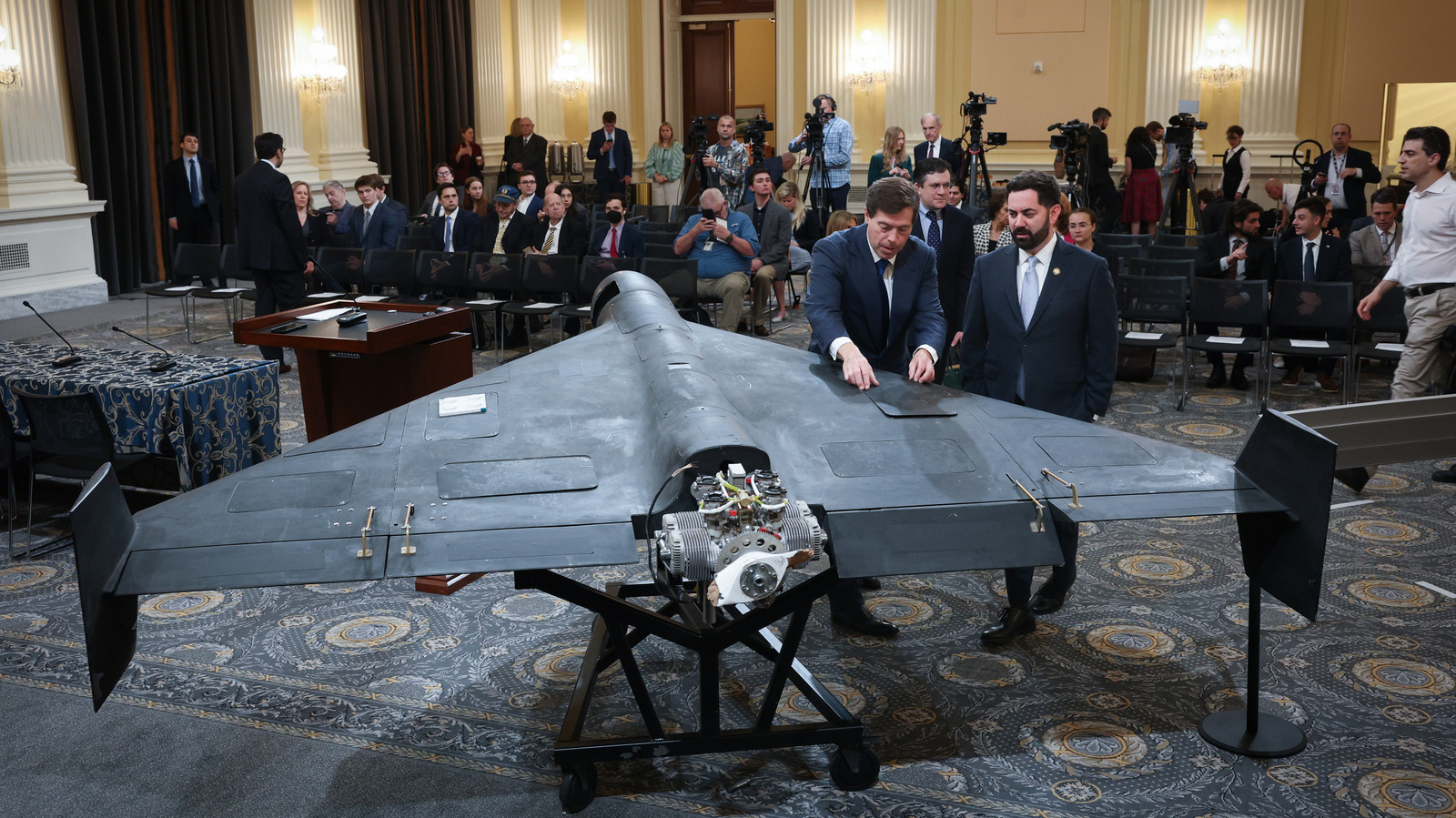
These Cheap Iranian Drones Keep Getting Shot Down, And That’s The Whole Point
Asymmetric Warfare: The $20k DDoS Attack on Physical Infrastructure
The unit economics of modern kinetic engagement are broken. We are witnessing a shift from precision strikes to resource exhaustion attacks, where the aggressor leverages cheap, disposable hardware to drain the financial and logistical reserves of high-tech defenders. The Shahed-136 isn’t a failure as it gets shot down; it’s a success because it forces the defender to burn a $12.7 million interceptor to stop a $20,000 airframe.
- The Tech TL;DR: Iranian Shahed-136 drones utilize a “swarm” logic similar to digital DDoS attacks, prioritizing volume over individual survivability.
- Cost Asymmetry: The cost-exchange ratio is catastrophic for defenders, with interceptors costing up to 600x more than the incoming threat.
- Infrastructure Strain: Legacy radar systems struggle with the low radar cross-section (RCS) and unhurried velocity of these loitering munitions, creating latency gaps in the kill chain.
This isn’t just a military problem; It’s an architectural bottleneck. In the software world, we call this a Denial of Service (DoS) attack. When a botnet floods a server with requests, the goal isn’t necessarily to breach the firewall, but to exhaust the system’s resources until it crashes. The Shahed swarm operates on the same principle against air defense grids like THAAD. The “server” (the defense battery) has a limited pool of “threads” (interceptor missiles). Once the pool is drained, the system goes offline.
The Cost-Exchange Ratio: A Broken Algorithm
The core vulnerability here is the cost-exchange ratio. In cybersecurity, we patch vulnerabilities because the cost of a breach exceeds the cost of the fix. In this kinetic scenario, the “fix” is exponentially more expensive than the “exploit.” The Shahed-136, powered by a modified 100-horsepower Limbach L550E piston engine, is essentially a flying lawnmower with a GPS module. It lacks the sophisticated avionics of a Western MQ-9 Reaper, which relies on high-bandwidth satellite links and complex sensor fusion.

According to U.S. Congress reports, a single THAAD interceptor missile carries a price tag of approximately $12.7 million. When you stack that against the $20,000 to $50,000 production cost of a Shahed, the math collapses. A defender needs a 90% success rate just to break even on a theoretical budget, but stockpiles are finite. As noted in recent operational reports, the usage rate during high-intensity conflicts has depleted limited interceptor stocks faster than manufacturing pipelines can replenish them.
This scarcity creates a supply chain bottleneck that enterprise IT leaders know all too well. Just as a shortage of GPU clusters can halt AI training, a shortage of interceptors leaves critical infrastructure exposed. This is where the role of cybersecurity auditors and risk assessment firms becomes paradoxically relevant. While they secure digital endpoints, the logic of “defense in depth” applies here. Organizations are now looking at managed service providers to build redundant, resilient networks that can survive partial outages, mirroring the necessitate for layered physical defense.
Radar Latency and the Low-Observable Problem
Why don’t we just shoot them all down sooner? The issue lies in detection latency and radar cross-section (RCS). The Shahed-136 is constructed largely of composite materials, which absorb radar waves more effectively than metal airframes. Its slow cruise speed (roughly 115 mph) often causes it to be filtered out by Doppler radar systems designed to track high-velocity jets or ballistic missiles.
Dr. Elena Rostova, a senior defense analyst at the Center for Strategic and International Studies (CSIS), notes the difficulty in distinguishing these threats from background noise.
“The signal-to-noise ratio is the enemy here. These drones fly below the clutter threshold of many legacy radar systems. By the time the fire-control radar locks on, the engagement window has shrunk to seconds, forcing the use of expensive, high-speed interceptors that were never designed for slow-moving targets.”
From a systems architecture perspective, this is a failure of input validation. The defense network is expecting high-speed inputs and is struggling to process low-speed, high-volume data packets. To mitigate this, engineers are looking toward multi-static radar configurations and AI-driven signal processing to filter out the “noise” of civilian aircraft and focus on the drone swarm.
Simulating the Exhaustion: A Python Logic Check
To understand the severity of the resource drain, we can model the intercept logic. The following Python snippet simulates a basic cost-exhaustion algorithm, calculating the remaining budget after a swarm attack based on current interceptor pricing.
class DefenseGrid: def __init__(self, budget, interceptor_cost): self.budget = budget self.interceptor_cost = interceptor_cost self.missiles_fired = 0 def engage_swarm(self, drone_count, intercept_rate): """ Simulates a swarm attack. Intercept_rate: Probability of a successful hit (0.0 to 1.0) """ missiles_needed = int(drone_count / intercept_rate) total_cost = missiles_needed * self.interceptor_cost if total_cost > self.budget: return f"CRITICAL FAILURE: Budget exceeded by ${total_cost - self.budget:,.2f}" self.budget -= total_cost self.missiles_fired += missiles_needed return f"Engagement Successful. Remaining Budget: ${self.budget:,.2f}" # Configuration based on Congressional data thaad_battery = DefenseGrid(budget=1000000000, interceptor_cost=12700000) shahed_swarm_size = 50 # A small swarm success_rate = 0.90 # 90% intercept rate print(thaad_battery.engage_swarm(shahed_swarm_size, success_rate)) Running this logic reveals the fragility of the defense model. A sustained campaign of small swarms can deplete a billion-dollar budget in a matter of weeks. This highlights the need for directed energy weapons (lasers) which offer a near-zero marginal cost per shot, effectively solving the “cost-per-packet” issue of missile defense.
The Hardware Reality: Shahed-136 vs. THAAD
The disparity in engineering philosophy is stark. One system is built for reusability and precision; the other is built for attrition. The table below breaks down the architectural differences that drive this economic imbalance.

| Specification | Shahed-136 (Attacker) | THAAD Interceptor (Defender) |
|---|---|---|
| Unit Cost | $20,000 – $50,000 | $12,700,000 |
| Propulsion | Limbach L550E (Piston) | Solid-fuel Rocket Motor |
| Guidance | GPS/INS (Commercial grade) | Active Radar Homing + IR Seeker |
| Max Speed | 115 mph (Subsonic) | Mach 8.2 (Hypersonic) |
| Reusability | Single-use (Kamikaze) | Single-use (Hit-to-Kill) |
Strategic Mitigation and Directory Triage
The solution to this asymmetric threat requires a shift in architecture, moving away from kinetic interceptors toward electronic warfare (EW) and directed energy. Jamming the GPS/INS guidance links of the Shahed swarm is far more cost-effective than shooting them down. This mirrors the shift in cybersecurity from perimeter firewalls to zero-trust architectures and traffic scrubbing.
For enterprise leaders, the lesson is clear: reliance on expensive, single-point defenses is a vulnerability. Whether protecting a data center from a DDoS attack or a city from a drone swarm, resilience comes from redundancy and cost-effective mitigation layers. Organizations facing similar resource exhaustion risks should consult with cloud infrastructure specialists to design systems that scale elastically under load, ensuring that a flood of requests—digital or physical—does not result in a total system collapse.
The era of the $10 million bullet is ending. The future belongs to the swarm, and the only viable defense is a system that can absorb the hit without bankrupting the operator.
Disclaimer: The technical analyses and security protocols detailed in this article are for informational purposes only. Always consult with certified IT and cybersecurity professionals before altering enterprise networks or handling sensitive data.