Thermal Grizzly Launches Delidded Ryzen 9 9950X3D2 for $1,400
Thermal Grizzly Ryzen 9 9950X3D2 Delidded Edition Priced at $1,403
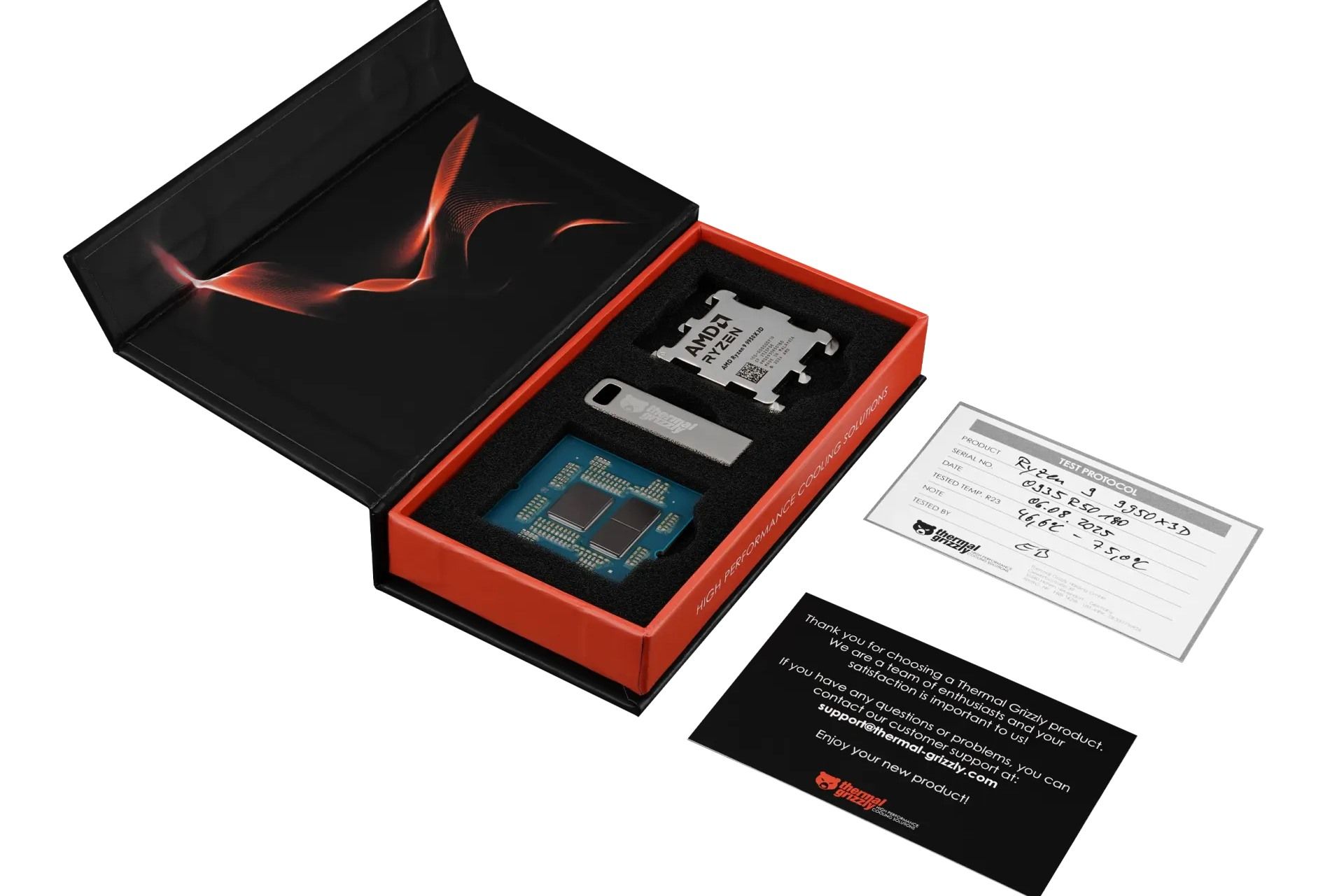
Thermal Grizzly has begun selling its delidded version of AMD’s Ryzen 9 9950X3D2 Dual Edition for $1,402.83, according to hardware reporting from Tom’s Hardware. The price represents a $500 premium over the standard retail version of the processor, delivering factory-stripped silicon accompanied by specialized testing, a dedicated USB drive containing performance metrics, and a 24-month worldwide warranty.
The Tech TL;DR:
- The Hardware: Thermal Grizzly offers a factory-delidded AMD Ryzen 9 9950X3D2 Dual Edition desktop processor priced at $1,402.83.
- The Warranty Trade-off: The product includes a 24-month worldwide warranty that waives the standard German 12-month burden of proof shift, but strictly prohibits manual clock speed tuning beyond factory specifications.
- The Performance Reality: While direct-die cooling reduces thermal resistance and acoustic noise under sustained loads, gaming performance remains directly in line with cheaper standard chips.
Architectural Breakdown and Thermal Headroom
The Ryzen 9 9950X3D2 functions as AMD’s halo desktop processor, featuring 16 Zen 5 cores, 32 threads, and a massive 192MB L3 cache enabled by an unusual dual-CCD 3D V-Cache configuration. The chip commands a 200W thermal design power (TDP) rating and routinely consumes elevated power levels under strenuous workloads. To manage this density, Thermal Grizzly physically removes the integrated heat spreader (IHS), cleans and tests each processor, records operating temperatures, and supplies a microscope image of the exposed silicon on an included USB drive.
Direct-die mounting reduces thermal resistance between the processor die and cooling blocks. This thermal efficiency lets the chip sustain standard boost frequencies without aggressive, high-RPM fan curves, reducing overall system acoustic output.
Warranty Boundaries and Overclocking Restrictions
Standard retail processors carry manufacturer warranties that become void the moment an end-user removes the heat spreader. Thermal Grizzly attempts to mitigate this risk by issuing a 24-month worldwide warranty. Under German consumer protection rules, the burden of proof normally shifts after 12 months, but the company’s terms explicitly waive this shift, maintaining product responsibility for the full two-year duration.
However, the warranty terms enforce strict compliance boundaries. The coverage applies to normal operation and manufacturer-sanctioned tuning such as AMD Precision Boost Overdrive (PBO) and EXPO memory profiles. Operating the silicon outside specified voltage or frequency parameters is explicitly excluded from coverage. Enthusiasts seeking extreme manual overclocking must weigh the utility of a pre-tested naked die against the reality that unauthorized frequency scaling invalidates the $1,400 financial safety net.
Workload Evaluation and Market Positioning
Independent analysis indicates that the Ryzen 9 9950X3D2 is built primarily for specialized workloads capable of capitalizing on massive cache footprints distributed across dual CCDs. Standard gaming benchmarks show performance matching lower-priced alternatives, and the processor occasionally lags behind the Ryzen 9 9850X3D in specific titles. Consequently, purchasing the $1,403 delidded variant serves niche environments or enthusiasts demanding peak multi-core cache density rather than mainstream gamers.

Furthermore, deploying naked-die hardware requires specific physical modifications. Standard Socket AM5 cooling hardware may fail to mount securely to a delidded processor package without specialized direct-die mounting frames.
Implementation Script: Monitoring Thermal Metrics via CLI
watch -n 1 "sensors | grep -E 'Tdie|Core' && uptime"
Editorial Kicker
As extreme desktop silicon pushes past traditional thermal ceilings, specialized aftermarket modifications bridge the gap between fragile enthusiast customization and commercial support. Whether a $500 premium for a naked halo processor justifies itself depends entirely on an organization’s appetite for risk and the precise demands of its multi-threaded computational pipelines.
*Disclaimer: The technical analyses and security protocols detailed in this article are for informational purposes only. Always consult with certified IT and cybersecurity professionals before altering enterprise networks or handling sensitive data.*