“There Are Two Kinds of Hope,” Ali Says in La Distance
“There are two kinds of hope,” Ali says in La Distance.
“The hope that I nurture … crashes into the imperfection and injustice of the world; but … pushes us to do our best with what we have.”
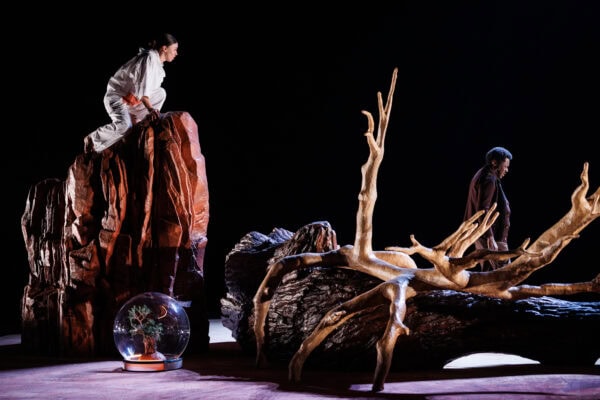
The line anchors Tiago Rodrigues’s new piece, which opened this week at the Brooklyn Academy of Music as part of the Next Wave season in partnership with L’Alliance Française, Exeunt Magazine NYC reported. Performed in French with English supertitles, the two-hander stars Adama Diop as Ali and Alison Dechamps as his daughter Amina, who in 2077 prepares to leave a collapsing Earth for Mars under the auspices of the CorpoNation Novus.
Ali records messages for Amina’s months-long journey; she replies from a spacecraft bound for a planet where she will undergo the “Protocol,” a treatment designed to erase her episodic memory and all knowledge of human history so she can build a new society unburdened by the past. The actors occupy opposite halves of a circular turntable set by Fernando Ribeiro — Ali’s side littered with books, a record player and printed photographs; Amina’s marked only by a glass terrarium.
The stage rotates so that each performer speaks only when visible to the audience, a device the review notes makes the conjunction of Mars passing behind the sun a literal countdown to the moment Amina forgets her father forever.
“Why do you waste your time telling me about these photographs?…I think your daughter has made a final decision,” Amina tells Ali as her memories begin to dissolve. By the end, she asks not why he sent her away but who he is to her: “It’s very kind of you to explain the nature of our relationship,” she says with “disinterested mildness.”
Diop plays Ali as a doctor who saved his toddler from “Collapse #2” and now watches his life’s work rendered obsolete; Dechamps moves from reserve to a raw admission of fear that the review calls a reset of their relationship “far too close to the end.”
Ali’s final communication — a handwritten letter Amina will never receive — slows to a message of support, though the play leaves open whether it reflects his patient hope or the “cruel” hope that “demands results and absolute solutions, and that needs to destroy everything to start again from scratch.”