
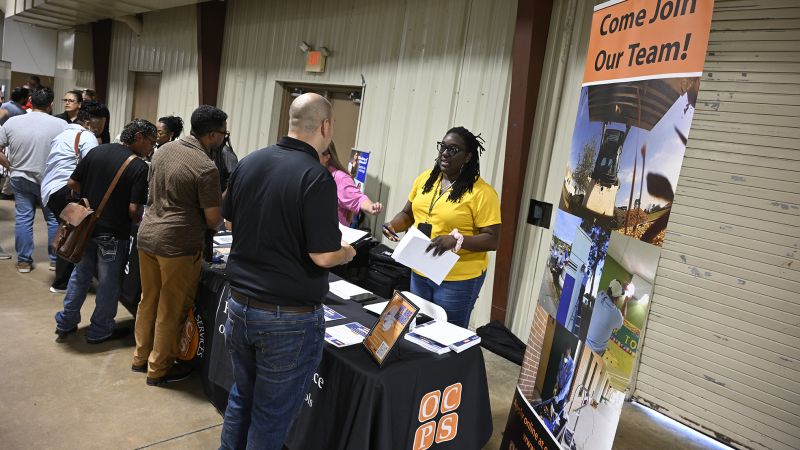
US Job Growth Stalls: Uncertainty and Sectoral Squeeze Grip Economy
July jobs report expected to show significant slowdown as broader market fears mount
The US job market, which appeared stable for the first half of the year, is showing signs of losing momentum. Expectations are for a considerable drop in job gains for July, sparking concerns about the broader economic outlook.
Mounting Evidence of a Slowdown
The upcoming July jobs report is projected to reveal a net gain of 115,000 jobs, a notable decrease from June’s 147,000. Furthermore, the unemployment rate is anticipated to rise to 4.2% from 4.1%. This slowdown follows a trend where monthly job additions have averaged between 102,000 and 158,000 through June. However, excluding the pandemic-induced recession, this pace represents the weakest first half of the year since 2010.
“We’re getting more and more reliant on a very small part of the economy to drive any sort of job growth. There just are no jobs right now, AI or no AI, tariffs or no tariffs.”
—Heather Long, Chief Economist for Navy Federal Credit Union
Businesses are hesitant to expand their workforces, largely due to persistent uncertainty surrounding President Donald Trump‘s trade policies and their potential impact on tariffs. This unpredictability has created a “perpetual holding pattern” for companies considering hiring or layoffs.
Labor Market Shows Stagnation
Recent data from the Job Openings and Labor Turnover Survey confirms a cooling labor market. Job openings declined in June, hiring reached a one-year low, and the rate of workers quitting their jobs fell below the five-year average. This indicates a lack of dynamism and reduced opportunities for job seekers.
Initial jobless claims remain low, but continuing claims have consistently hovered near a November 2021 high. Last week, new claims for unemployment insurance increased slightly to 218,000, while continuing claims held steady at 1.946 million, remaining close to a four-year peak.
In July, layoff announcements saw a significant increase of 29% compared to June, with 62,075 cuts announced. These cuts are attributed to federal budget reductions, the impact of artificial intelligence (AI), and tariff concerns. Andrew Challenger, senior vice president at Challenger, Gray & Christmas, noted that AI accounted for over 10,000 cuts last month, with tariff-related impacts affecting nearly 6,000 jobs this year.
With hiring sluggish and labor turnover diminishing, individuals are experiencing longer periods of unemployment. While the unemployment rate decreased in June, this was partly due to a shrinking labor force and a fall in participation rates.
The unemployment rate’s reliability as an economic health indicator is being questioned, particularly as shifts in immigration patterns influence labor force growth. Foreign-born workers have become a significant driver of labor force expansion since early 2020, and efforts to curb unauthorized immigration are contributing to a contraction in the labor pool.
Sectoral Disparities Emerge
Job growth is typically slower during summer months, but the current labor market is also experiencing a structural slowdown. Job gains are heavily concentrated in a few specific industries, leading to difficulties for those seeking employment outside these sectors.
“The job market is frozen outside of health care and education, and this is a real hardship for anyone looking for a job.”
—Heather Long, Chief Economist for Navy Federal Credit Union
The average duration of unemployment rose to 23 weeks in June, with the proportion of long-term unemployed (27 weeks or more) increasing to 23.3%, approaching a three-year high. In June, sectors like health care, social assistance, and state and local government, which represent less than 15% of total employment, were responsible for 94% of the month’s job gains.
Economists noted potential anomalies in the June data for state and local government employment, which saw an estimated increase of 80,000. While education jobs typically decline in summer, this year’s drop may have been less pronounced than in previous years, leading to a stronger registered gain after seasonal adjustments.
The primary sectors expected to drive job growth in July are health care, social assistance, and leisure and hospitality. The diffusion index for private industries in June, which measures the breadth of hiring, stood at 49.6, indicating that more industries lost jobs than gained them.
While some tariff-related price increases are becoming evident in consumer goods, their most significant impact on the labor market has been the pervasive uncertainty they create. Heather Long identifies tariff uncertainty as the leading factor hindering the labor market, followed by post-pandemic normalization and, distantly, the effects of AI.
Despite wages continuing to outpace inflation, economic conditions have led the Federal Reserve to maintain its pause on interest rate hikes. This environment has fostered a “K-shaped economy,” where economic growth is driven by a small segment of the population, while others struggle. According to the Bureau of Labor Statistics, the average duration of unemployment increased to 23 weeks in June, and the share of workers unemployed for 27 weeks or more rose to 23.3%, nearing a three-year high.
The US Bureau of Labor Statistics reported that in June, health care, social assistance, and state and local government entities, which collectively constitute less than 15% of total employment, accounted for 94% of the month’s job gains. This concentration highlights a significant imbalance in the labor market.
The Federal Reserve’s recent decision to pause interest rate hikes reflects the complex economic landscape, characterized by wage growth outpacing inflation but also a return to a “K-shaped economy.” In this scenario, the affluent are thriving while those with fewer resources face ongoing challenges.
“People are really stretched thin,” Long observed, expressing concern that persistent labor market weakness could exacerbate existing financial pressures, such as rising household debt. She added, “There simply is not much hiring, white-collar or blue-collar. I’m hopeful that will change if we can get tariff certainty by the end of the summer and a rate cut by September.”
