The lunar crater Schickard is currently visible in the southwest
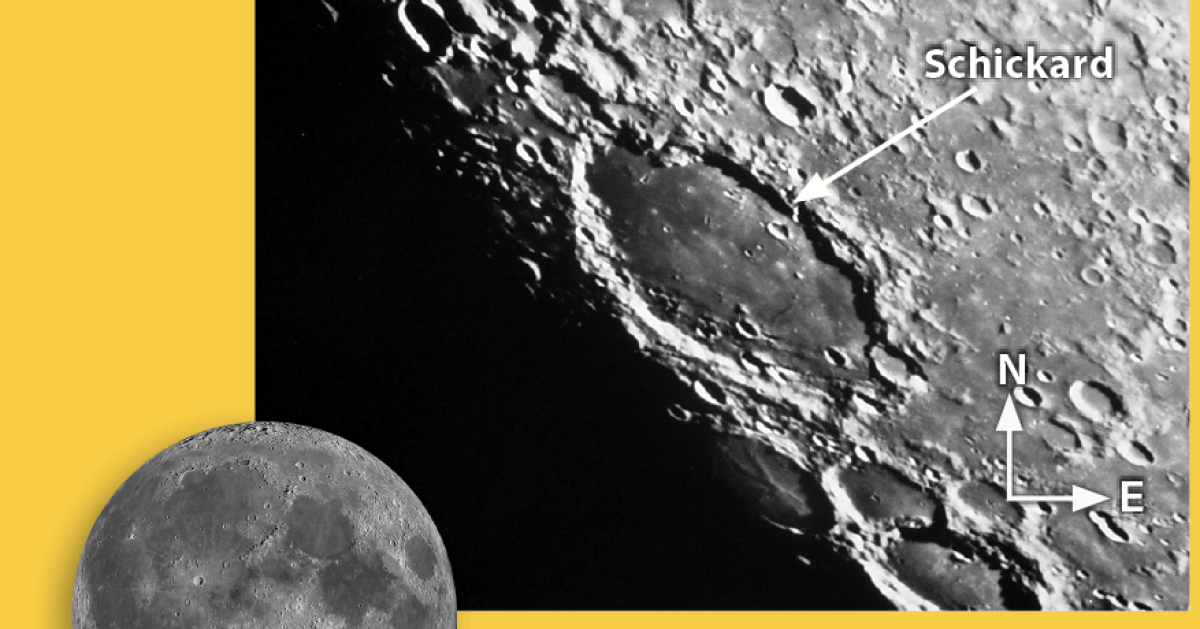
The lunar crater Schickard is currently visible in the southwest as the Moon nears its Full phase, providing a clear target for observers on Sunday.
Because the Moon is illuminated at 97 percent, astronomers recommend using a Moon filter before turning a telescope toward the satellite to mitigate the intense brightness.
Located near the small, circular Mare Humorum, Schickard is a broad impact crater that has become prominent as the Sun rises across the lunar surface. The crater, which measures approximately 130 miles (210 kilometers) across, is estimated to be roughly 4 billion years old. While its position near the Moon’s limb causes it to appear oblong from Earth, orbital imagery confirms the feature is actually circular in shape.
Observers examining the crater will notice that its dark floor is not perfectly smooth; instead, it is pockmarked by smaller craters that formed after the initial impact. The crater’s outer walls appear shallow and weathered, with the western wall showing signs of slumping when compared to the eastern rim.
The southwestern portion of the floor exhibits a rougher texture than the rest of the formation. This contrast exists because ancient lava flows flooded most of the crater, but failed to reach the southwestern region.

For those viewing from 40° N 90° W, the Moon rises at 2:59 P.M. and sets at 4:34 A.M. local time. These specific lunar observations are provided by Astronomy magazine, which notes that the current 97 percent illumination level is measured at 10 P.M. local time. The event coincides with other celestial activity this week, including Mercury appearing far west of the Sun on November 21.
Studying the structural integrity of Schickard reveals significant geological wear over its four-billion-year history.
A closer inspection of the western wall shows how it has slumped, a process that stands out when contrasted with the comparatively stable eastern rim. These geological details remain accessible to skywatchers during the current waxing gibbous phase, which maintains a 97 percent illumination level.
Schickard originated during the Pre-Nectarian period, marking it as a significant feature from the lunar geologic timescale. This ancient impact crater features a floor that underwent partial lava flooding, which explains the distinct geological contrast observed today. While the majority of the basin was smoothed by these volcanic flows, the southwestern region remained uncovered, preserving a rougher, unflooded texture that stands in sharp contrast to the rest of the formation.
As the Moon approaches its Full phase, the western limb is increasingly coming into view, offering a prime opportunity to study features like Schickard that demonstrate the long history of giant impacts on the lunar surface.