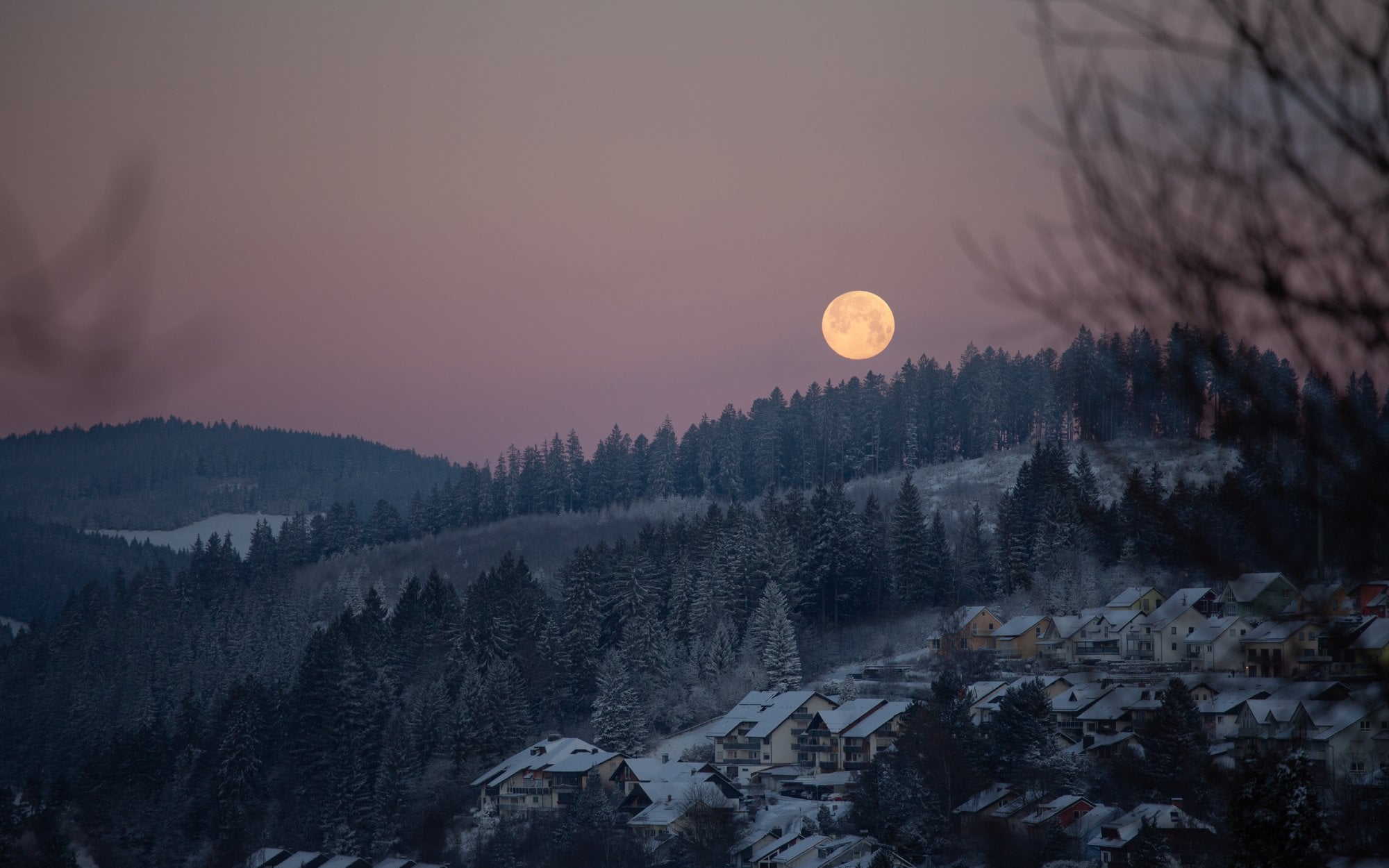
The First of Two Supermoons Will Reach Peak Illumination on Tuesday at 15:53 Local Time
The first of two supermoons will reach peak illumination on Tuesday at 15:53 local time, according to astronomical data cited by tvnmeteo. Już 24 listopada na niebie pojawi się listopadowa pełnia, Polskie Radio 24 reported.
Known traditionally as the Beaver Moon, November’s full moon coincides with the lunar perigee — the point in the Moon’s elliptical orbit closest to Earth. At that moment the Moon will sit roughly 359.3 thousand kilometers from the planet, Podróże Onet reported, placing it near the boundary of the distance commonly used to define a supermoon.
A second supermoon follows on Dec. 24, Christmas Eve, reaching its peak at 2:28 a.m. Polskie Radio 24 reported. That night the Moon will come even closer, about 356.6 thousand kilometers away, making it the larger and brighter of the pair. Jej kulminację przewidziano na godz. 2.28 w nocy.
What a supermoon means
The term “supermoon” is not an official astronomical designation. It was coined in 1979 by astrologer Richard Nolle, Polskie Radio 24 and Rzeczpospolita both noted. Astronomers refer to the alignment as a perigee-syzygy: a full moon occurring near perigee.
Because the Moon’s orbit is an ellipse rather than a circle, its distance from Earth varies by roughly 50,000 kilometers between perigee and apogee, the farthest point.
When full phase falls near perigee, the lunar disk can appear up to 14 percent larger and shine up to 30 percent brighter than a full moon at apogee, according to figures from NASA cited by Rzeczpospolita and tvnmeteo.
In practice the difference is subtle. “The difference may however be difficult to notice with the naked eye,” tvnmeteo reported. Samej różnicy w wielkości prawdopodobnie jednak niemal nie zauważymy. Na rozległym nocnym niebie brakuje bowiem punktu odniesienia.

Astrologer and observer perspectives on the November supermoon
Lucja Wolińska said that the Frost Moon supermoon will illuminate the sky on November 24, according to Polskie Radio 24.
Sabian symbol and regional observations for the full moons
For the December supermoon on Christmas Eve, the Moon will reach perigee at roughly 356.6 thousand kilometers from Earth, closer than the November pass. The November full moon will sit near the commonly cited supermoon boundary at approximately 360.8 thousand kilometers, with its apparent diameter about 6 percent larger than an average full moon.
Traditional names reflect seasonal activity and remembrance
The November full moon is known as the Beaver Moon because beavers finish building and repairing lodges and gather food stores for winter in this period. Historically, November was also the trapping season before frozen waters cut access to beaver habitats.
Other traditional names include Foggy Moon, Windy Moon, and Moon of Slaughter, while some traditions also refer to it as the Frost Moon.
The term “supermoon” originated in 1979 when astrologer Richard Nolle coined it in Dell Horoscope magazine, defining it as a new or full moon occurring with the Moon at or near (within 90% of) its closest approach to Earth in a given orbit (perigee).
Nolle based his calculations on 90% of the difference in lunar apsis extremes for the solar year, establishing the astrological framework later referenced in popular astronomy. He expanded this concept in 2000 by introducing the “extreme supermoon” designation for any new or full moons at “100% or greater of the mean perigee.”

Viewing conditions and names
Cloud cover may hinder observations across much of Poland on Tuesday evening. Synoptic forecaster Tomasz Wakszyński told tvnmeteo that most of the country will be overcast, with clearer spells expected only in the west. Większe przejaśnienia i lokalne rozpogodzenia spodziewane są tylko na zachodzie.
The Moon often looks most striking at rising, when the so-called Moon illusion makes it appear disproportionately large against buildings or trees on the horizon. Podróże Onet and tvnmeteo both recommended watching shortly after moonrise, which in Warsaw occurs around 15:00, just before sunset at 15:46. Godzinę wschodu Księżyca należy sprawdzić dla konkretnej miejscowości. Nie musi ona dokładnie pokrywać się z godziną zachodu Słońca. Zjawisko to może wystąpić podczas każdej pełni.
November’s full moon carries several traditional names. “Beaver Moon” reflects the period when beavers finish winter preparations and trappers once set lines before waters froze, tvnmeteo and Rzeczpospolita explained. Listopadowa pełnia tradycyjnie nazywana jest “Księżycem Bobrów” lub “Bobrową Pełnią”. German-speaking regions call it the Mourning Moon, referencing the cluster of remembrance days in November, Podróże Onet reported.
Nazywana jest również Mglistym Księżycem, Wietrznym Księżycem czy Księżycem Uboju. Other historical names include Frost Moon and Foggy Moon. W niektórych tradycjach listopadową pełnię określa się także mianem Mroźnego Księżyca. The December full moon is widely known as the Cold Moon, marking the onset of winter’s coldest stretch. Grudniowa pełnia nosi nazwę Zimnego Księżyca (Cold Moon).