
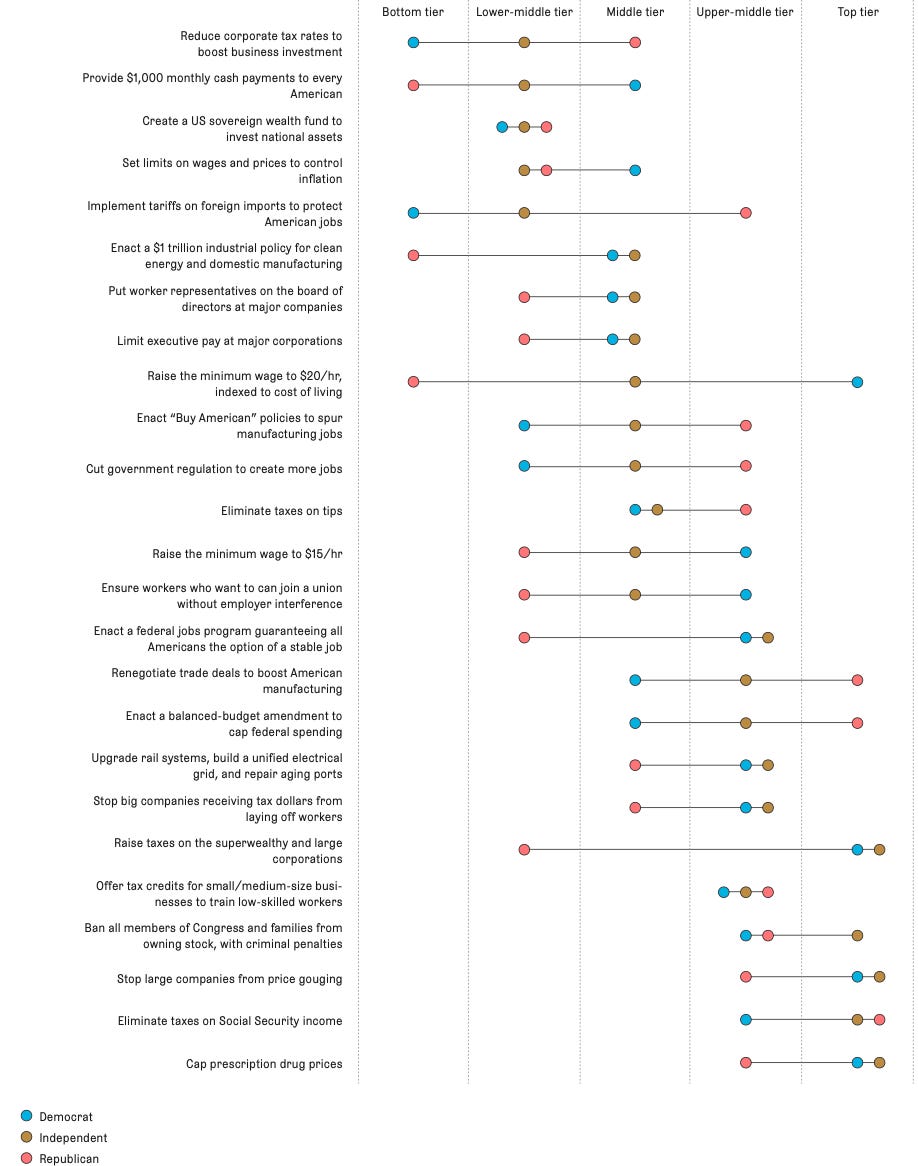
The Fractured Landscape of a working-Class Agenda
A recent study reveals a striking disconnect in American politics: the absence of a cohesive, broadly supported economic agenda for working-class citizens. While there’s significant agreement on a handful of specific policies, they represent a surprisingly disparate collection of ideas, ranging from buisness tax credits for job training to restrictions on congressional stock ownership, price gouging limitations, Social Security tax elimination, and prescription drug price caps. This odd mix highlights a fundamental problem – a lack of unifying vision for economic improvement.
Currently, no major political party, independent leader, or significant labor organization champions such a diverse and, frankly, quirky platform. This isn’t due to a lack of effort; rather, it reflects a deeper issue. The study demonstrates that a politically viable, universally appealing working-class agenda simply doesn’t exist in the current landscape.
the economic approaches of the two major parties are starkly different and largely siloed. Republicans and Donald Trump focus on tariffs, new trade agreements, tax cuts, and deregulation. Democrats,conversely,prioritize clean energy industrial policy,bolstering the existing social safety net,and increased regulation alongside potential tax increases. Crucially, neither of these approaches garners consistent support from across the political spectrum, including independent voters.
This contrasts sharply with historical periods like the New Deal and Great Society eras, which saw broad consensus around initiatives like labor rights, workplace protections, public works projects, and social insurance. Today, there’s no comparable, unifying agenda to rally around. The result is a fragmented economic debate, a “hodgepodge of incompatible ideas” lacking a clear direction or consistent political representation.
Consequently, political discourse increasingly gravitates towards culture war issues, where the lines are clearly drawn for voters. The economic conversation, however, remains muddled, leaving working-class Americans to pick and choose from a collection of policies that don’t necessarily address their core concerns.republicans will emphasize tariffs and tax cuts, while Democrats will focus on combating “oligarchy” and advocating for wage increases and healthcare access. Workers will likely find themselves supporting some, but not all, of these proposals.
The potential consequences are significant. Both parties risk facing resistance and shifting allegiances from working-class voters if tangible improvements aren’t seen in areas like high-paying job availability, affordable living costs, quality of life, and opportunities for wealth building.
It’s critically importent to note that this lack of clarity isn’t a failing of those attempting to develop a working-class agenda. These efforts are valuable and well-intentioned.Rather, it’s a symptom of the broader confusion within modern politics, fueled by rising distrust in institutions and the competing interests of diverse groups within the American workforce, differentiated by job type and political affiliation.
Ultimately,the party or movement that can successfully navigate these competing interests and articulate a compelling,unified vision for economic progress will be poised to gain significant and lasting support.While a challenging task in today’s polarized habitat,it remains a critical project for ensuring the well-being of all American workers.
