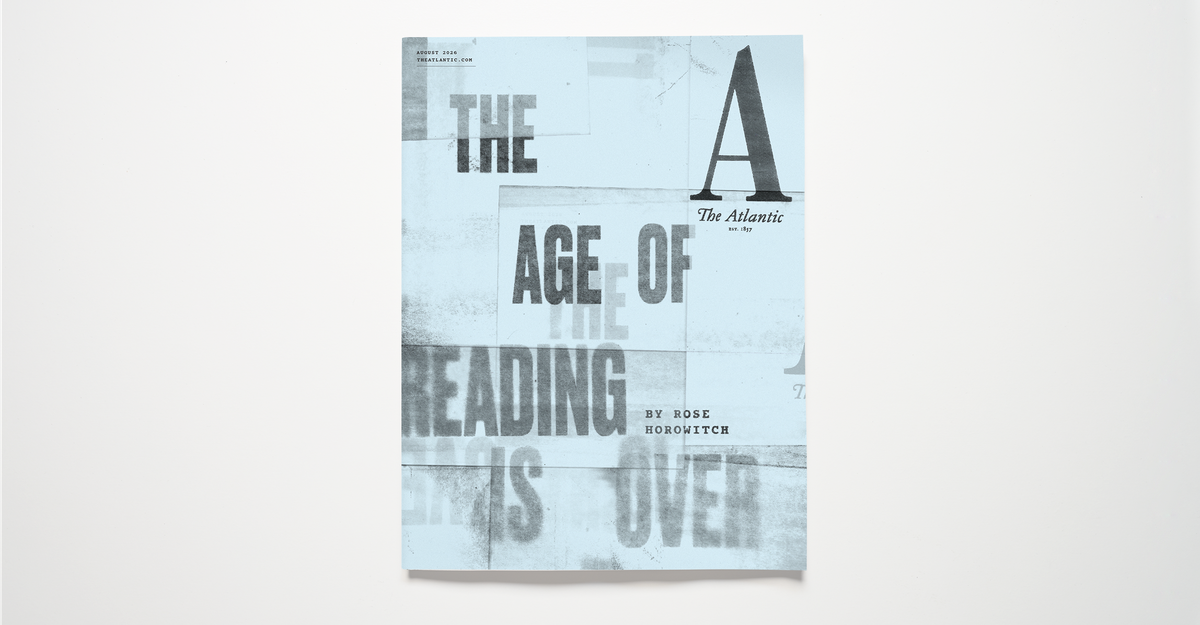
The Age of Reading Is Over: The Rise of a Postliterate World
In the August issue of The Atlantic, staff writer Rose Horowitch reports that the United States has entered a “postliterate” era, defined by a broad collapse in book reading across all demographics. This decline impacts cognitive ability and civic discourse, as society shifts toward fragmented, text-based digital consumption over sustained, book-length analysis.
The Erosion of Deep Literacy and Intellectual Synthesis
The transition away from book reading is not merely a shift in leisure habits; it represents a fundamental change in how the human brain processes information. Horowitch identifies a widespread decline in reading that transcends traditional boundaries of age, gender, and education. Even among groups historically associated with high literacy—such as women and college graduates—the engagement with long-form literature has plummeted.

This trend carries significant implications for the future of democratic institutions. Literacy has historically been the bedrock of political consciousness and complex thought. As the inclination to read books fades, the capacity for higher-order synthesis and critical interrogation of information diminishes. This creates an environment where, as Horowitch notes, information is consumed in rapid, ephemeral bursts—emails, social media threads, and instant messages—rather than through structured, cohesive arguments.
The economic reality of the humanities further underscores this decline. Careers in letters and journalism are increasingly viewed as dead ends, causing a structural atrophy in the sectors responsible for producing long-form content.
The Postliterate Presidency and AI Dependency
Horowitch points to Donald Trump as the first “postliterate” president, arguing that his communication style is uniquely suited to an era defined by distraction and confrontation rather than textual depth. This style exploits the very cognitive shifts that have made book reading less central to public life. If the medium of communication defines the message, the move away from books toward fragmented digital feeds fundamentally alters the political landscape.
The rise of artificial intelligence accelerates this transition. Horowitch warns that over-reliance on AI for writing tasks threatens the human capacity for independent thought. By outsourcing the development of views to machines, individuals risk losing the cognitive friction required to sharpen their own intellects. NYU philosopher Kwame Anthony Appiah warns that if humans surrender these capacities, they risk becoming “very different creatures.”
Regional Consequences and the Future of Civic Engagement
This apathy toward deep reading leaves a vacuum that is often filled by misinformation or simplified, reactionary narratives. As communities face increasingly complex challenges—from urban planning to environmental policy—the inability to synthesize long-form information becomes a tangible threat to civic progress.
The Inheritance of Wisdom in an Apathetic Age
Despite the ease with which historical knowledge can be accessed in the digital age, Horowitch concludes that the threat of apathy remains the primary barrier to intellectual survival. The wealth of human knowledge currently available is unprecedented, yet the inclination to engage with that inheritance is at a historic low.
The shift is not an inevitable byproduct of technology, but a choice in how society prioritizes its cognitive resources. The loss of the ability to interrogate the past through its texts leaves the current generation ill-equipped to understand the trajectory of its own civilization. As the next generation reads significantly less than their predecessors, the pace of this decline is expected to accelerate. The future of this intellectual inheritance rests on whether current institutions can incentivize a return to deep reading or if they will continue to optimize for the distracted, postliterate world currently taking shape.