Thailand Inspects Border Gold Mines, Reviews Chemical Transit Controls for Myanmar Pollution
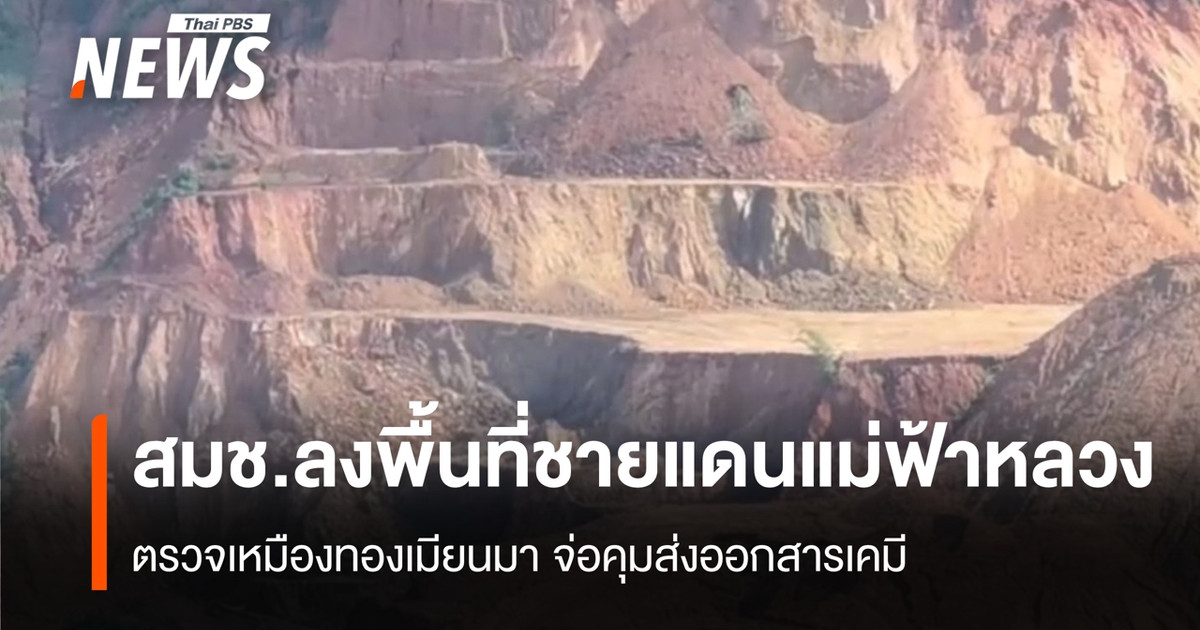
National Security Council Secretary-General Gen. Chaiyapruk Didyasarin inspected the Ban Mong Kao Lang border outpost in Mae Fah Luang district, Chiang Rai, on Saturday to assess gold mining operations in Myanmar’s Mae Jok village that sit near the Thai frontier.
The visit followed a Friday meeting chaired by Prime Minister Paetongtarn Shinawatra that directed security agencies to accelerate domestic water and soil remediation while pursuing diplomatic pressure on Myanmar and China, where concession holders for the mines are based.
Gen. Chaiyapruk said the government is compiling a list of chemicals used in mining — including ammonium sulfate, a leaching agent for rare earth extraction — for potential export controls under the Ministry of Defence.
Border mines feed global supply chains
Satellite imagery from the Stimson Center shows extensive mining activity in Myanmar’s Shan State, upstream of the Sai, Kok, and Ruak rivers that flow into Thailand. The International Energy Agency estimates Myanmar supplied roughly 45 percent of global heavy rare earth output from mines in 2024, with China dominating downstream processing, Spring News reported.
In-situ leaching — injecting ammonium sulfate solutions into clay-rich hillsides to strip rare earth ions — is the prevailing method. The pregnant solution is then collected for separation, leaving behind waste that can enter watersheds during monsoon rains.
Chemical controls face transit loopholes
Gen. Chaiyapruk acknowledged legal limits on blocking chemical shipments that transit Thailand en route to Myanmar. The Ministry of Commerce is reviewing transit regulations to tighten oversight of goods that enter Thailand before being re-exported, or that pass through border crossings destined for unregistered mining sites.
Deputy Prime Minister and Foreign Minister Maris Sangiampongsa has engaged Myanmar counterparts, while the Prime Minister has raised the issue directly with Beijing, given Chinese concession holders operate many of the sites. A Joint Working Group on transboundary water quality between Thailand and Myanmar is scheduled to meet in Bangkok on November 25–26, the first such session under the new framework, according to LINE TODAY.
Domestic regulations tighten mineral traceability
Importers will need to provide concession holder identification, corporate registration from the country of origin, a certificate of origin, and the precise coordinates of the source mine.
DPIM said it found no abnormal exports of mining chemicals such as cyanide — critical for gold leaching — from Thailand in recent years, according to thansettakij.
Academic warning: watersheds nearing irreversible ‘deadlock’
Seasonal monitoring with the Pollution Control Department shows heavy metal and arsenic concentrations peak during the rainy season, not the dry season, as runoff flushes mine waste into rivers, Prachachat Business reported.

He cited the legacy of the Yom River in Mae Hong Son, where decades after mine closure, water passing through old sites still registers arsenic levels 30–40 times above standards, and villagers report chronic skin conditions. Mae Sai district, which lacks an alternative raw water source unlike areas served by the Kok River, faces acute vulnerability.
“If Thailand does not adjust its strategy to manage the problem at the source, the Sai and Kok basins will move into a ‘deadlock’ that cannot be restored.”
Security agencies prepare ‘drastic measures’
Gen. Chaiyapruk said the Prime Minister has ordered security agencies to prepare “drastic measures” within their authority, including potential suspension of imports and exports of chemicals linked to mining pollution. Defence Minister Gen. Phumtham Wechayachai is expected to meet with the National Security Council on Monday to review the chemical control list.
The Secretary-General said that some border segments remain undemarcated, complicating patrols. Military units on the ground have established a shared understanding of operational boundaries, and long-term talks will explore measures to prevent mining expansion closer to the Thai frontier.
The government will categorize mines by legality, concession holder, and geographic corridor before designing targeted interventions for each cluster, Gen. Chaiyapruk said. Communities near the border have been promised clean drinking water supplies while monitoring continues.