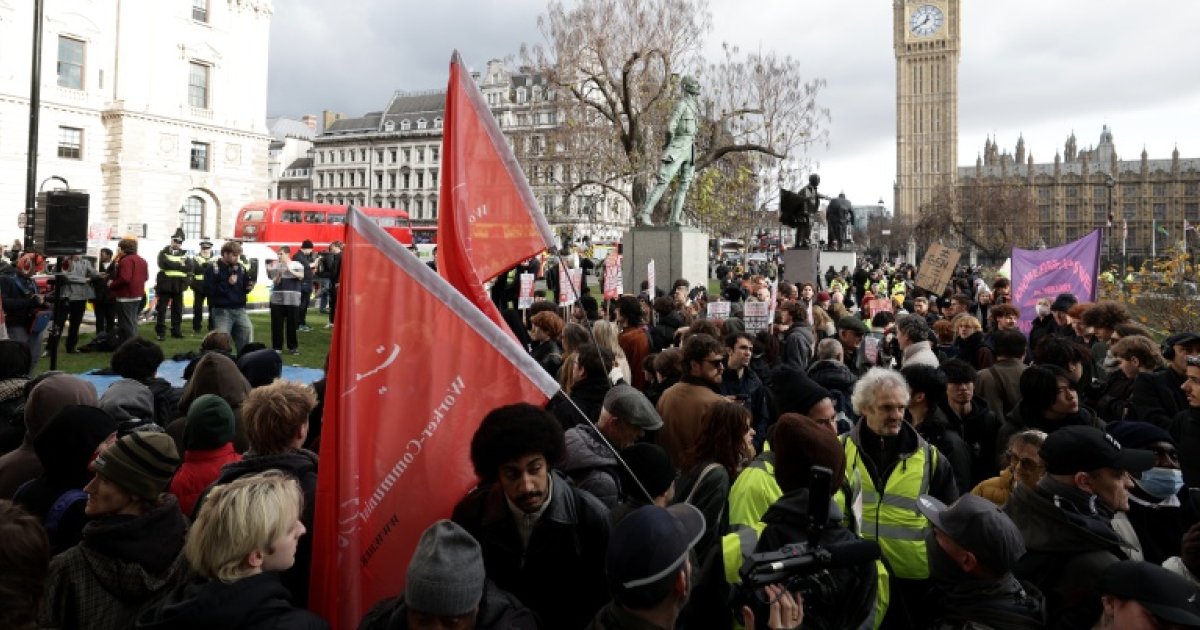
Tens of Thousands Join Youth Strike Across Europe Over Cost of Living, Militarization, Public Services
Tens of thousands of demonstrators mobilized across Europe on Friday to protest against the rising cost of living, the perceived militarization of society, and the degradation of public services, according to Rfi.
The international youth strike, coordinated by various student and labor organizations, marks a sustained wave of social unrest.
From London to Milan and Amsterdam to Lausanne, protesters took to the streets to demand systemic changes. In Germany, the collective “GenZ regelt” reported that approximately 21,000 people participated in demonstrations across 70 cities.
The protests were not limited to a single day. As reported by RFI, organizers planned actions spanning November 20, 21, and 22. The mobilization in Rome saw three distinct processions converge near the Colosseum to protest the 2027 national budget, which critics argue prioritizes military spending over social welfare.

The movement has been characterized by a profound skepticism toward government institutions. In Berlin, 19-year-old student Jacob Braune highlighted the growing sense of abandonment among the younger generation, according to TV5MONDE – Informations.
“We are trying to resist because it is our future and it is elderly people who are currently deciding what our future will look like,” said Braune, as reported by Actu Orange.
Similar sentiments were echoed in other capitals. In Madrid, students pointed to the physical decay of educational infrastructure. Gabriela Gimeno Serrano, a 16-year-old student, described schools infested with rats and cockroaches, with facilities in a “deplorable state,” TV5MONDE – Informations reported. In London, protesters highlighted the financial burden placed on students, with 23-year-old Mihaela Ivanova questioning the long-term prospects for her generation amid energy and climate crises.
While many protests remained peaceful, some areas experienced clashes between participants and law enforcement. Historian Sylvain Boulouque said that while transnational coordination is not new, the specific focus on youth-led anti-militarization represents an “original” dynamic, characterized by a shared defiance of authority.
| Location | Primary Focus | Key Reported Issue |
|---|---|---|
| Germany | Anti-militarization | Fear of returning conscription |
| Italy | Budget/Cost of living | High military spending |
| Spain | Public education | Infrastructure decay |
| United Kingdom | Student debt | Economic crisis |
The movement’s demands are broad, encompassing calls for increased salary floors, rent controls, and higher taxes on the wealthy. In France, these demonstrations coincide with the eighth anniversary of the "gilets jaunes" movement, further complicating the political situation for the government.
Syndicates and housing rights associations from across Belgium, the UK, Spain, France, Greece, Italy, and Portugal have formulated six common demands, including a guarantee of housing for all and an immediate end to rearmament policies.
Historian Sylvain Boulouque, born in 1970, specializes in the history of communism and anarchism. He has authored works including a 2019 book analyzing misinformation during the “gilets jaunes” movement and a 2022 history of anarchists. He defended his thesis on the CGTU in November 2025 at the University of Reims and has contributed to the “Livre noir du communisme” and the think tank Fondapol.
The mobilizations are set to continue throughout the weekend, with further strikes and demonstrations scheduled in Belgium on Monday, November 23. “If the government does not listen to us, we cannot remain silent,” Olivia Ferrario, an 18-year-old student, told TV5MONDE – Informations.