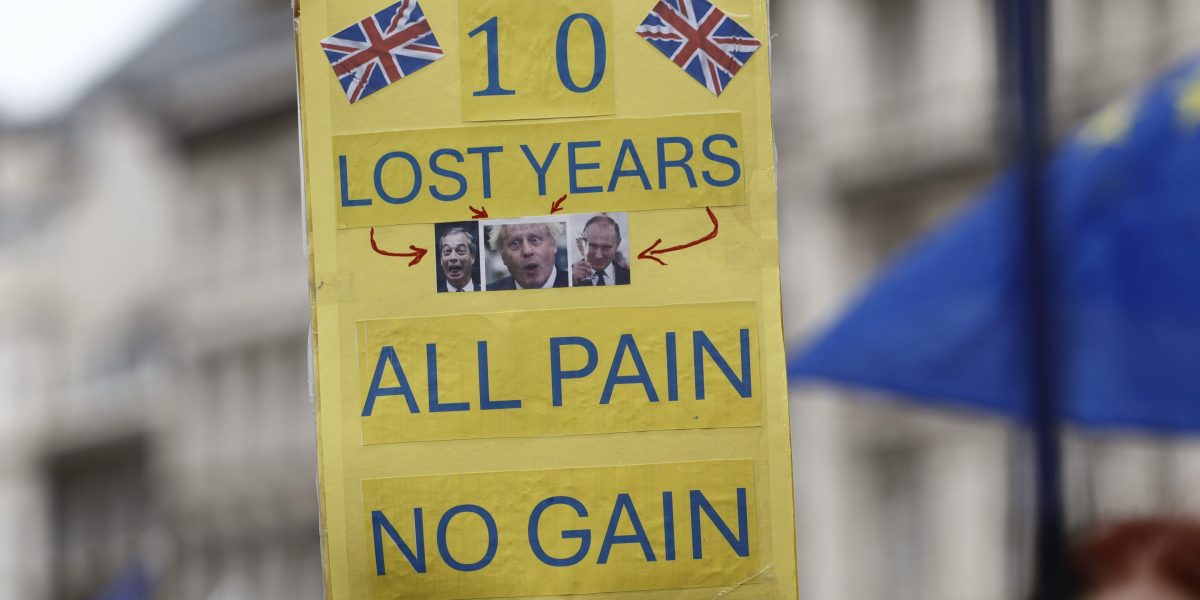
Ten Years After Brexit: UK Economy Still Struggling
Simon Boyd, managing director of REIDSteel, remains a vocal Brexit supporter despite mounting economic evidence that the UK’s GDP has shrunk by 6%–8% since leaving the EU, with productivity down 3%–4% and investment slashed 12%–13%—figures confirmed by the National Bureau of Economic Research’s cross-border study published in Q1 2026. His stance—rejoining the EU would be “re-boarding the Titanic while surrendering life vests”—underscores a growing divide between Brexit’s ideological backers and the fiscal reality facing British manufacturers, exporters, and labor-dependent sectors.
Why Boyd’s Brexit Bet Still Stands: The Hard Numbers Behind the Deficit
Boyd’s refusal to backtrack on his 2016 vote hinges on two claims: first, that Brexit’s economic underperformance stems from political missteps—not the principle of leaving—and second, that the UK’s current trade architecture remains too entangled with Brussels to unlock its full potential. The data tells a different story.

According to the NBER’s 2026 report, Brexit’s cost to the UK economy is quantifiable and persistent. Gross domestic product (GDP) per capita is now 4% lower than it would have been had the UK remained in the EU, while trade barriers have inflated the cost of exporting goods to Europe by an average of 18% since 2021, per the UK Office for National Statistics (ONS). For REIDSteel, which ships prefabricated steel structures to Ghana and Barbados, these costs translate directly to margin compression: EBITDA margins for UK steel exporters have fallen from 12.3% in 2019 to 8.9% in 2025, according to World Steel Association data.
“The issue isn’t Brexit itself—it’s the half-measure deal politicians delivered,” Boyd told *The Associated Press* in May 2026. “We’re still bound by EU regulatory alignment on goods, but without the single market’s efficiencies. That’s why rejoining would be absurd—we’d be back under Brussels’ rules, minus the benefits.”
The contradiction is stark when compared to the UK’s trade agreements. Since leaving the EU, the UK has signed deals with 70+ countries, yet 41% of UK exports still flow to the EU, per the Department for International Trade’s Q2 2026 report. For Boyd, the problem isn’t the volume—it’s the velocity. Customs checks at Dover have added 4–6 days to supply chains for steel manufacturers, pushing inventory costs up by 15%–20%, according to a Chatham House analysis.
Where the Brexit Bargain Went Wrong: Labor, Logistics, and Lost Productivity
The UK’s post-Brexit labor crunch is equally damaging. Before 2016, 1.2 million EU workers lived in the UK, filling roles in manufacturing, hospitality, and agriculture. By 2025, that number had dropped to 600,000, per ONS migration data. The impact on sectors like catering is immediate: 30% of UK restaurants now struggle to hire, with 25% of curry houses reporting 50%+ revenue declines since 2020, according to the Bangladesh Caterers Association UK.

For manufacturers like REIDSteel, the labor shortage compounds supply chain delays. “We’ve had to automate 40% of our production line just to keep up,” Boyd said. “But that’s a short-term fix. The real issue is that UK plc is no longer an attractive base for global supply chains.”
Creon Butler, head of Chatham House’s global economy program, frames the problem in macro terms: “Brexit wasn’t just a policy choice—it was a wealth transfer. The UK is poorer today because we left the single market without replacing it with an equivalent alternative.” His analysis aligns with the European Central Bank’s 2025 assessment, which projects that UK productivity growth will remain 1.2% below EU peers through 2030 without structural reforms.
The Car Industry’s Brexit Hangover: How UK Automotive Exports Collapsed
Mike Hawes, CEO of the Society of Motor Manufacturers and Traders (SMMT), represents an industry that predicted Brexit’s damage with eerie accuracy. “We told the public this would hurt us,” Hawes said in a Q1 2026 earnings call. “And it has.”
UK car exports to the EU fell by 35% in the first quarter of 2026 compared to 2019 levels, per SMMT data. The cost of compliance with EU technical regulations—now a $1,200–$1,800 per vehicle burden—has forced manufacturers to relocate production. Jaguar Land Rover shifted 20% of its supply chain to Slovakia in 2024, while Nissan exited the UK entirely in 2021, citing Brexit-related uncertainty.
“The UK auto sector is now a shadow of what it was,” said David Bailey, chief economist at the Centre for Cities. “We’ve lost $12 billion in annual investment since 2016, and the only way to reverse that is either rejoin the EU or accept permanent second-tier status.”
Boyd dismisses rejoining as impractical. “The EU would demand concessions on fishing quotas, agricultural subsidies, and regulatory sovereignty—essentially, we’d be a vassal state again,” he argued. “But the alternative is clear: without a radical overhaul of our trade policy, UK businesses will keep bleeding cash to Brussels while getting none of the benefits.”
The Political Fallout: Why Starmer’s EU Talks Failed Before They Started
Prime Minister Keir Starmer’s abrupt resignation in June 2026—just as EU talks were set to begin—exposes the political paralysis at the heart of Brexit’s aftermath. Polling from King’s College London shows 48% of Britons now believe Brexit is worse than expected, up from 28% in 2021. Yet Starmer’s Labour Party remains divided: 30% of MPs openly support rejoining the single market, while the Conservative opposition clings to Brexit’s ideological purity.

The economic stakes are higher than ever. The UK’s current account deficit widened to 5.2% of GDP in Q1 2026, per the Bank of England, with trade imbalances deepening as EU partners like Germany and France accelerate their own trade blocs. “We’re in a race to the bottom,” warned Andrew Sentance, chief economist at PwC UK. “If we don’t fix our trade relationships soon, the UK will become a peripheral player in global manufacturing.”
How UK Businesses Are Fighting Back: The B2B Solutions Filling the Brexit Gap
While politicians dither, British firms are turning to specialized B2B providers to mitigate Brexit’s damage. Here’s how:
- Trade Compliance & Customs Automation: With 80% of UK exporters still grappling with post-Brexit customs delays, firms like [DHL Global Forwarding] and [Kuehne+Nagel] offer AI-driven customs clearance platforms that cut processing times by up to 60%. REIDSteel, for example, now uses [TradeGecko]’s automated tariff classification tool to slash errors in EU-bound shipments.
- Labor & Visa Solutions: The UK’s post-Brexit visa system has left sectors like hospitality and manufacturing scrambling. Firms such as [Visa4UK] specialize in fast-tracking skilled-worker visas, while [Oliver Wyman] helps companies restructure around local hiring pools.
- Supply Chain Reshoring: With 40% of UK manufacturers now considering reshoring critical production, [EY Supply Chain Consulting] is advising clients on nearshoring to countries like Turkey and Morocco—where trade barriers are lower and labor costs are competitive.
The question now is whether these stopgaps can bridge the gap until the UK’s trade policy evolves—or if Brexit’s economic drag will force a reckoning. Boyd’s Titanic analogy may be dramatic, but the data suggests he’s not wrong: the UK’s current path offers neither the sovereignty Brexit promised nor the prosperity it demanded.
For businesses navigating this uncertainty, the World Today News Directory connects you to vetted B2B partners—from trade compliance experts to reshoring strategists—ready to help you future-proof your operations. Explore the solutions shaping post-Brexit commerce here.