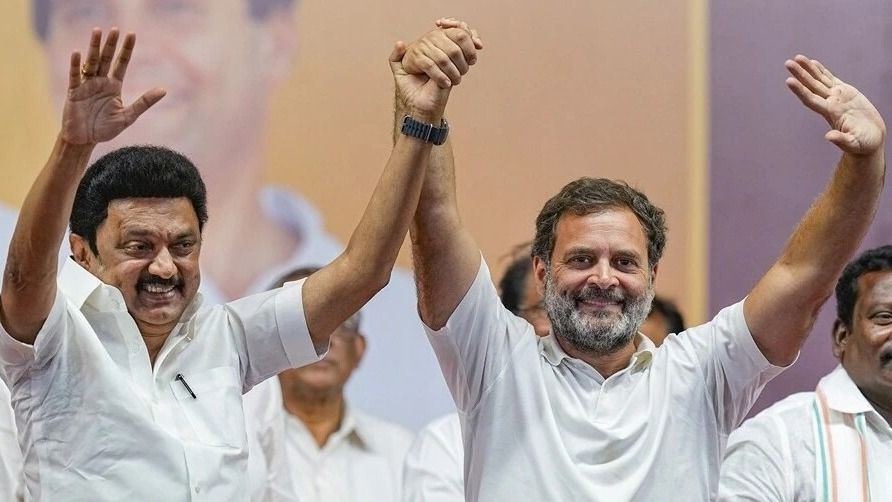
Tamil Nadu Political Shake-up: Congress Ditches DMK for Vijay’s TVK
The DMK has formally denounced the INDIA bloc after the Congress party abandoned their long-standing alliance to support Vijay’s Tamilaga Vettri Kazhagam (TVK). This seismic political shift in Tamil Nadu has left the DMK isolated and prompted the Governor to demand that Vijay provide concrete proof of a legislative majority before being permitted to form a new government.
This is more than a tactical realignment; it is a systemic collapse of the opposition’s unified front in one of India’s most influential states. For years, the alliance between the DMK and Congress served as a stabilizing force against national headwinds. Now, that stability has evaporated. By pivoting toward Vijay, a high-profile entrant into the political arena, the Congress party is betting on a disruptive “third way” to capture the electorate, effectively treating the DMK as a liability rather than a partner.
The immediate fallout is chaos in the corridors of power in Chennai.
The Breach: A Calculated Betrayal
The shift began when the Congress party explicitly rejected its partnership with the DMK, choosing instead to align with Vijay and his TVK party. This move has sent shockwaves through the regional political establishment, as it fundamentally alters the arithmetic of power in the state assembly. The DMK’s reaction was swift and caustic, with party leadership declaring that the INDIA bloc—once envisioned as a formidable national coalition—is now functionally dead in Tamil Nadu.
The logic behind the Congress pivot likely stems from a desire to distance itself from the DMK’s regional dominance and instead ride the wave of Vijay’s personal popularity. However, this gamble creates a precarious vacuum. While the Congress may find a new ally in Vijay, it has burned the bridge with the DMK, a party with deep-rooted organizational machinery across every district of the state.
For businesses and civic entities operating in the region, this instability is a red flag. Sudden shifts in governing coalitions often lead to the stalling of infrastructure projects and a freeze in municipal approvals. When the executive leadership is in flux, the first casualty is usually administrative continuity. This is why many regional developers are now seeking constitutional law experts to navigate the potential for prolonged political deadlock or unexpected changes in state policy.
“The transition from a stable coalition to a fragmented landscape of competing claims creates a governance deficit. Until a clear majority is established, the state’s administrative machinery is essentially operating in a holding pattern.”
The Governor’s Mandate and the Majority Crisis
Vijay has not wasted time in claiming the right to form the government, asserting that his new alliance holds the mandate of the people. However, the path to the Chief Minister’s office is not a straight line. The Governor of Tamil Nadu has intervened, insisting that Vijay must prove his majority on the floor of the house.
This requirement is a critical constitutional safeguard. In a climate where alliances can dissolve overnight, the Governor’s demand for a formal floor test prevents the installation of a government based on mere claims of support. The tension is further heightened by critiques from other political figures, including Vishal, who has argued that simply claiming power without adhering to democratic etiquette is unacceptable.
The legal battle over “majority proof” often descends into a war of attrition involving party symbols, membership lists, and contested affidavits. In such high-stakes scenarios, political parties frequently engage strategic political consultants to manage the logistics of floor tests and ensure that legislators remain loyal during the critical vote.
To understand the broader legal framework governing these transitions, one can refer to the Election Commission of India guidelines on party splits and mergers, which often dictate who holds the legal right to a party’s symbol and seats during a coalition collapse.
Regional Economic Implications
Tamil Nadu is a powerhouse of automotive manufacturing and textile exports. Political volatility in Chennai doesn’t just affect the state assembly; it ripples through the global supply chain. When the “who’s who” of state leadership is undecided, foreign investors typically pause their capital expenditure. The uncertainty surrounding the TVK-Congress alliance creates a perceived risk regarding the consistency of industrial subsidies and labor laws.
The shift also impacts local municipal governance. With the DMK slamming the INDIA bloc and the state moving toward a potential TVK-led administration, local bodies may face a period of partisan friction. This often results in a slowdown of urban development projects and a backlog in the Government of Tamil Nadu‘s public works department.
We are seeing a pattern where the “personality cult” of new political entrants overrides the traditional “party machinery” of established veterans. If Vijay successfully forms a government, it will mark a paradigm shift in how power is brokered in South India—moving away from ideological blocs and toward celebrity-driven mandates.
The New Power Dynamic
- The Isolated Giant: The DMK remains a powerful force but is now fighting a war on two fronts—against the national BJP and a betrayed ally in the Congress.
- The Disruptor: Vijay (TVK) has successfully leveraged Congress support to leapfrog from a newcomer to a potential head of state.
- The Gamble: Congress has traded a secure, if subordinate, role in the DMK alliance for a high-risk, high-reward partnership with an unproven leader.
The fragility of this new arrangement cannot be overstated. Alliances built on the ruins of previous partnerships are notoriously unstable. If the TVK fails to deliver on its initial promises, or if the Congress finds Vijay’s leadership style incompatible with national party directives, the state could face another round of political musical chairs within months.

Navigating this era of “fluid politics” requires more than just following the news; it requires a sophisticated understanding of governance and risk management. Organizations currently caught in the crossfire of these shifting alliances are increasingly relying on public policy advisors to shield their operations from the whims of a changing administration.
As the Governor awaits the proof of majority, the state remains in a state of suspended animation. The death of the INDIA bloc in Tamil Nadu is not just a loss for the opposition’s unity; it is a signal that the old rules of engagement in Dravidian politics have been rewritten. Whether this new chapter brings fresh energy or systemic instability depends entirely on whether Vijay can translate his popularity into a durable, functioning government.
The coming weeks will determine if this was a masterstroke of political realignment or a catastrophic miscalculation. For those tasked with maintaining business and civic stability amidst the storm, the only certainty is that the old alliances are gone. Finding verified professionals who understand the intersection of law, politics, and governance is no longer optional—it is a necessity for survival in a volatile political landscape. The World Today News Directory remains the primary resource for connecting with the experts equipped to handle these unfolding crises.