
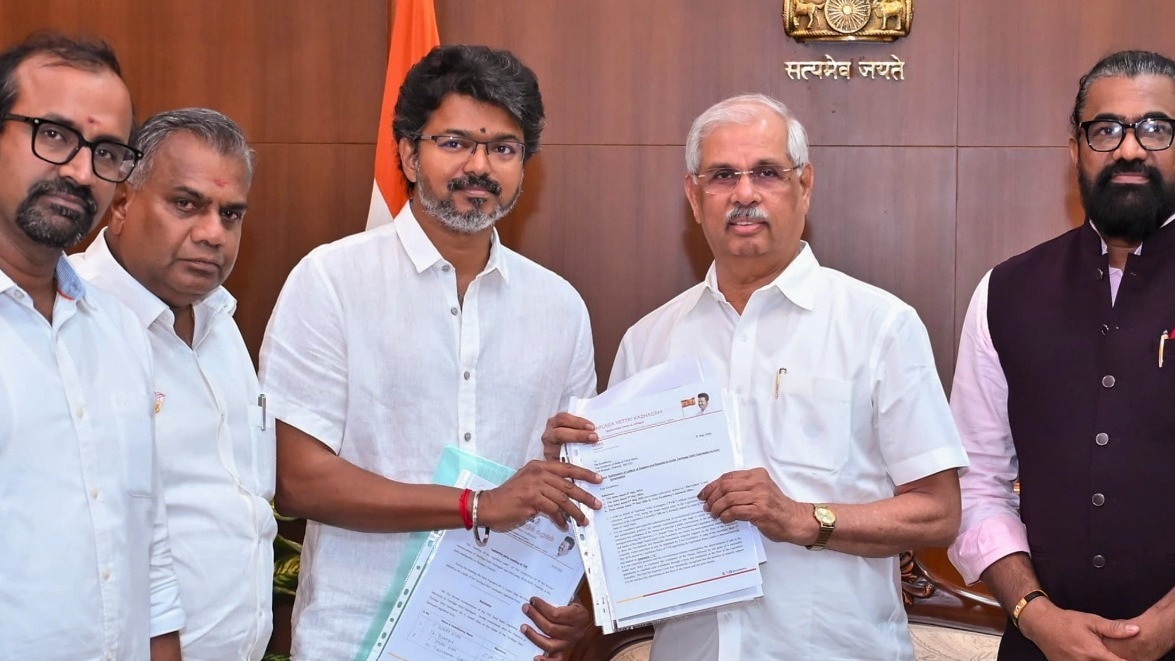
Tamil Nadu New CM: TVK Vijay Oath Ceremony Schedule
Vijay, chief of the Tamilaga Vettri Kazhagam (TVK), is preparing to take the oath as the Chief Minister of Tamil Nadu. While the ceremony marks a historic political shift, the administration’s stability remains precarious as the VCK decides its support and the IUML maintains its alliance with Stalin.
The atmosphere in Chennai is one of electric anticipation mixed with deep-seated anxiety. For the first time in years, the traditional Dravidian political binary has been disrupted by a force that blends cinematic charisma with a grassroots populist surge. But as any veteran of South Indian politics knows, the distance between winning an election and successfully governing a state is measured in the fragile loyalty of coalition partners.
The immediate crisis is a mathematical one. The TVK has emerged as a dominant force, yet the finality of their power depends on the alignment of smaller, strategic parties. The Viduthalai Chiruthaigal Katchi (VCK) currently holds the balance of power, with their decision on support expected imminently. Simultaneously, the Indian Union Muslim League (IUML) has signaled its continued allegiance to the leadership of M.K. Stalin, creating a fractured legislative landscape that could lead to early instability.
The High Stakes of Coalition Calculus
In a parliamentary system, the oath of office is a symbol, but the support letter is the actual currency of power. The hesitation of the VCK is not merely about policy; We see about the leverage they can exert over the new administration’s social agenda. If the VCK chooses to withhold support or demands significant concessions, the TVK may find itself leading a government that is perpetually one disagreement away from a collapse.
This uncertainty creates a vacuum in administrative continuity. When a government’s survival is questioned before the first cabinet meeting, the bureaucracy tends to freeze. Civil servants often hesitate to sign off on major infrastructure projects or policy shifts until the power structure is solidified.

“The transition from a populist cinematic image to the rigid demands of administrative governance is the steepest climb any leader in Chennai faces. The real test for the TVK will not be the oath ceremony, but the first ninety days of legislative negotiation.”
This volatility doesn’t just affect the halls of the Secretariat; it ripples through the state’s economic hubs. From the industrial belts of Coimbatore to the tech corridors of Chennai, investors are watching the VCK and IUML dynamics closely. A government that spends its first month fighting for survival is a government that cannot effectively implement the Tamil Nadu state development goals.
The Cinema-to-Statehouse Pipeline
Tamil Nadu has a long, storied history of actors transitioning into political titans. The state’s political identity is inextricably linked to the silver screen, where the image of the “savior” or the “champion of the poor” is cultivated long before a single ballot is cast. Vijay’s ascent is the latest iteration of this phenomenon, but it arrives in a more fragmented digital age.
Unlike previous eras, the current political climate is defined by hyper-localized demands and a more scrutinizing electorate. The TVK isn’t just fighting against the DMK or AIADMK; they are fighting the expectation of perfection that comes with cinematic stardom. The challenge for Vijay will be translating “screen presence” into “policy presence.”
For the business community, this transition introduces a layer of unpredictability. New leaders often bring new priorities, which can mean a sudden shift in land-use laws, labor regulations, or environmental mandates. Navigating these shifts is a logistical minefield. Many corporate entities are currently consulting constitutional law experts to ensure their current contracts remain valid under a potentially radical new administration.
Regional Economic Implications and Administrative Risk
The shift in power comes at a critical juncture for Tamil Nadu’s industrial growth. As the state competes for global semiconductor investments and electric vehicle manufacturing, political stability is a primary metric for foreign direct investment. If the TVK-led government is perceived as unstable due to the VCK’s indecision or the IUML’s opposition, it could dampen the enthusiasm of international stakeholders.
the friction between the IUML and the new administration could complicate urban governance in regions where the league holds significant influence. Municipal laws and local infrastructure projects often require a degree of cross-party consensus to avoid stalling in the courts.
To mitigate these risks, regional enterprises are increasingly turning to government relations consultants to bridge the communication gap between the old guard and the new TVK leadership. The goal is simple: ensure that the machinery of the state continues to move even while the political gears are grinding.
The Immediate Path Forward
- The VCK Decision: The most critical short-term variable. Their support provides the cushion needed for a stable legislative term.
- The IUML Stance: While they remain with Stalin, their role as a persistent opposition bloc will force the TVK to negotiate on minority rights and urban development.
- Bureaucratic Alignment: The need for the new CM to quickly win over the state’s administrative machinery to avoid a policy deadlock.
As the state looks toward the swearing-in, the legalities of government formation will be scrutinized by the Election Commission of India and the Governor’s office. Any perceived irregularity in the claim to form the government could lead to a protracted legal battle in the High Court, further delaying the state’s progress.

The current instability is a reminder that in politics, as in business, the transition period is the most dangerous phase. Companies operating in the region are now prioritizing risk management firms to shield their assets from the potential fallout of a coalition collapse.
The rise of the TVK is more than just a news story; it is a case study in the evolution of democratic mandates. Whether Vijay can transform a wave of popularity into a sustainable governing structure remains to be seen. However, one thing is certain: the period of “business as usual” in Tamil Nadu has ended. For those navigating this new era, the only safeguard is professional, verified guidance. Whether you need to interpret new legislative mandates or secure your operational footprint, the World Today News Directory remains the definitive resource for connecting with the legal and strategic professionals equipped to handle this unfolding political transformation.