

Parliamentary Chairman Demands Prime Minister’s Exit
Coalition Faces Reckoning as Skvernel Issues Ultimatum
Parliamentary Chairman Saulius Skvernelis has delivered a stark ultimatum, declaring he can no longer work within the current government under Prime Minister Gintautas Paluck. The move signals a deepening crisis within the ruling coalition, with Skvernelis warning that his party, the Democrats, will abandon ship if Paluck, embroiled in scandal, remains in power.
“We Will Not Be There”
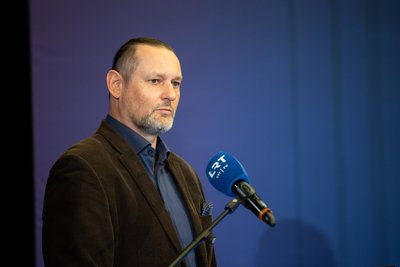
Addressing the press, Skvernelis reiterated his position, stating, “If something did not hear the knowledge we said a week ago – some coalition partners are not all with perception – so they had to repeat it today.”
He unequivocally asserted that the Prime Minister’s continued tenure is no longer tenable for his faction.
Political analyst Mažvydas Jastramski emphasized the gravity of Skvernelis‘s declarations. “There are other signs – not just S. Skvernel’s statements. For example, Giedrimas Jeglinskas’ comments about defense lately. There is a total image that they are dissatisfied and want to change something in the coalition,”
Jastramski observed, highlighting a broader discontent.
Navigating Political Minefields: Potential Coalition Shifts
Jastramski outlined five potential outcomes for the government’s survival:
- If Paluck stays, the Democrats depart, leaving the Social Democrats and the “Nemunas Dawn” party with a slim majority.
- Should Paluck resign, the “Nemunas Dawn” could exit, making way for the Peasants party, potentially forming a coalition of 74-77 mandates, contingent on support from Polish representatives.
- With Paluck‘s departure, the Democrats could leave, and the Peasants join, creating a bloc of 79-82 mandates.
- The current coalition could persist with 85 mandates, though doubts remain about the “Nemunas Dawn’s” allegiance.
- The least probable scenario involves a minority government without the “Nemunas Dawn,” holding 66 mandates, possibly with support from the Peasants.
Presidential Prudence Amidst Uncertainty
The Presidency appears to be adopting a strategy of cautious observation, avoiding direct calls for resignation. Jastramski believes the administration hopes the situation will resolve organically, a outcome most beneficial to the President. “I think she thinks the situation will be resolved by itself. Those creeping on the Democrats are very serious steps, that it can be resolved by itself, which is the most beneficial scenario for the President,”
he explained.
A voluntary resignation by Paluck, perhaps citing the ongoing pressure and its impact on governance, is seen as a plausible resolution that would avoid an explicit no-confidence vote. This would allow the Prime Minister to frame his departure as a move to protect his party and the nation.
“Va Banque” Politics: Skvernel’s High-Stakes Gamble
Professor Mindaugas Jurkynas of Vytautas Magnus University views Skvernelis‘s current stance as a high-stakes gamble. “If we look at arithmetic, if Prime Minister Paluck does not retreat, and S. Skvernel Democrats are shrinking, the arithmetic majority is enough. If the ‘Dawn of the Nemunas’ and its faction supports the premiere as there will be a vote of confidence, Skvernel is politically playing ‘VA Banque’ and saying that it is retreating, may remain in opposition and the government may remain,”
Jurkynas stated.
Jurkynas noted that both the Social Democrats’ Presidium and the “Nemunas Dawn” have publicly backed the government’s stability. However, he pointed out that the President’s position hinges on the outcomes of investigations by law enforcement agencies, emphasizing a commitment to the presumption of innocence.
He further elaborated on the criteria for evaluating politicians: legal compliance, adherence to campaign promises, ideological consistency, and moral standing. While legal transgressions are clear-cut, moral assessments can vary widely in a pluralistic society, leaving the final judgment to the electorate.
Presidential Power: Constitutional Constraints
Jurkynas underscored that the President’s power to dismiss a Prime Minister is constitutionally limited, particularly when a parliamentary majority supports the incumbent government. “According to the constitutional framework, we are a more parliamentary state with certain features of semi-presidency. If the majority of the Seimas stands in the masonry for their premiere and the Government’s activities, no president will move it. Much,”
he explained.
Unlike past presidents with strong party backing, the current President lacks such direct parliamentary support, significantly curtailing their ability to influence government changes. Jurkynas, while lacking internal party knowledge, noted the Social Democrats’ public commitment to Paluck, as demonstrated in recent party meetings.
Uncertainty Clouds Paluck’s Future
Associate professor Ignas Kalpokas expressed caution regarding Paluck‘s prospects, highlighting numerous unknowns. “When you look at the public statements of the Social Democrats, it is like repeating keywords such as ‘stability.’ But the game is very interesting,”
Kalpokas remarked.
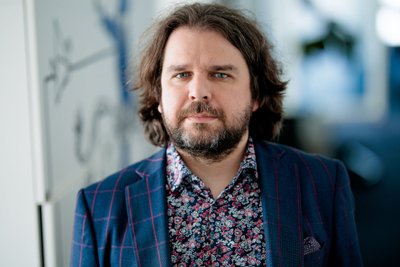
He suggested that Skvernelis‘s demands extend beyond replacing the Prime Minister, aiming to exclude the “Nemunas Dawn” from the coalition entirely, a move that presents significant mathematical challenges for forming a stable government. “Equally, if the Presidency and the Social Democrats stubbornly to preserve G. Paluck, R. Žemaitaitis obviously supports it, it would not be a painful thing to throw Skvernel from the coalition,” Kalpokas speculated.
The possibility of behind-the-scenes agreements, perhaps involving Skvernelis and factions within the Social Democratic Party, cannot be discounted. Kalpokas also indicated that the Presidential team might be considering alternative strategies, potentially involving figures like J. Olekas. The feasibility of removing the “Nemunas Dawn” remains a significant hurdle, potentially requiring complex negotiations with parties like the Peasants.
Democrats might be calculating that the political cost of remaining allied with Paluck outweighs demonstrating principled opposition by withdrawing from the ruling coalition.
Shifting Alliances and Ministry Maneuvers
Beyond J. Olekas, other political figures appear to be capitalizing on the shifting dynamics. Kalpokas noted that J. Jeglinskas is actively positioning himself, suggesting a potential cabinet reshuffle where he could assume the role of Minister of National Defense. Similarly, D. Šakalienė is reportedly pursuing her objectives.
Paluck, seemingly entrenched in his position, may attempt to delay any decisive action. “Paluck, whatever in his letter to the party, is very entangled in the chair,”
Kalpokas observed, acknowledging the personal and career investment involved. The Prime Minister’s recently renovated residence, valued at €200,000, further underscores his reluctance to depart abruptly.
A symbolic vote of confidence in the Seimas after the holidays is a possibility, though Paluck may find it increasingly difficult to deflect criticism with abstract arguments as public scrutiny intensifies over financial matters and alleged improprieties.