Skip to content
World Today News
  • Home
  • News
  • World
  • Sport
  • Entertainment
  • Business
  • Health
  • Technology
World Today News
  • Home
  • News
  • World
  • Sport
  • Entertainment
  • Business
  • Health
  • Technology
Thursday, March 5, 2026
World Today News
World Today News
  • Home
  • News
  • World
  • Sport
  • Entertainment
  • Business
  • Health
  • Technology
Copyright 2021 - All Right Reserved
Home » Home care/HCBS
Tag:

Home care/HCBS

Health

Medicaid Home Care Fraud: Risks, Safeguards & New Spending Data

by Dr. Michael Lee – Health Editor March 1, 2026
written by Dr. Michael Lee – Health Editor

The Trump administration is temporarily halting some Medicaid funding to Minnesota, citing concerns over fraud, Vice President JD Vance announced Wednesday. The move, which will initially withhold at least $515 million each quarter, marks a significant escalation in the administration’s scrutiny of state Medicaid programs and a departure from previous federal practices.

Vance, speaking alongside Administrator for the Centers for Medicare & Medicaid Services (CMS) Dr. Mehmet Oz, described the action as part of an “aggressive crackdown on misuse of public funds.” The administration alleges non-compliance with federal requirements designed to prevent fraud, waste and abuse within Minnesota’s Medicaid program.

The concerns center on alleged fraud within Minnesota’s Medicaid home care programs, which provide assistance with daily living activities to older adults and people with disabilities. These programs have grown significantly in recent years, with over 5 million people nationally now utilizing Medicaid home care, according to estimates from the Kaiser Family Foundation (KFF). The administration’s focus on home care reflects a broader concern about potential vulnerabilities in this sector, where services are delivered in private homes to individuals who may be less able to advocate for themselves.

CMS issued a letter to Minnesota Governor Tim Waltz on February 14, 2026, outlining the alleged deficiencies and initiating the funding pause. The agency rejected an initial corrective action plan submitted by the state within a week, and Minnesota is currently appealing that decision even as submitting a revised plan on January 30, 2026.

Minnesota has taken steps to address the alleged fraud, including terminating its Housing Stabilization Services program, auditing autism services providers, adding new licensure requirements for autism centers, and pausing admissions of new providers into 13 high-risk Medicaid services. The state is also enhancing its review of claims using data analytics and artificial intelligence, increasing training for providers and employees, and increasing oversight of Medicaid managed care organizations.

Historically, CMS has addressed Medicaid fraud through claim disallowances and collaborative efforts with states to recoup funds. This new “compliance process,” however, allows the agency to withhold future payments based on a determination of “failure to comply substantially” with federal requirements – a shift that effectively penalizes states in anticipation of future fraudulent activity.

The Trump administration’s actions come as Medicaid faces renewed scrutiny regarding its long-term financial sustainability. House Budget Committee Chair Jodey Arrington (R-Texas) has stated that major changes to federal entitlement programs, including Medicaid, are necessary to address the national debt. The administration has also signaled an interest in revisiting policies related to Medicaid waivers, potentially encouraging states to adopt work requirements and other eligibility restrictions, as was the case during Trump’s first term.

A recent KFF analysis highlighted that Medicaid long-term care has shifted dramatically from institutional settings to home-based care. In 1981, home care accounted for just 1% of all long-term care spending; by 2023, it had risen to 64%. This shift reflects both consumer preferences and the impact of the 1999 Supreme Court ruling in Olmstead v. L.C., which affirmed the right of individuals with disabilities to receive care in the most integrated setting appropriate to their needs.

CMS released a new dataset on February 14, 2026, containing provider-level spending data intended to help identify unusual billing patterns. While the agency highlighted personal care as the top procedure in terms of spending, the data’s limitations – including the omission of institutional records and prescription drug costs – could lead to inaccurate conclusions, according to KFF.

Minnesota is appealing CMS’ decision and awaits a response to its revised corrective action plan.

March 1, 2026 0 comments
0 FacebookTwitterPinterestEmail
Health

CMS Releases Medicaid Spending Data: What Providers Need to Know

by Dr. Michael Lee – Health Editor February 21, 2026
written by Dr. Michael Lee – Health Editor

The Centers for Medicare & Medicaid Services (CMS) released a dataset on February 14, 2026, containing provider-level spending data for Medicaid services, intended to help identify potential fraud, waste, and abuse. The release follows a November 2024 comprehensive plan outlining CMS’s strategy for Medicaid integrity through fiscal year 2028, and builds on efforts dating back to 2010 with the establishment of the Center for Program Integrity (CPI).

The dataset includes information on services rendered between 2018 and 2024, encompassing both fee-for-service claims and those processed through Medicaid managed care organizations. Specifically, the data provides the National Provider Identifier (NPI) for both the billing and servicing provider, the Healthcare Common Procedure Coding System (HCPCS) code for the service, the month and year the service was provided, the number of beneficiaries seen, the number of procedures delivered, and the total amount paid.

However, the dataset excludes significant portions of Medicaid spending, notably institutional care and prescription drug costs. Hospital care alone accounts for 37% of total Medicaid expenditures, making its omission a substantial limitation. The data lack crucial contextual information necessary for a comprehensive assessment of spending patterns. This includes enrollment numbers, benefit designs, state-specific payment rates, and diagnoses associated with the procedures. The absence of place of service information – whether a service was delivered in-person or remotely – and other modifiers further restricts the data’s analytical utility.

CMS acknowledges the potential for misinterpretation when using the data in isolation. A key concern highlighted by the agency is the varying granularity of procedure codes. For example, the code used for “personal care” encompasses a wide range of service durations, from 15 minutes to a full day, while codes for psychotherapy are more precisely defined by visit length (30, 45, or 60 minutes). This inconsistency can skew comparisons between different service categories. Without including institutional spending, personal care appears as the largest spending category in CMS’s example, a result that would change with a more complete dataset.

Another challenge lies in the comparability of providers. The data include individual practitioners as well as large organizations like state and local government agencies. In CMS’s illustrative analysis, ten of the twenty largest “providers” were identified as state or local government entities that both administer and directly deliver Medicaid benefits, particularly for behavioral health and developmental disabilities. Variations in how states structure their Medicaid delivery systems further complicate comparisons.

The quality of the underlying data, sourced from the Transformed Medicaid Statistical Information System (T-MSIS), similarly presents a concern. CMS maintains a “data quality atlas” to identify potential issues, and the agency’s own reporting indicates data quality concerns in several states. Specifically, CMS reported in 2024 that six states had unusable spending data, and an additional sixteen states had data of “high concern.” It remains unclear how these data quality issues were addressed in the publicly released dataset.

The release of this data also occurs against a backdrop of significant changes to Medicaid enrollment and service utilization driven by the COVID-19 pandemic. The continuous enrollment period initiated during the pandemic led to increased enrollment, while heightened awareness of behavioral health and long-term care needs drove increased demand for those services. Changes in state policies regarding coverage, eligibility, and provider payment rates further influenced spending patterns between 2018, and 2024.

CMS has not yet announced a specific timeline for follow-up analysis or enforcement actions based on the released data. The agency continues to collaborate with states on program integrity efforts, as outlined in the November 2024 plan, and offers training through the Medicaid Integrity Institute.

February 21, 2026 0 comments
0 FacebookTwitterPinterestEmail
Health

Medicaid 2026: Coverage, Financing, and Access Challenges Ahead

by Dr. Michael Lee – Health Editor February 1, 2026
written by Dr. Michael Lee – Health Editor

Here’s a breakdown of the ⁤key ‍points from the ‍provided ⁢text,focusing on potential​ impacts to Medicaid access⁤ in rural‌ areas:

1. Funding Cuts⁢ & ​Mitigation:

* ⁢ Medicaid funding Cuts: Meaningful Medicaid funding cuts are expected over the next decade.
* Rural Funding Influx: A⁤ temporary influx of funding from the ⁤Rural Health transformation Program‌ may offer short-term relief,but ‌won’t fully offset⁢ the cuts.
* ‌ “Optional” Services​ at⁤ Risk: Restrictions on coverage of “optional” ⁣Medicaid services (like behavioral health and‌ home care) ⁢are likely, perhaps limiting⁣ care for ​those with ​complex ⁣needs.
* Home Care notably Vulnerable: Home care services ​are especially susceptible to cuts‌ due to existing spending ⁣management tools (caps on spending/enrollment).

2. 1115 Medicaid Exhibition Waivers:

* Administrative influence: The administration (currently Trump) can considerably⁢ shape Medicaid access through ⁣its‍ approval or rejection ‌of 1115 waivers. These ⁤waivers allow states to ⁣test‌ new Medicaid approaches.
* Shifting ‌Priorities: ⁣ Waiver ​priorities change with each administration.​ The Trump⁢ administration has:
⁢⁣ * Rescinded Biden-era‍ guidance on covering health-related social needs (HRSN).
* Indicated plans to phase out certain waiver financing tools (DSHP).
* Notified states⁤ it ​won’t approve/extend⁣ waivers with continuous eligibility provisions ⁤or workforce initiatives.
* Budget ⁤Neutrality Requirement: ⁣A ​new provision⁤ requires waivers to be⁤ “budget-neutral” (not ‍increase federal ‌spending compared⁤ to without the‍ waiver),a long-standing policy but with​ potentially stricter enforcement.

3. Workforce & Immigration:

* Workforce Challenges: Access to care will be further strained by ⁢workforce challenges linked to ⁣reimbursement rates and changes in immigration policy.
* Immigration ⁢Policy Impact: Changes in immigration policy could exacerbate healthcare employment shortages.

In essence, ​the text paints a picture⁤ of potential challenges ​to Medicaid access, particularly in rural⁣ areas, due to a combination of⁤ funding cuts, shifting administrative priorities⁤ regarding waivers, ⁣and workforce/immigration⁤ concerns.

February 1, 2026 0 comments
0 FacebookTwitterPinterestEmail
Health

FY 2027 State Budgets: Medicaid Funding Cuts and Policy Shifts

by Dr. Michael Lee – Health Editor January 31, 2026
written by Dr. Michael Lee – Health Editor

summary of Medicaid Budget Trends & Future Outlook (FY 2026 & 2027)

This text details a shift in Medicaid policy, moving from expansion and streamlining to potential restrictions and increased administrative burdens. Here’s a breakdown:

FY 2026 Trends:

* Initial Progress: Prior to FY 2026, states focused on improving member dialog and reducing administrative hurdles.
* Budget-Driven Restrictions: Tighter state budgets led to some states implementing eligibility restrictions. Examples include:
* California: Reinstated asset limits for long-term care Medi-Cal eligibility.
* D.C.: Lowered Medicaid income limits for certain enrollees.
* Various States: rolled back state-funded coverage for immigrants.
* Project Delays: Uncertainty at the federal level caused some states to cancel or postpone Medicaid projects, including those related to federal waiver policies (like pre-release coverage and continuous enrollment for children).

FY 2027 Outlook:

* Continued Restriction Consideration: Upcoming budget debates are likely to include consideration of further Medicaid eligibility restrictions to address state budget challenges.
* Implementation of 2025 Reconciliation Law: States will begin implementing changes from the 2025 reconciliation law, which will:
* Pause Streamlining Efforts: Halt implementation of provisions from the Biden-era “Eligibility and Enrollment” Final Rule designed to simplify processes.
* Restrict Immigrant Eligibility: Limit Medicaid coverage for certain immigrants.
* Increase Redeterminations: Conduct more frequent eligibility checks for adults covered under the ACA expansion.
* Introduce Work Requirements: Implement Medicaid work requirements for ACA expansion adults.
* Implementation Challenges: These changes will require significant overhauls of state eligibility systems, potentially diverting resources from other Medicaid priorities.
* Potential for Further Cuts: Increased implementation costs, combined with budget pressures and potential federal funding cuts, could lead more states to restrict coverage for optional eligibility groups. (Example: Idaho considering repealing Medicaid expansion).

In essence, the trend is shifting from expanding access to potentially shrinking it, driven by state budget concerns and new federal policies.

January 31, 2026 0 comments
0 FacebookTwitterPinterestEmail
Health

Medicaid Home Care Payment Rates and Workforce Shortages Ahead of the 2025 Reconciliation Law

by Dr. Michael Lee – Health Editor January 14, 2026
written by Dr. Michael Lee – Health Editor

Long-standing workforce challenges in Medicaid home care (also known as home- and community-based services or HCBS) impact care for the over 5 million people who use these services. Shortages and high turnover rates among the direct care workforce reflect demanding work and low wages, particularly among home care workers (who are direct care workers that provide HCBS). This issue brief describes states’ ongoing efforts to respond to shortages of home care workers and how they pay these workers, finding that increased payment rates are a key component of states’ efforts to address workforce shortages.

Such shortages could increase as states will face tough choices about how to absorb Medicaid cuts stemming from the 2025 reconciliation law, which is estimated to reduce federal Medicaid spending by $911 billion over the next decade. When faced with fiscal pressures in the past, states have responded with restrictions on home care, and as a result of the reconciliation law, states may again face significant pressures to cut Medicaid payment rates, offer fewer covered benefits, or restrict eligibility. The Medicaid cuts could also affect access to health coverage among home care workers because over one-in-three workers in home care settings are enrolled in Medicaid. Reduced access to health coverage among the workforce could exacerbate other challenges.

Workforce challenges may also worsen in future years because of changes in immigration policy. Nearly one-in-three home care workers are immigrants, and the Trump Administration’s intensified immigration enforcement and restrictive policies are deepening anxiety and fear among immigrants of all statuses. KFF survey data finds that 13% of immigrants have avoided going to work since January 2025 because of concerns about drawing attention to someone’s immigration status, a number which rises to 40% among people who are likely to be undocumented immigrants. Fewer immigrants overall and potentially lower rates of employment among immigrants could reduce the size of the home care workforce. With more limited immigration, there will be fewer workers overall to care for an aging population.

Amidst this evolving landscape, this issue brief describes Medicaid payment rates for home care and other workforce supports that are in place in 2025, before the majority of the 2025 reconciliation law provisions start taking effect. This issue brief is one of several reporting the data from the 23rd KFF survey of officials administering Medicaid home care programs in all 50 states and the District of Columbia (hereafter referred to as a state), which states completed between April and July 2025. The survey was sent to each state official responsible for overseeing home care benefits (including home health, personal care, and waiver services for specific populations such as people with physical disabilities). All states except Florida responded to the 2025 survey, but response rates for certain questions were lower. States generally completed the survey prior to enactment of the 2025 reconciliation law. Survey findings are reported by state and waiver target population, although states often offer multiple waivers for a given target population. Key takeaways include:

  • All responding states reported taking actions to address workforce shortages, with most states raising payment rates (Figure 1).
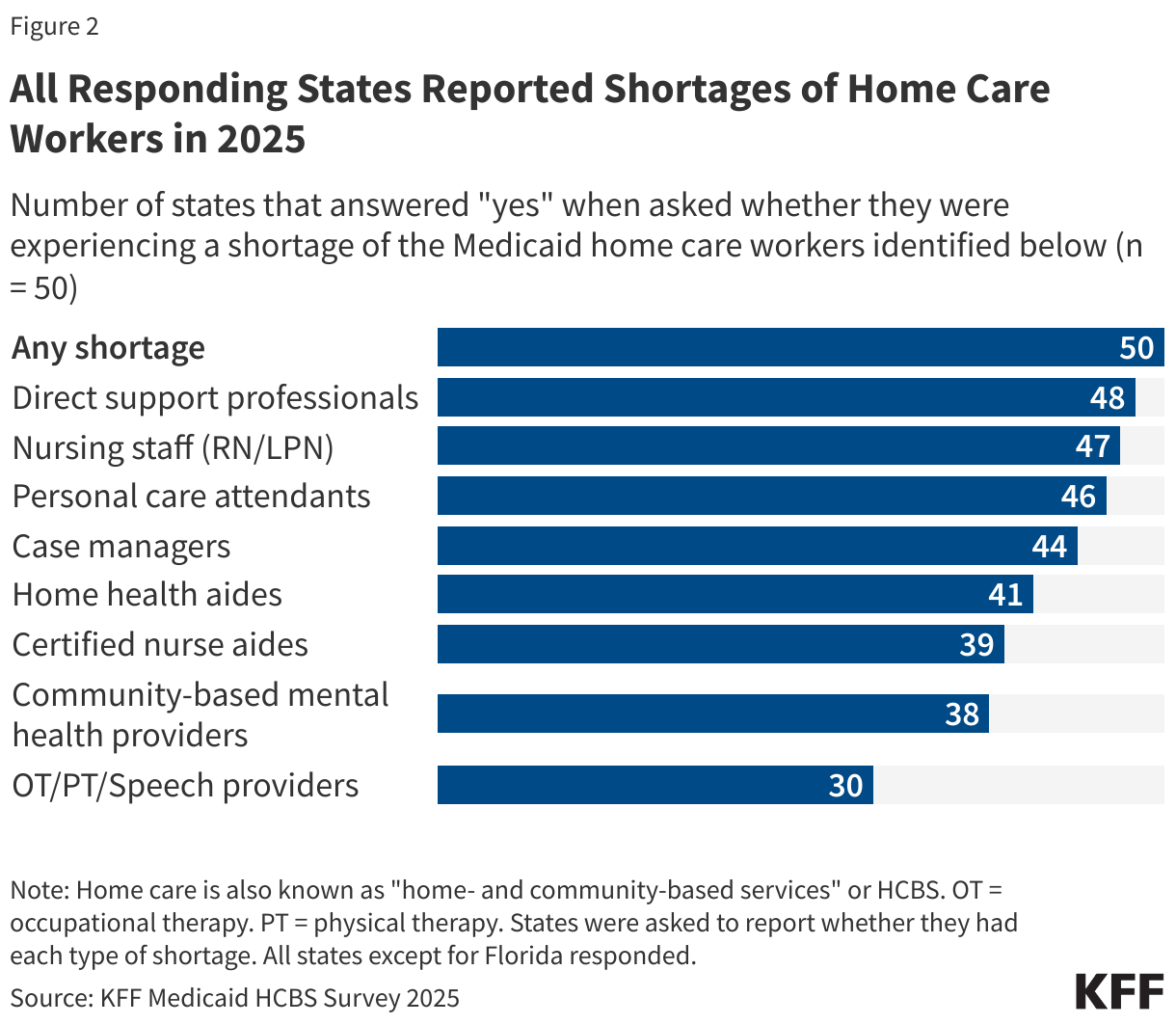
  • All states reported shortages of home care workers, most frequently among direct support professionals, nursing staff, personal care attendants, and case managers.
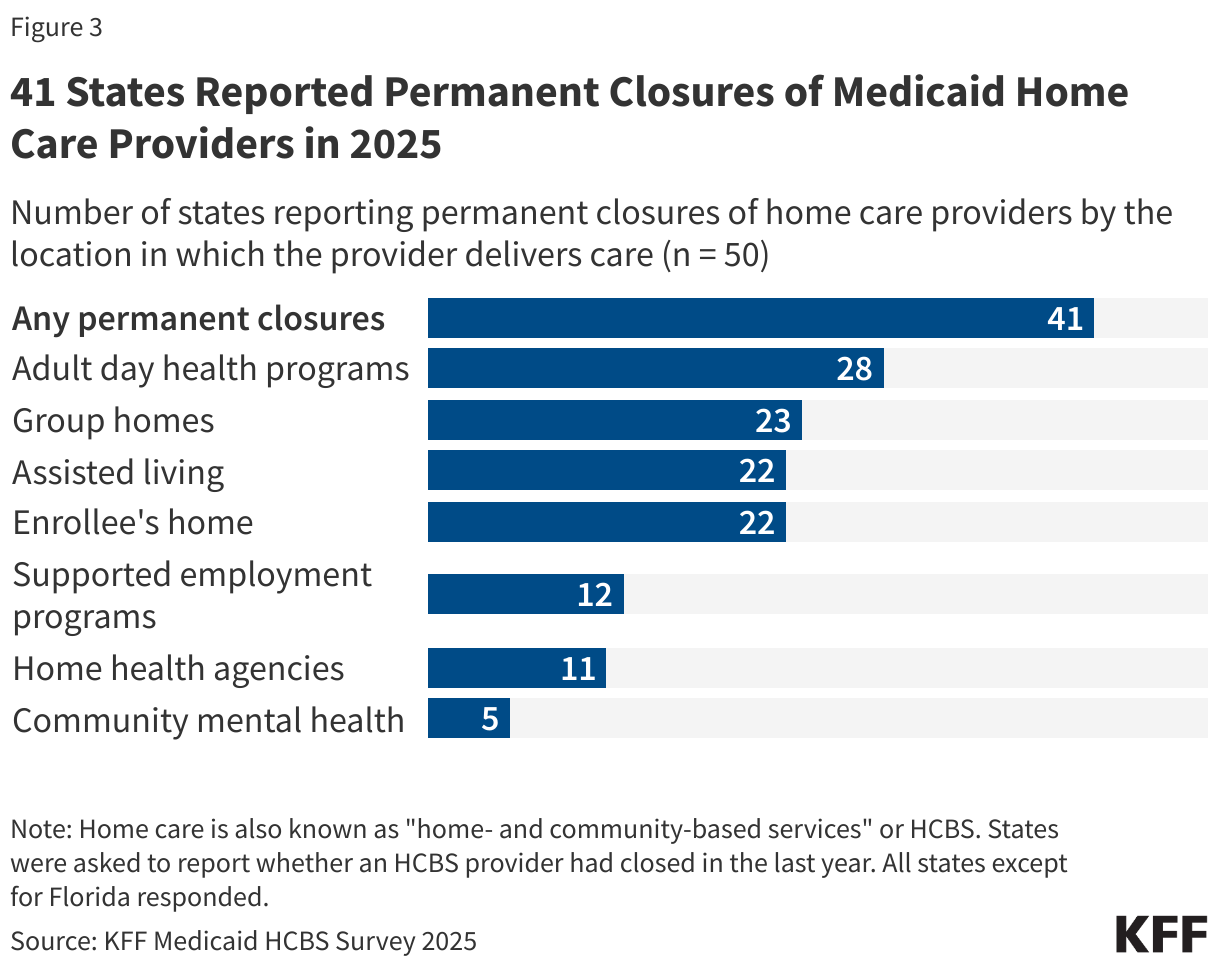
  • Most (41) states reported permanent closures of home care providers within the last year.
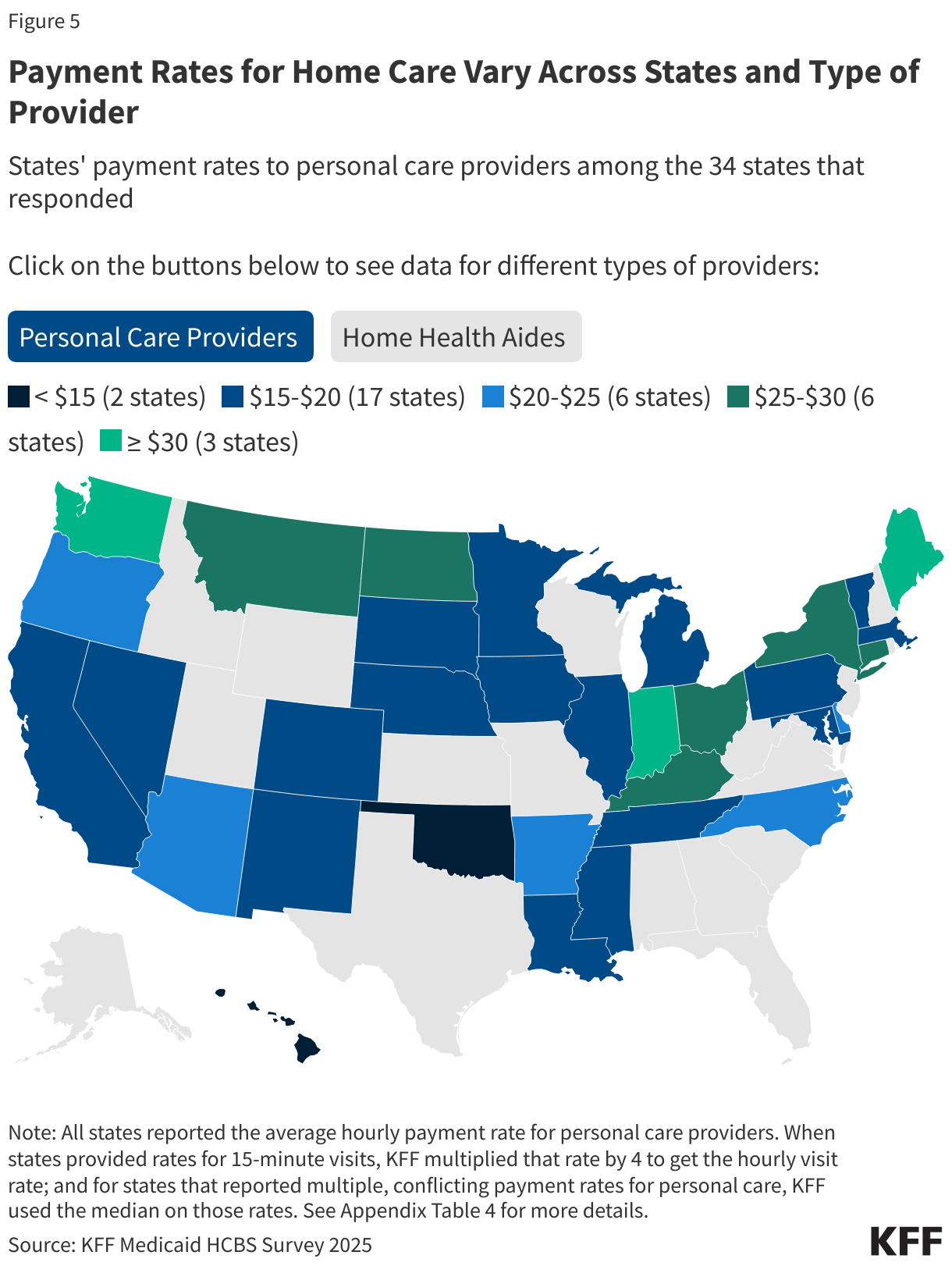
  • Among the 34 states that reported time-based payment rates for personal care providers, more than half pay less than $20 per hour.

How are States Addressing the Workforce Challenges in Home Care?

All responding states reported workforce shortages in 2025, with the most common shortages being among direct support professionals (48 states), followed by nursing staff (47 states) and personal care attendants (46 states) (Figure 2, Appendix Table 2). States were asked if they had shortages of each type of provider but were not provided with a definition of “shortage.” Most states also reported shortages in case managers (44 states), home health aides (41 states), certified nurse aides (39 states), community-based mental health providers (38 states), and occupational, physical, and speech therapy providers (30 states). In some cases, states may not have reported a shortage of a particular type of provider because that type of service is not offered through their home care program.

Medicaid Home Care Payment Rates and Workforce Shortages Ahead of the 2025 Reconciliation Law

All states reported shortages for more than one type of provider, and 43 states reported shortages among five or more provider types. Such shortages may reflect low compensation coupled with demanding working conditions. In the spring of 2024, home care providers participating in KFF focus groups reported that their jobs had high physical demands and mental demands that were often “overwhelming.” The groups described their wages as low, particularly given the demands of their jobs; and how staffing shortages made their jobs harder because they may not know if they would be able to leave work at the end of their shift. In survey responses, states attributed shortages to low reimbursement rates, lack of qualified providers, and high turnover rates.

Within the last year, 41 states reported permanent closures of home care providers, which were most common among adult day health programs (28 states), followed by group homes (23 states), assisted living facilities, and the enrollee’s home (22 states each) (Figure 3, Appendix Table 3). States were asked if there were any permanent closures of providers that offer services for Medicaid enrollees based on the location in which the providers deliver care. For a setting such as an assisted living facility or group home, a closure could reflect either the closure of an assisted living facility or the closure of a home care agency that sent workers into facilities and group homes. States were not asked to provide a reason for the closures. Some states reported closures of supported employment providers (12 states), home health agencies (11 states), and community mental health providers (5 states). Most states reported closures among more than one type of provider: 35 states reported closures among two or more provider types, and 26 states reported closures among three or more provider types.

41 States Reported Permanent Closures of Medicaid Home Care Providers in 2025

All responding states reported taking actions to address provider shortages, with 48 states increasing payment rates, 38 states developing or expanding worker education and training programs, and 24 states offering incentive payments to recruit or retain workers (Figure 1, Appendix Table 1). Less common initiatives included establishing or raising the state minimum wage (20 states), offering worker retention bonuses (20 states), and offering paid sick leave for workers (18 states). States also reported other types of initiatives to strengthen the workforce, including initiatives allowing people to receive paid care from family members. For example, Oregon created a new 1915(c) waiver that allows parents of minor children to be paid for providing attendant care to their child. States’ actions to address provider shortages in 2025 were similar to those in 2024.

All but 11 states use managed care to provide at least some home care, and in over half of the states with managed care, fee-for-service payment rates impact the payment rates that managed care plans pay home care providers. Out of the 39 states that use managed care to provide at least some home care, 20 states reported that the fee-for-service payment rates represent the minimum amount that plans must pay providers, 2 states, Michigan and Wisconsin, reported that the rate represents the maximum payment rate for managed care plans, 11 states reported that the fee-for-service rates do not affect payments by private plans, and 6 states responded that the answer was unknown or did not respond to the question.

How Much do States Pay for Medicaid Home Care?

KFF asked states to report their average hourly rate paid to two types of home care provider agencies (personal care agencies and home health agencies) and three types of specific home care providers (personal care providers, home health aides, and registered nurses), but many states were unable to report all rates (Appendix Table 4). The number of states that responded to the survey but did not provide hourly payment rates or reported that payment rates were unknown was 4 for personal care agencies and 32 for home health agencies. Many states also did not provide payment rates for specific provider types: For registered nurses and home health aides, more than half of states did not provide hourly payment rate information or reported that payment rates were unknown.

Starting July 2026, states are required to report detailed payment rates for personal care, home health, and other services, per the provisions of the Biden Administration final Access rule (see Box 1). In addition to reporting payment rates for certain home care services, starting in 2030, states must demonstrate that at least 80% of the payments went to compensation for providers, also described as “direct care workers.” Meeting that requirement will require states to know both agency and provider payment rates. Among the states that were able to report payment rates, only 15 could report payment rates for personal care agencies, home health agencies, personal care providers, and home health aides, all of which would be required under the rule. Those 15 states include states that reported a mix of hourly and non-hourly rates, which makes comparisons between provider and agency rates more complicated. These challenges highlight the difficulties states face as they implement the requirements in the new rule, which will take effect in July 2026 (Box 1).

Box 1: Biden Administration Final Access Rule’s Provisions on Home Care

On May 10, 2024, the Biden Administration released a final rule aimed at helping to ensure access to Medicaid services, which has several notable provisions aimed at increasing transparency and improving access to Medicaid home care, increasing home care payment rates, and addressing home care workforce challenges. Although the 2025 reconciliation law delayed other Medicaid rules until 2034, it did not address the final rule on access to Medicaid services.

The rule cites workforce shortages as a major contributor to home care access barriers among Medicaid enrollees. To address those access barriers, the rule requires states to implement the following requirements. Some of the rules take effect as early as 2026, which means guidance to states about how to implement the requirements could emerge soon.

• Starting July 2026, states must report state hourly payment rates for personal care, homemaker services, home health aide services, and habilitation and publish that information on the state website. If states rates vary across provider types, geographies, or other factors, the states must report each of those rates.

• For each type of payment rate, the disclosures must also include the number of Medicaid paid claims and the number of Medicaid enrollees who received the service within the calendar year.

• States must establish an interested parties advisory group (IPAG) comprised of direct care workers, Medicaid enrollees and their representatives, and other interested parties. The IPAG will meet at least every two years to advise and consult on the sufficiency of current and proposed payment rates for personal care, homemaker services, home health aide services, and habilitation.

• Starting July 2030, states must ensure that at least 80% of payments to Medicaid providers for designated home care go directly to compensation for direct care workers. Designated home care include personal care, homemaker services, home health aide services, and habilitation. States may adopt separate standards for small providers or exempt small providers that meet reasonable criteria.

Beyond payment rates, the Access rule includes other requirements aimed at increasing access to home care. Starting July 2027, states will be required to report the number of people on waiting lists for services and the average amount of time from when homemaker services, home health aide services, or personal care services are initially approved to when services begin and the percentage of authorized hours that are provided. The proposed rule also includes provisions that would strengthen requirements around person-centered planning and needs assessment, create new requirements around incident management, establish requirements for people to file grievances if they are receiving home care from the state Medicaid program, and require states to report on nationally-standardized quality measures.

The home care payment-related requirements are one component of a broader emphasis on addressing Medicaid payment rates. The Access rule also requires states to report all fee-for-service Medicaid payment rates on state websites, and to compare various service-specific rates to those of Medicare. A companion rule on Medicaid managed care requires states to submit an annual payment analysis comparing managed care plans’ payment rates to Medicare payment rates for selected services.

States reported many reasons why it was difficult to report payment rates, including the following.

  • Some states reported that services were bundled together in various ways and therefore, the payment rates were not distinguishable.
  • Among states with managed care, some states responded that they did not know the payment rates for agencies because the services were paid for by managed care plans and they did not have access to those payment rates.
  • Other states responded that they knew the payment rates for agencies but not what the agencies paid their home care workers. Multiple states reported that they do not “dictate” what agencies pay to providers or that individual providers negotiate their own payment rates with the agencies.

In addition to having difficulty reporting payment rates, many states reported different payment rates for personal care across different waivers, and the waiver payment rates often differ from the payment rates for personal care provided through the state plan. When states reported multiple payment rates for personal care, KFF used the median of those payment rates in the analysis.

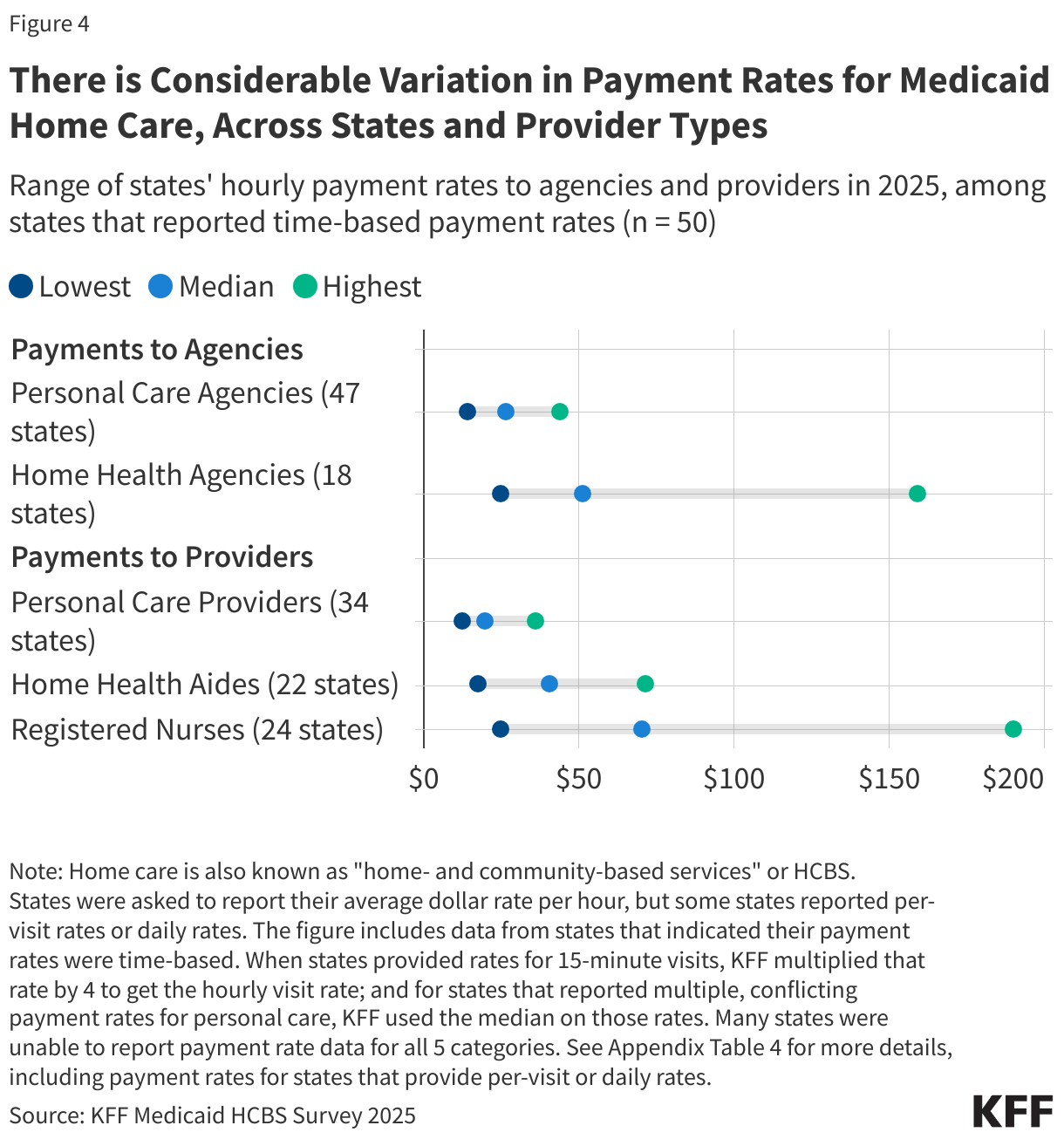
The payment rates to home care providers show considerable variation and are somewhat higher than those reported by other organizations on account of differences in reporting and provider categorization (Figure 4). KFF’s survey estimates that median payment rates to providers are $19 per hour for personal care providers, $41 for home health aides, and $70 for registered nurses. It is difficult to compare those numbers to other sources of data for the following reasons.

  • Other organizations group classes of providers together differently. PHI reports that in 2024, the median rate for home care workers was $17 per hour and $18 per hour for residential care aides. The Bureau of Labor Statistics reports $17 per hour for home health and personal care aides in 2024.
  • Other organizations include payment rates for workers regardless of the source of payment whereas KFF rates only reflect the Medicaid rates. Medicaid often covers more intensive personal care services than other payers, which may contribute to the higher rates.

Payment rates to home health agencies are generally larger than those to personal care agencies, but there is considerable variation in both (Figure 4). Among states reporting hourly rates, the rates for home health agencies range from $25 to $159 whereas those for personal care agencies range from $14 to $44. Those states reported that the median hourly payment to home health agencies was $51 and $26 for personal care agencies. Between 2024 and 2025, the median payment rates for personal care agencies and most other provider types increased marginally.

There is Considerable Variation in Payment Rates for Medicaid Home Care, Across States and Provider Types

Among states able to report any payment rate data, payments for personal care workers range from below $15 to over $30 per hour (Figure 5, Appendix Table 4). Rates for home health aides are somewhat higher than those of personal care workers, reflecting the additional training requirements for such workers. Among the states with payment rates for home health aides in the highest category, some states reported that the rates were per visit or per day (which is noted in Appendix Table 4). There were other states with particularly high payment rates that did not report providing rates per visit or per day, but the rates may still reflect a non-hourly payment basis.

Payment Rates for Home Care Vary Across States and Type of Provider

January 14, 2026 0 comments
0 FacebookTwitterPinterestEmail
Health

Medicaid Home Care 2025: State Waivers, Coverage, and Managed Care Trends

by Dr. Michael Lee – Health Editor January 14, 2026
written by Dr. Michael Lee – Health Editor

As the population ages and the number of individuals with disabilities continues to grow, ‍the demand ⁢for long-term care services is ⁣steadily increasing. Many older adults and people ‍with disabilities require assistance with essential‍ self-care tasks like bathing, dressing, and⁤ eating. This support, known as‌ “long-term care,”⁢ can be delivered in a variety of settings—from ​institutional ‌facilities such as nursing homes and assisted living⁤ facilities , to⁢ the comfort of one’s own home and​ within the community. Despite a common misconception—with⁣ four in ten adults ⁢ incorrectly⁢ believing ⁢Medicare‍ is the primary payer—Medicaid is, in‌ fact, the​ cornerstone of⁣ funding ‍for these vital services,⁢ covering nearly two-thirds of all home care spending in the United States as of 2023 .

Recent federal policy changes,especially the 2025 reconciliation law,are⁤ poised to ​substantially impact the landscape of Medicaid and,consequently,home care ⁣provision. This law is projected to ​reduce federal Medicaid ‌spending by approximately $911 billion (roughly 14%) over the next‌ decade . These cuts could have far-reaching implications for the home care workforce, ⁢support ⁣for family ‌caregivers, and the scope of​ services covered by state Medicaid programs . Considering that over⁢ half of all Medicaid⁤ spending already supports care for⁢ individuals 65 and older and those with disabilities—the very population most reliant on home ‌and community-based services—the proposed⁢ reductions present substantial challenges for states . The reconciliation law also ‌introduced​ a ‌new type of ‍1915(c) home ⁤care waiver for individuals who do not require the level of care provided in institutional settings. However, the uptake of these new waivers⁤ is expected to be limited ⁢due to the aforementioned funding cuts and requirements for ‌states to demonstrate that the ⁣waivers won’t⁣ lengthen existing wait times for services.​

this‌ article provides an⁢ overview of Medicaid home ⁢care—also referred to as “home-‌ and community-based services” (HCBS)—exploring who is covered, what services ⁣are ⁣available, and the critical ⁤changes occurring ⁢in the ⁢system as‍ of 2025.Data presented here ⁣is ⁢based on a extensive ​survey of state ‍officials ​conducted by the Kaiser Family Foundation (KFF),encompassing all 50 states ​and the District of ⁤Columbia between‍ April and July ‌2025 .Over 5.1 million people recieve Medicaid-covered home care services annually , ‍underscoring the pervasive need for these ⁤essential supports.

how Medicaid⁤ Home Care Works: A State-by-State Landscape

Unlike institutional long-term care, which states are required to cover, home care services⁢ are largely optional under Medicaid. ⁤ States are mandated to cover ⁣home health services—including⁣ part-time nursing, home health ​aide support,⁢ and⁣ necessary medical supplies—but the provision of other crucial​ services, ​such ‌as personal care, is at the ​discretion of each‌ state. States utilize various “authorities”—or programs—to deliver home⁤ care, generally categorized as falling under the Medicaid state plan or operating through waivers .Services included under the⁤ state plan must be universally available to eligible individuals,‍ while those offered ⁢through ‍waivers may be ‍restricted⁣ based on factors ⁣like ⁢geographic location, income, or type of disability.⁤ In instances where demand exceeds available resources, states frequently enough employ waiting lists to manage access to waiver⁤ programs.

Currently, all states⁤ have at least one home ⁣care program, ‍with ‌many operating multiple programs to cater to diverse needs. The most prevalent ⁣models are 1915(c) waivers (utilized in 47 states) and the personal‌ care benefit offered ‌through the state ​plan ‌(available in 33 states). 1115 waivers (employed in 15 ​states) and the Community First Choice option (present in 10 states, as⁣ of ⁤Figure‌ 1 in the source material) also ⁣play a role in the home care ecosystem. ‍ This demonstrates a growing shift towards home- and community-based ​services over traditional‍ institutional care;‌ in⁤ 2023, 5.1 million people utilized Medicaid home ⁣care, compared to 1.4 million in‌ institutional long-term care .

Eligibility for Medicaid Home Care

The primary pathway to Medicaid​ home care eligibility is ⁤based​ on either a disability ‌or age​ (65 or older). These “non-MAGI” ‌pathways—which ⁣don’t rely on⁤ Modified Adjusted Gross Income calculations—are‍ common⁣ for individuals ‍needing long-term support.Beyond age or disability, eligibility typically requires‌ meeting certain income and ⁤asset limitations . ​Most states allow for⁣ somewhat higher ⁤income thresholds, capping it at‌ 300% of the Supplemental Security Income (SSI) limit—equivalent to $2,901 per⁣ month ‍in 2025 —with asset‍ limits generally capped​ at $2,000 per person. To​ qualify, enrollees must also demonstrate a functional ⁤need for assistance with activities of daily living (ADLs), which include tasks like eating, bathing, and dressing. ‍A significant proportion of Medicaid home‌ care recipients—over half—are dually eligible⁣ for both Medicaid and medicare,​ adding complexity to program ⁣coordination .

Variation in Program Structure and Covered Services

As of 2025, states operated over 300 different programs for Medicaid home care, each‌ often tailored to specific population groups. The majority (259) are operated​ through 1915(c) waivers, while 15 utilize 1115 waivers. Programs most commonly target individuals ​with intellectual or developmental⁢ disabilities⁤ (48 states) and those aged 65⁣ or⁤ older, ⁣or ‌with physical ‌disabilities‍ (46 states).States frequently offer multiple waivers to address the diverse ‌needs ⁣within ‌these populations—such as,18 states offer three or more waivers for individuals ‌with intellectual or ⁢developmental disabilities,and 10 states offer three or more waivers for older adults or those with‌ physical ‍disabilities.

What Services are Covered?

Beyond core home⁣ health services, Medicaid home ‍care encompasses a broad range ‍of supports designed to assist with both ADLs and instrumental activities ‍of daily living (IADLs). The Centers for‌ Medicare & Medicaid Services (CMS) provides a comprehensive taxonomy ⁣to ⁣standardize service descriptions across the country . ‍ Commonly covered services include adult day care, supported employment, round-the-clock‍ care, ‍services for family caregivers, home-delivered​ meals,⁣ and non-medical transportation.

All responding states (50) provide supported employment, day services, home-based services, and cover equipment/technology modifications, a testament to‌ their ⁤foundational role​ in home care. ​Though, service availability varies significantly. as​ an⁣ example, Colorado offers⁣ illness support, ⁤group counseling, and bereavement services within a waiver for⁤ medically fragile children, while Louisiana provides dental services, and supportive housing options for individuals with intellectual or developmental‍ disabilities. Rent and​ food expenses for live-in caregivers are the least frequently covered service. States tailor service offerings based on the target ‍population served. For example,47 states cover supported employment through waivers for individuals with intellectual or developmental disabilities,compared to only ⁢15 states ⁣for older adults or those with physical limitations. similarly, ⁣home-delivered ​meals are widely available for seniors‌ (41 states) but less common for individuals with ‍intellectual or developmental disabilities (10 states).

Managed care‍ and the Future of Medicaid Home Care

Managed ‍care is⁣ becoming increasingly common in the ‌delivery of ​Medicaid home care. All⁢ but 11‍ states now utilize managed care organizations (MCOs) ⁢to⁢ deliver⁢ at least some home ‌care services . States contract with MCOs, paying them‍ a fixed fee (capitation) per enrollee, with the MCO responsible for‍ coordinating and providing services. This approach aims to enhance care ⁣coordination and predictability ​in ⁤spending. Managed⁣ care is more prevalent for‌ home‍ health services provided under​ state​ plans and 1115 waivers than ​for 1915(c) waivers. ⁢ Furthermore,the number⁣ of states integrating managed‌ care into ⁤their 1915(c) waivers has grown,with 26‌ states now utilizing this approach ‌in 2025—four more than in the ​previous year.

The evolving landscape of Medicaid,driven ‍by factors like ⁤the⁣ 2025 reconciliation law ⁤and⁤ the increasing adoption of managed care,presents⁤ both ​challenges and‌ opportunities. States will need⁣ to ⁣navigate funding reductions while‍ striving ​to maintain access to‍ high-quality, person-centered home⁤ care services.​ Careful consideration will be required to⁤ ensure that vulnerable populations—including older adults, people with disabilities, and dual-eligible beneficiaries—continue to ‍receive the support they need to live safely and ‍independently in their communities. Ongoing monitoring ​of these trends and innovative approaches to ⁣care delivery will be crucial in shaping the future of Medicaid home care.

This work was supported ‌in part by Arnold Ventures.‍ KFF maintains full editorial control⁢ over all ​of its policy analysis,polling,and journalism activities.

January 14, 2026 0 comments
0 FacebookTwitterPinterestEmail
Newer Posts
Older Posts

Search:

Recent Posts

  • Song Ping, Former Top Chinese Leader, Dies at 109

    March 4, 2026
  • WV High School Wrestling: State Tournament Preview – Cameron, Oak Glen & More

    March 4, 2026
  • Regional & National Football League Selection | France Football Matches

    March 4, 2026
  • Gnocchi Parisienne: Recipe & Wine Pairing for Airy Cheese Dumplings

    March 4, 2026
  • Matsuoka’s Instagram Live Stream Interrupted by Alarm | Gaming Incident

    March 4, 2026

Follow Me

Follow Me
  • Privacy Policy
  • About Us
  • Accessibility statement
  • California Privacy Notice (CCPA/CPRA)
  • Contact
  • Cookie Policy
  • Disclaimer
  • DMCA Policy
  • Do not sell my info
  • EDITORIAL TEAM
  • Terms & Conditions

@2025 - All Right Reserved.

Hosted by Byohosting – Most Recommended Web Hosting – for complains, abuse, advertising contact: contact@world-today-news.com


Back To Top
World Today News
  • Home
  • News
  • World
  • Sport
  • Entertainment
  • Business
  • Health
  • Technology
World Today News
  • Home
  • News
  • World
  • Sport
  • Entertainment
  • Business
  • Health
  • Technology
@2025 - All Right Reserved.

Hosted by Byohosting – Most Recommended Web Hosting – for complains, abuse, advertising contact: contact@world-today-news.com