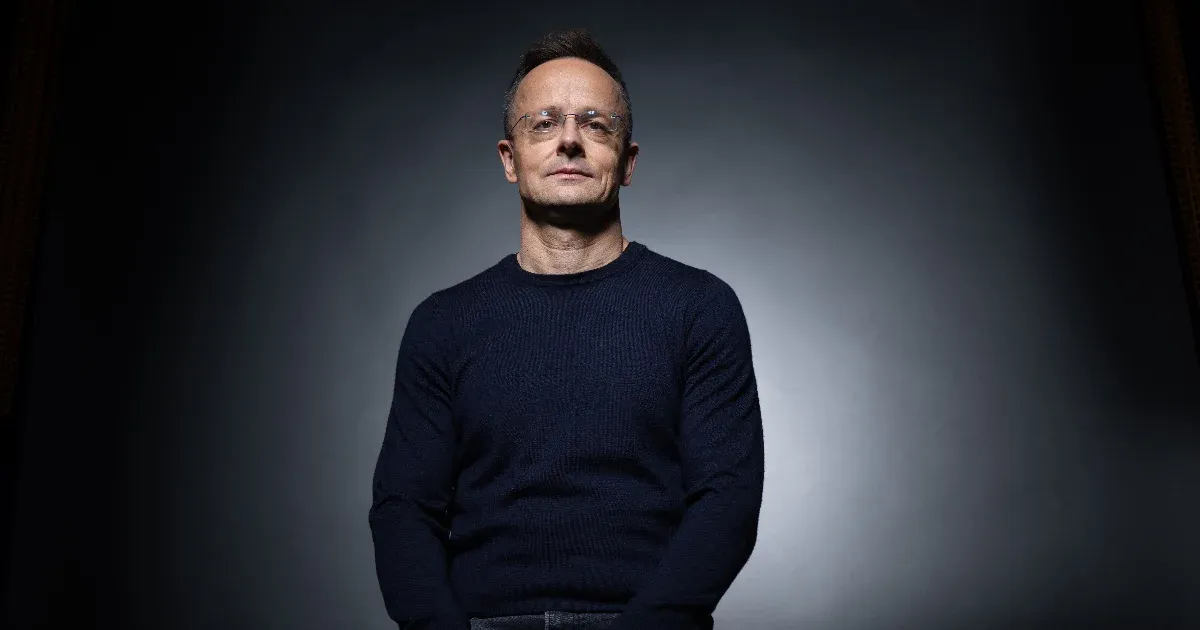
Szijjártó Péter on Military Service, Accountability and Political Abuse of Power in Recent Interviews
Hungarian Foreign Minister Péter Szijjártó stated in a televised interview on April 22, 2026, that he has never served in the military and does not believe he is fit for combat duty at age 48, directly responding to growing domestic pressure over national defense obligations amid heightened regional tensions following recent parliamentary elections.
The remarks, delivered during a live appearance on the independent news outlet Telex, come as Hungary grapples with internal debates over military conscription, NATO commitments, and the legacy of over a decade and a half of Fidesz-led governance under Prime Minister Viktor Orbán. Szijjártó’s comments have reignited scrutiny over the government’s defense posture, particularly as neighboring countries increase defense spending and regional security dynamics shift in the wake of the 2025 Black Sea stabilization efforts and ongoing NATO deterrence missions along NATO’s eastern flank.
While Szijjártó emphasized his civilian role in diplomacy, critics argue that his refusal to acknowledge personal military eligibility undermines national unity expectations during a period of strategic recalibration. The statement follows a series of public appearances where the minister addressed allegations of electoral interference, accused foreign actors of meddling in Hungary’s 2026 parliamentary vote, and reacted to the electoral success of the Tisza Party—a emerging centrist force that gained significant ground in urban centers like Budapest, Debrecen, and Szeged.
The Weight of Legacy: Fifteen Years of Fidesz Rule and the Question of Accountability
Szijjártó’s defense of his personal stance occurs against the backdrop of a broader national reckoning. In a separate Telex interview published the same day, he was pressed on who bears responsibility for the consequences of 16 years of Fidesz governance—a reference to the party’s continuous hold on power since 2010. While he deflected direct accountability, asserting that “many, far more than deserved, have abused their power in our vicinity,” the comment implicitly acknowledged systemic governance challenges without naming specific individuals or institutions.

This reluctance to name names contrasts sharply with growing calls from civil society groups and opposition figures for a transparent evaluation of policy outcomes in areas such as judicial independence, media freedom, and defense readiness. Organizations like the Hungarian Civil Liberties Union (HCLU) have documented over 200 legislative changes since 2010 that critics argue have eroded checks and balances, while the Venice Commission of the Council of Europe has issued multiple opinions expressing concern over Hungary’s democratic backsliding.
“When a state avoids introspection on its own trajectory, it risks mistaking resilience for rigidity. True national strength lies not in denying vulnerability, but in confronting it with honesty.”
The institute, a respected independent think tank, has urged policymakers to move beyond partisan defensiveness and engage in evidence-based assessments of long-term governance impacts—particularly as Hungary prepares for its next EU budget negotiation cycle and faces potential linkage mechanisms tied to rule-of-law compliance.
From Ballot Boxes to Border Security: How Electoral Shifts Reshape National Priorities
Szijjártó’s comments too followed his live reaction to the Tisza Party’s electoral gains, which he characterized as the result of “massive foreign interference” in the voting process—a claim echoed in parallel interviews with outlets such as 24.hu and Portfolio.hu. Although, international election monitors from the OSCE Office for Democratic Institutions and Human Rights (ODIHR) reported no evidence of systemic fraud or foreign manipulation in the 2026 Hungarian parliamentary elections, noting instead a competitive environment with high voter turnout and transparent vote tabulation.
The discrepancy between official narratives and international assessments has fueled domestic polarization. In Budapest’s 7th district, where the Tisza Party won a plurality, local councilors have begun advocating for greater municipal autonomy in emergency planning, citing concerns over delayed national-level responses to infrastructure vulnerabilities. Similarly, in Debrecen, city officials have pushed for increased investment in dual-use civil defense facilities that could serve both civilian emergency needs and national mobilization scenarios.
“We don’t need politicians to tell us whether they’re fit for the front—we need them to ensure our cities are prepared for any crisis, whether it comes from abroad or stems from our own unpreparedness.”
Such sentiments reflect a growing trend among urban administrators to prioritize resilient local systems over reliance on national-level assurances—especially as climate-related risks, cyber threats, and energy insecurity compound traditional security concerns.
The Defense Debate: Conscription, Capacity, and the Civilian-Military Divide
Hungary currently operates a voluntary professional military force, having abolished conscription in 2004. However, recent polls by the Nézőpont Institute indicate that 58% of Hungarians support reintroducing some form of national service—either military or civilian—in response to perceived security threats. Despite this, Szijjártó’s personal stance highlights a growing disconnect between public sentiment and the lived experience of policymakers, many of whom have not served in uniform.
This gap has practical implications. As NATO pushes for increased burden-sharing among member states, Hungary’s defense spending remains below the alliance’s 2% of GDP target, standing at approximately 1.6% in 2025 according to NATO’s official statistics. While the government has announced plans to acquire recent air defense systems and upgrade armored units, critics argue that personnel readiness and recruitment retention remain under-addressed challenges.

organizations specializing in veteran transition and civic resilience are gaining prominence. Groups that assist former service members in reintegrating into civilian life—such as the Hungarian Veterans’ Foundation—are increasingly consulted not only for employment support but also for insights into building national resilience through shared civic duty. Similarly, legal firms with expertise in national security law and defense procurement are seeing increased demand from municipalities seeking to clarify their roles in emergency scenarios.
| Indicator | Hungary (2025) | NATO Average | Source |
|---|---|---|---|
| Defense Spending (% of GDP) | 1.6% | 2.03% | NATO Defense Expenditure Report |
| Active Military Personnel per 1,000 Inhabitants | 4.2 | 6.8 | SIPRI Military Strength Database |
| Veteran Unemployment Rate | 12.1% | 8.4% (EU avg) | Eurostat Labor Market Data |
The data underscores a dual challenge: Hungary lags behind NATO benchmarks in both defense investment and personnel density, while its veteran population faces disproportionate economic hardship—a combination that could undermine long-term readiness if not addressed through coordinated policy and social support.
Where Responsibility Meets Repair: Bridging the Gap Between Policy and Practice
The questions raised by Szijjártó’s statements extend beyond personal biography—they touch on how societies prepare for uncertainty. When leaders decline to acknowledge their own limits, it falls to institutions and communities to fill the void with practical readiness. This is where the real work begins: not in rhetoric, but in resources.
For citizens concerned about national resilience, engaging with vetted emergency planning consultants can help households and tiny businesses develop continuity plans for scenarios ranging from cyberattacks to natural disasters. Municipalities seeking to clarify their legal authority during crises often turn to specialized public safety attorneys who understand the interplay between national emergency laws and local governance statutes. And for those interested in fostering civic engagement through service, organizations that connect individuals with national service programs—whether in disaster response, environmental stewardship, or community health—offer a constructive path forward that transcends partisan divides.
These are not partisan solutions. They are practical steps toward a society where readiness is not declared, but built—brick by brick, plan by plan, person by person.
The true measure of a nation’s preparedness is not found in the declarations of its ministers, but in the quiet, persistent work of those who demonstrate up before the crisis arrives—training, planning, and preparing not because they were told to, but because they understand that safety is a shared responsibility.