Survival Outcomes in Non-Endometrioid Uterine Malignancies at a North Kerala Tertiary Centre: A 10.25-Year Retrospective Study
A 10.25-year Kerala retrospective study of 255 rare uterine cancer patients left leiomyosarcoma local-recurrence unresolved, requiring multicentre evaluation.
Rare uterine cancers treated at a Kerala referral centre showed sharply different five-year survival depending on subtype in a retrospective study of 255 patients followed through the end of 2023.
- Uncommon uterine malignancies accounted for 27.6% of 925 uterine cancers treated at Malabar Cancer Centre between 2011 and 2021.
- Five-year overall survival ranged from 89.5% in low-grade endometrial stromal sarcoma to 30.8% in leiomyosarcoma.
- Receiving treatment with curative intent independently predicted better survival, with a hazard ratio of 0.33.
The study analysed patients with non-endometrioid uterine carcinomas and uterine sarcomas treated at Malabar Cancer Centre, a tertiary oncology institute in northern Kerala, between January 1, 2011 and March 31, 2021. Researchers verified survival status through December 31, 2023, using medical records and structured telephone follow-up for patients lost to clinical contact.
Endometrioid adenocarcinomas make up more than 90% of uterine cancers worldwide; the remaining uncommon histologies carry disproportionately high rates of extrauterine spread. Global data place uterine malignancies as the 16th most common cancer, with 434,620 new cases in 2024, while corpus uterine cancer accounted for a 1.8% incidence rate in India that year.
What the 255-patient cohort contained
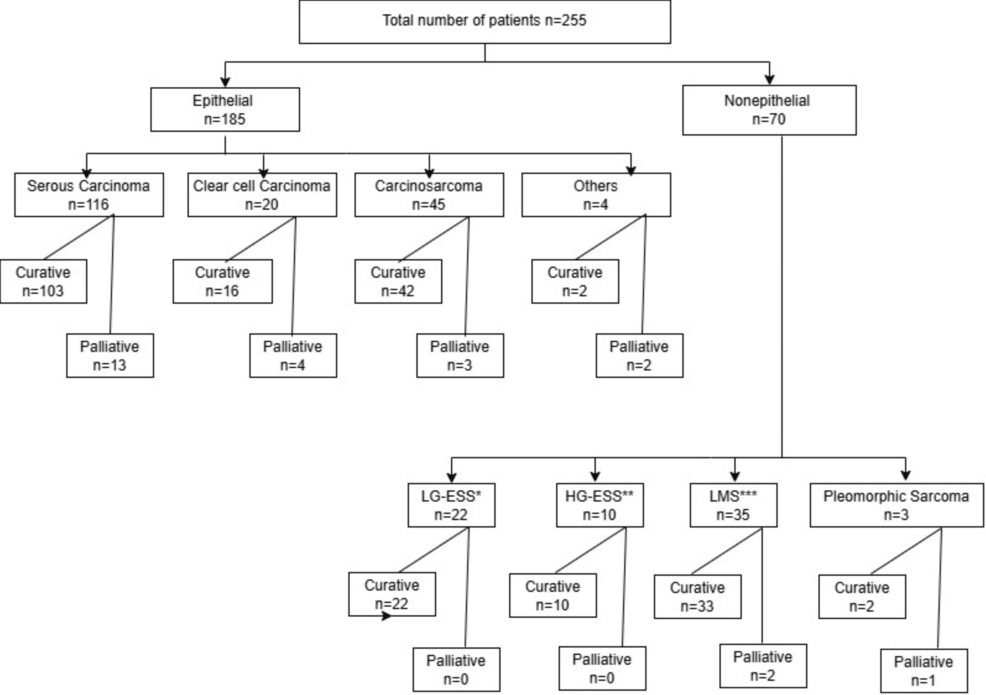
Of 925 uterine malignancies evaluated, 255 were uncommon histologies. Epithelial subtypes made up 72.5% of that group — 116 serous carcinomas, 45 carcinosarcomas, 20 clear cell carcinomas and 4 undifferentiated or squamous cell carcinomas. Non-epithelial sarcomas accounted for the remaining 70 patients: 35 leiomyosarcomas, 22 low-grade endometrial stromal sarcomas, 10 high-grade endometrial stromal sarcomas and 3 pleomorphic sarcomas.
The median patient age was 59 years. Most disease was caught early — 158 patients, or 62%, presented at stage I — and 230 patients, or 90.2%, underwent curative-intent treatment. Staging was assigned retrospectively using the 2009 FIGO systems for endometrial carcinomas and uterine sarcomas, and diagnoses relied on institutional pathology without central re-review.
Survival split sharply by subtype
Among epithelial malignancies, with a median follow-up of 56 months, five-year outcomes differed significantly across subtypes. Serous carcinoma and clear cell carcinoma fared best, while carcinosarcoma showed markedly inferior results.
Stage mattered within serous carcinoma specifically. Early-stage disease (stage I/II) carried a five-year overall survival of 70.2% versus 59.4% for advanced stages (III/IV), a difference the researchers reported as statistically significant. The relapse-free survival gap between the same stage groups — 66.7% versus 53.8% — did not reach statistical significance.
Recurrence proved lethal across every histology
Recurrence rates peaked in leiomyosarcoma at 71.4%, and local recurrences in that subtype are flagged in the study for multicentre evaluation. Among non-epithelial tumours, median follow-up ran longer at 79 months, and survival divergence across subtypes was pronounced: low-grade endometrial stromal sarcoma exhibited favourable outcomes, while high-grade stromal sarcoma and leiomyosarcoma demonstrated aggressive behaviour.
Time-dependent Cox regression quantified how much recurrence raised the risk of death. Disease recurrence increased mortality hazard 18.9-fold overall, 16.4-fold within epithelial subgroups and 33.7-fold within non-epithelial subgroups, with no significant interaction by histological class.
Treatment intent as the one modifiable predictor
Multivariable analysis identified one independent predictor of improved overall survival: curative-intent treatment, with a hazard ratio of 0.33 (95% confidence interval 0.12–0.94). The finding aligns with the centre’s treatment pathway, under which non-metastatic cases receive primary surgery, followed by adjuvant systemic therapy and radiotherapy based on histopathological staging, while metastatic cases receive palliative chemotherapy and/or hormonal therapy, while palliative radiotherapy is provided for symptom relief or oncological emergencies like spinal cord compression.
The study received institutional ethics committee approval from Malabar Cancer Centre, which registers over 4,500 new cases annually and draws patients from northern Kerala and neighbouring Tamil Nadu and Karnataka.
What the data changes, and for whom
For clinicians in South India, the frequency data carry local weight. The relative frequency of epithelial subtypes mirrored global literature, but low-grade ESS and LMS occurred more frequently — a pattern the authors note has previously been documented only in isolated subtype series from Northern India and from Tamil Nadu.
Indian literature on these tumours remains largely restricted to isolated subtype series; prior Asian retrospective series on uterine sarcomas have been reported from China and Pakistan.
For patients, the stage-stratified serous carcinoma figures show that early detection improves survival: five-year OS differed between early (stage I/II) and advanced stages (stage III/IV) (70.2% vs 59.4%, p=0.042).
Women diagnosed with these uncommon histologies — or with recurrent disease despite first-line treatment — would typically be managed at a comprehensive cancer centre, and the study's curative-intent finding shows why access to such surgical and adjuvant care shapes outcomes more than histology alone for some subtypes.
The open question
The authors themselves flag the limits of a single-centre retrospective design: institutional referral patterns may limit direct population-level generalisability, and recurrence dates could not always be confirmed pathologically or radiologically by telephone, forcing conservative estimates from symptom onset. The study’s own conclusion leaves the leiomyosarcoma local-recurrence pattern unresolved, calling for multicentre evaluation — a question the 10.25-year Kerala dataset alone cannot answer.
The study’s setting carries its own history: Malabar Cancer Centre in Thalassery, Kannur district, an autonomous not-for-profit institution under the Kerala government’s Health and Family Welfare Department, was inaugurated in 2001 under the E. K. Nayanar Government and initially functioned under the Electricity Department before being handed over to the Health Department in 2008.
It serves patients mainly from the Malabar region, neighbouring Karnataka and Tamil Nadu, and Mahe in Puducherry, with new patient consultations rising from 1,040 in 2008 to 6,500 in 2019.
In June 2022 the centre was upgraded to the Post Graduate Institute of Oncology Sciences and Research, where about 270 students and six PhD research students now study. It was the first government institution in Kerala to establish a Department of Ocular Oncology, and the only one approved for conducting human clinical trials for a COVID-19 vaccine.
Disclaimer: The information provided in this article is for educational and scientific communication purposes only and does not constitute medical advice. Always consult with a qualified healthcare provider regarding any medical condition, diagnosis, or treatment plan.