
Subaru WRX STI DCCD opens center differential during handbrake use
Subaru Secretly Built The Ultimate Drift Hack Into Its All-Wheel Drive Super Sedan
Subaru designed the Driver’s Control Center Differential (DCCD) in the WRX STI to automatically open the center differential whenever a driver pulls the mechanical handbrake lever while the vehicle is in motion. Technical release information published by Subaru for the early U.S.-market WRX STI models indicates that this automated drivetrain intervention allows the sedan to initiate a controlled slide by letting the rear wheels slow down while the front wheels maintain rotation and steering control.
Subaru drivetrain automation and torque split for drifting
- Drivetrain Automation: Pulling the mechanical handbrake switch signals the DCCD control module to instantly release the center differential’s electronic clutch pack.
- Torque Split Dynamics: When unpowered, the planetary center differential defaults to a rear-biased 35:65 front-to-rear torque distribution instead of binding the axles during a rear-wheel lock event.
- Factory Intent: Subaru explicitly noted in technical documentation that the system facilitates vehicle drift behavior during rear wheel locking events.
How the Driver’s Control Center Differential Manages Axle Speeds
A mechanical handbrake operates via a cable that applies a shoe to the rear brakes to secure a parked vehicle. In the early U.S.-market Subaru Impreza WRX STI sedan—which launched for the 2004 model year—that handbrake lever also activates an integrated switch sending vital telemetry to the DCCD controller. The control module processes this signal alongside inputs tracking wheel speed, braking pressure, throttle position, and cornering behavior to govern the center differential’s multi-plate clutch.
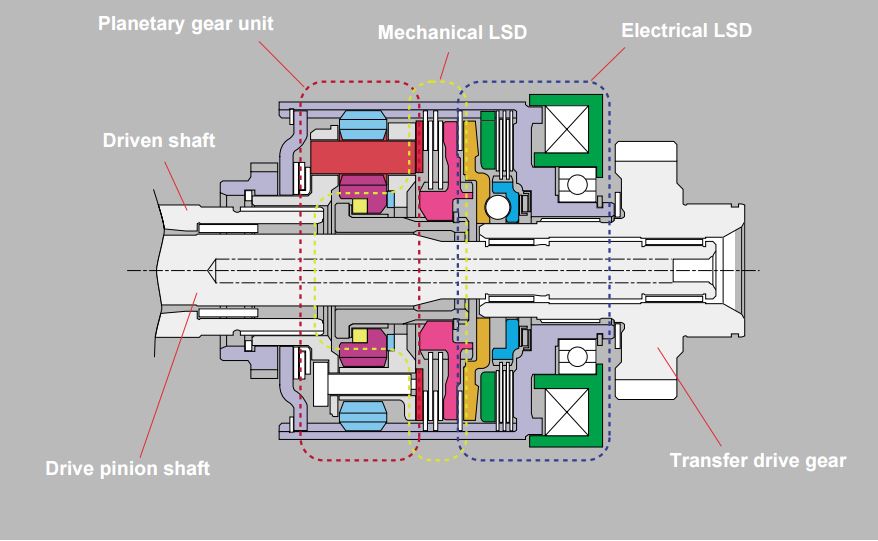
During standard driving conditions, if no current reaches the DCCD coil, the planetary center differential distributes 35% of engine torque to the front wheels and 65% to the rear. The system can progressively apply electrical current to increase clutch pack engagement, shifting torque distribution closer to a balanced 50:50 split. However, when the system detects a parking brake application while the vehicle is moving, the controller overrides normal locking behavior. Instead of forcing the front and rear axles to rotate at matching speeds—which would normally happen in a traditional all-wheel-drive system—the DCCD releases the clutch entirely.
Overcoming All-Wheel Drive Drivetrain Constraints During Rally Maneuvers
In traditional rear-wheel-drive or older non-AWD rally cars, executing a handbrake turn required simply yanking the lever to lock the rear tyres. Implementing the same maneuver in a permanent all-wheel-drive platform presents a mechanical conflict because the driveline links both axles through a center differential designed to manage speed differentials. Without intervention, a locked rear axle paired with a locked center differential creates severe drivetrain binding and fights the driver’s steering inputs.

Subaru engineered the DCCD to recognize unusual traction events autonomously. By factoring in wheel speed data and braking inputs, the electronics determine that the rear wheel lock is intentional rather than a loss of control, eliminating the need to tie the front and rear axles tightly together. Mitsubishi deployed a comparable feature in its Lancer Evolution line starting with the Evolution VII for the 2003 model year, where pulling the parking brake similarly switched the center differential to a free state.
Evolution of Active Drivetrain Management Systems in Subsequent Model Years
Building upon the architecture of the initial U.S. release, Subaru refined the system further for the 2006 model year, expanding the capabilities of the active differential management suite. The DCCD controller was programmed to dynamically reduce limited-slip differential clutch engagement during conventional braking and anti-lock braking system (ABS) activation. By continuously modulating clutch lockup to limit tight-corner binding based on real-time cornering telemetry, the active drivetrain management architecture balanced high-performance agility with predictable street manners, while leaving an unmistakable mechanical backdoor for drivers seeking traditional rally-style handbrake slides.