Study: Supergiant Star Consumed Companion 2.5M Light-Years Away
Astronomers have observed a supergiant star consuming its smaller companion in the Andromeda galaxy, a process that culminated in a violent stellar merger.
The event, located 2.5 million light-years from Earth, was documented in a study published in the journal Nature. The eruption that marked the final collision was a million times brighter than the Sun, according to the researchers.
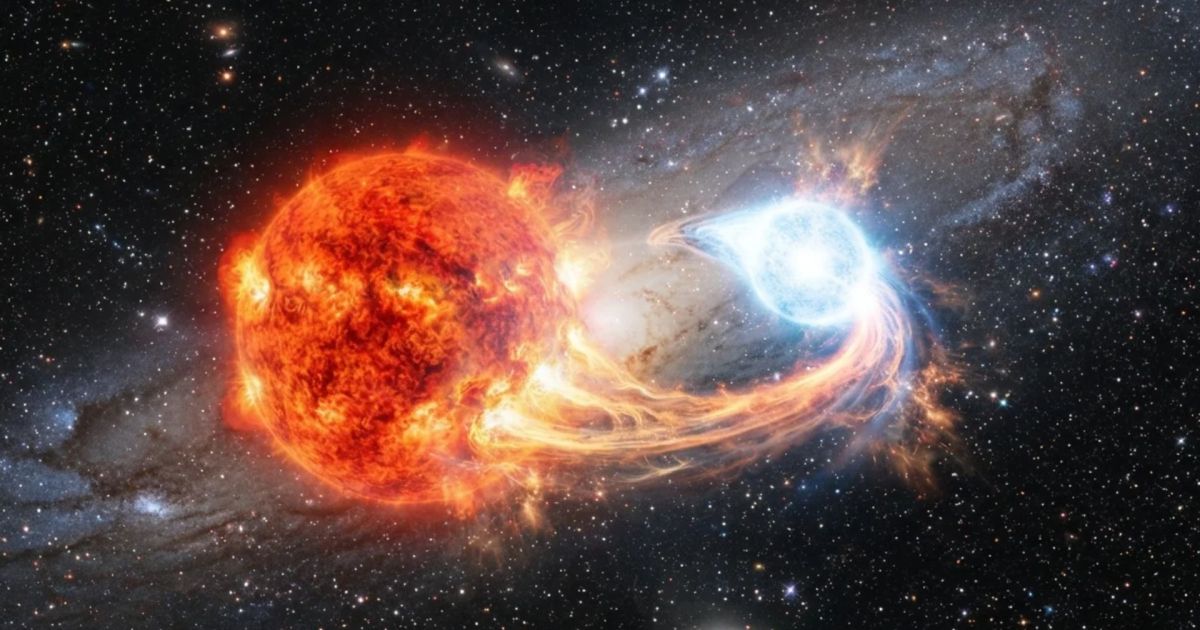
For the first time, astronomers recorded the exact moment a dying giant star engulfed its smaller companion in a binary system in the Andromeda galaxy, culminating in a violent stellar merger at the end of 2025.
Tracking the Bao merger
The system, officially designated AT2025abao and nicknamed "Bao" after traditional steamed buns, involved two stars that shared a common gas envelope. According to reporting by UOL, the larger star—a supergiant—had seven times the mass of the Sun and a radius 350 times larger. Its companion, identified as a smaller star with approximately 0.7 solar masses, spiraled inward as it lost orbital energy due to friction.
The larger star was an asymptotic giant branch (AGB) star, a very bright, relatively cool star that had consumed nearly all its nuclear fuel. Unlike young, dense stars, AGB stars are surrounded by large, irregular envelopes that make interaction with a companion particularly complex.
The binary system maintained a stable orbit for thousands of years before the smaller star made contact with the outer layers of the larger one, beginning to lose orbital energy and spiral toward the core.

Data from the WINTER and NEOWISE infrared telescopes first detected the system’s approach in 2018, according to CNN Brasil. Over the next seven years, the smaller star was gradually engulfed by the supergiant’s outer layers. The first indications appeared in February 2023 in records from the NEOWISE mission.
After that, ground-based and space instruments detected increasing brightness, dust release, and changes in radiation emitted by the system. Between 2018 and 2025, the star in Andromeda brightened continuously, dimmed, and underwent a dramatic eruption. "It was a monstrous star, completely overshadowing its companion in the data," Karel Temmink of Radboud University told UOL.
Collision Triggers Eruption Detected in 2025
The interaction triggered a dramatic increase in brightness, followed by a powerful eruption in late 2025. Researchers from Columbia University described the final stage of the merger as being "almost like a bomb exploding inside a living star," as noted by UOL. The collision with the core of the larger star released energy compared by Columbia University researchers to the detonation of a stellar bomb. The energy released in the final phase helps explain the eruption observed in 2025.
The eruption was detected on October 17, 2025, by the Zwicky Transient Facility, an automated system that scans the sky for objects that change in brightness. "One day the brightness started to rise and, in a week, it reached the peak!" said Viraj Karambelkar, lead author of the study and NASA Hubble Fellow at Columbia University in New York.
The final velocity surprised Nadia Blagorodnova, associate professor at the University of Barcelona and co-author of the paper. Stellar mergers are very, very difficult to observe in real time because they are hard to predict, Karambelkar said. This is one of the reasons it has been very, very challenging to catch this stellar engulfment process in real time, because it is literally an instant on the timescale of these stars.

The following table summarizes the primary characteristics of the binary system:
| Feature | Supergiant (Big Bao) | Companion (Little Bao) |
|---|---|---|
| Radius | 350 times the Sun | ~0.7 solar radii |
| Luminosity | ~18,000 times brighter than the Sun | N/A |
Monitoring by the James Webb Space Telescope on December 24, 2025—47 days after the eruption peaked—indicated that the system had stabilized into a single, massive star. Scientists suggest this merger may have produced a "rejuvenated" star, though researchers continue to study the object's long-term evolution.
Unlike mergers between small, rigid bodies, the gaseous and expanded structure of the supergiant allowed for gradual absorption. According to the scientists, the shock may have generated a rejuvenated star, guaranteeing a new life cycle for the resulting celestial body.
The Andromeda Galaxy, cataloged as Messier 31, is the nearest major galaxy to the Milky Way at 2.5 million light-years from Earth. A barred spiral galaxy with a diameter of about 152,000 light-years, it is the largest member of the Local Group by extension. Persian astronomer Abd al-Rahman al-Sufi first recorded it around 964 CE as a “nebulous smear,” the earliest known reference to a galaxy beyond our own.

The research team expects that future observations from the Vera C. Rubin Observatory and the Nancy Grace Roman Space Telescope will help identify additional systems undergoing similar common envelope evolution. Scientists currently await further data on the magnetic fields and chemical composition of the merged star to determine its future trajectory. In other systems, common envelope evolution can end without merger, with both stars surviving in tighter orbits.
These pairs can, over time, give rise to neutron stars and black holes, explode as supernovae, and even generate gravitational waves, according to NASA. She should have a very high magnetic field, perhaps. Perhaps she should have strange chemical compositions. She should have strange temperatures and luminosities, precisely because she received this new injection of fuel, but we still have a few years ahead until this happens, Karambelkar said.