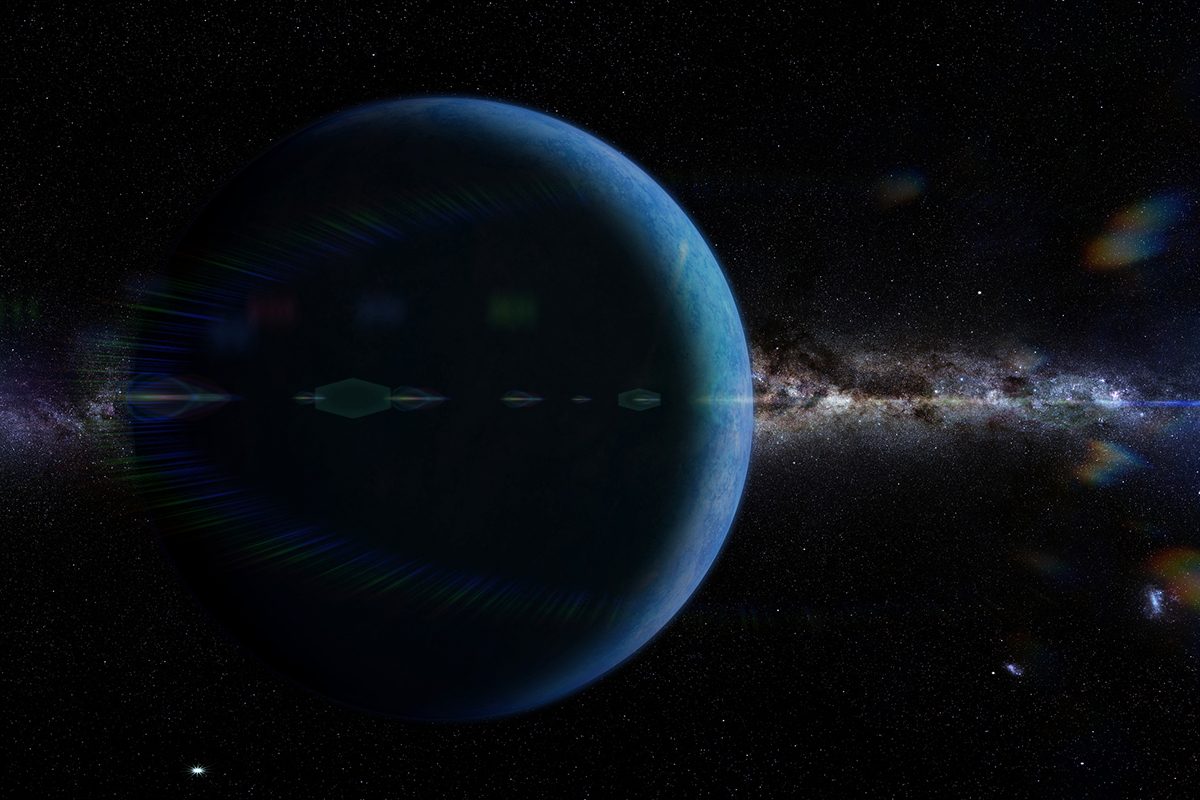
Study Proposes Hidden Super-Earth Beyond Neptune to Explain Orbits
Astronomers propose a hidden planet 1.5 to 2 times Earth’s mass orbiting between 200 and 500 astronomical units from the Sun, a study published November 23 reports.
- Planet X2 would be far smaller than the hypothesized Planet Nine but orbit farther out.
- Simulations spanning 4.5 billion years reproduce the tilted, distant orbits of objects like Sedna.
- The Vera C. Rubin Observatory in Chile could confirm or rule out the planet within years.
New model, different planet
The research, led by Professor Patryk Sofia Lykawka of Kindai University in Japan and the University of Southern Queensland in Australia, appears in Monthly Notices of the Royal Astronomical Society, BBC Sky at Night Magazine reported.
Unlike the Planet Nine hypothesis — which posits a world 5 to 10 times Earth’s mass — the new modeling points to a “super-Earth” no larger than twice our planet’s mass, orbiting on a highly elongated path that never brings it closer than 200 AU, or roughly 30 billion kilometers, from the Sun.
“Our model reproduces several of the unusual orbital patterns observed among distant icy objects, although there are still differences between the model and observations that we need to investigate further,” Lykawka said in a statement accompanying the paper.
Explaining the outliers
Astronomers have long struggled to explain the orbits of extreme trans-Neptunian objects such as Sedna, whose closest approach to the Sun lies far beyond Neptune’s gravitational reach, and 2012 VP113. Over the past two decades, surveys have uncovered a growing population of icy bodies with steeply inclined or highly elongated paths that the known eight planets cannot account for.

The team ran N-body simulations of the Solar System’s 4.5-billion-year evolution, testing 18 variants of a distant Earth-class planet. A planet of roughly two Earth masses at a semimajor axis of 350 to 500 AU produced populations of detached and high-inclination objects that closely match the observed distribution. A one-Earth-mass variant stirred too few steeply tilted orbits, while models without any extra planet failed entirely.
“When you run computer simulations, there is no way for the planets that we know of to have stirred these objects and put them where they are,” Professor Jonti Horner, a co-author at the University of Southern Queensland, said. “That’s something telling us that there is something else going on.”
Not Planet Nine
The Planet Nine hypothesis, advanced by Caltech astronomers Konstantin Batygin and Mike Brown in 2016, relies on a much more massive body — about 4.4 to 10 Earth masses — orbiting closer in, with a semimajor axis around 290 to 380 AU. A 2025 analysis by Amir Siraj, Christopher Chyba and Scott Tremaine favored roughly 4.4 Earth masses at 290 AU.
Horner said that Planet X2 is “quite different” from Planet Nine and that the two hypotheses are not mutually exclusive. “Our work does not rule out the possibility of Planet 9 influencing some objects’ orbits,” he said.
Simulations test Earth-mass planet variants
About 95% of the Dark Energy Survey sample used for comparison lies between 60 and 250 AU from the Sun, Lykawka and co-authors Jonathan Horner and Pedro Bernardinelli noted.
Earlier searches and the Planet Nine contrast
“Our work does not rule out the possibility of Planet 9 influencing some objects’ orbits,” he said, adding that the new proposal does not explain everything but fits reality much better than if the current list of planets is all there is.
Rubin Observatory will test the prediction
The Vera C. Rubin Observatory in Chile, now conducting its Legacy Survey of Space and Time, offers the first realistic chance to detect Planet X2 or the telltale orbital signatures it would produce. “As the Rubin Observatory surveys the sky, we will find new clues that help us understand the distant reaches of the Solar System — and whether another planet is still waiting to be discovered,” Horner said.
The Vera C. Rubin Observatory in Coquimbo Region, Chile, began full survey operations in July 2026 for its ten-year Legacy Survey of Space and Time, scanning the southern sky every few nights with an 8.4-meter Simonyi Survey Telescope and a 3.2-gigapixel camera. This cadence and depth will catalog millions of solar system objects, producing the “footprints” — extreme trans-Neptunian objects — whose orbital clustering would reveal Planet X2’s gravitational influence.
The observatory has already identified new distant objects, including the dwarf-planet candidate 2026 ED138 at roughly 46 AU. Horner said that finding more “footprints” — additional extreme trans-Neptunian objects — will sharpen the test: “By finding more of these objects, we’re finding more footprints, which is leading us to the final answer of whether or not there is another planet out there.”