Study Proposes Earth-Sized Planet Beyond Kuiper Belt to Explain Odd Orbits of Distant Objects
A study published last month argues that an undiscovered Earth-sized planet could explain the odd orbits of distant icy bodies beyond Neptune.
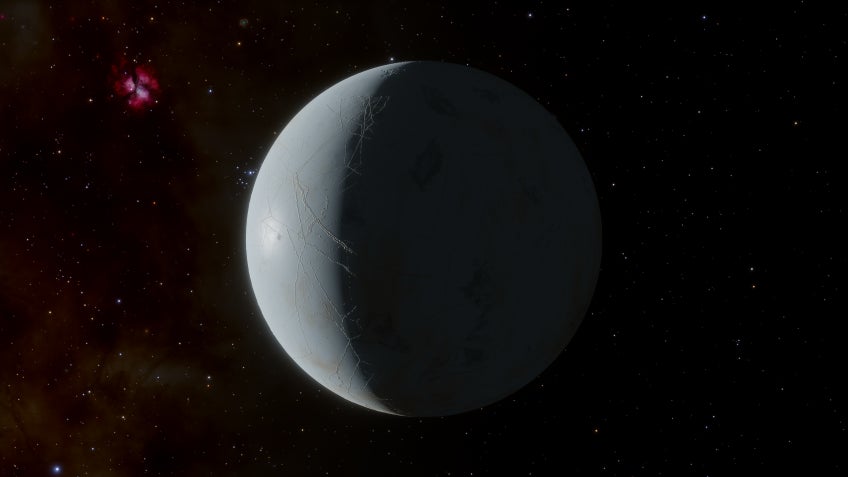
The paper, published Oct. 28 in Monthly Notices of the Royal Astronomical Society, proposes a planet 1.5 to 2 times Earth’s mass orbiting hundreds of astronomical units from the Sun — far beyond the Kuiper Belt, BFM reported. Researchers Patryk Sofia Lykawka, Pedro Bernardinelli and Jonathan Horner ran thousands of simulations spanning 4.5 billion years of solar system history to test the idea.
"If this planet exists, it could change the way we understand the history of our solar system and how its most distant objects came to follow such unusual orbits," Lykawka said.
Astronomers have long struggled to explain three distinct groups of trans-Neptunian objects beyond 50 astronomical units. Detached objects have perihelia too distant for Neptune to have placed them there. Highly inclined objects orbit tilted more than 45 degrees from the planetary plane, some even backward. Extreme objects like Sedna and 2012 VP113 follow vastly elongated orbits. The authors counted 11 such extreme objects as of April 2026.
Neptune’s outward migration early in solar system history accounts for structures within 50 astronomical units. Beyond that distance, the three populations remain unexplained by current models.
The team modeled the solar system’s four giant planets embedded in a disk of thousands of small bodies — 1,500 Pluto-sized and 13,500 smaller — to capture what they describe as the "grainy," realistic migration of Neptune. Each simulation ran on a single CPU core for four to five months.
They compared three scenarios: no extra planet; planetary embryos ejected early; and a stable distant planet dubbed X2. The first two scenarios failed to produce the observed detached, highly inclined and extreme objects. The X2 scenario reproduced all three populations while leaving the classical Kuiper Belt and Neptune’s resonant objects undisturbed — a key constraint, since a planet passing closer than 200 astronomical units would have destroyed those stable resonant populations.
The proposed planet would orbit at a semi-major axis of 350 to 500 astronomical units — 12 to 17 times Neptune’s distance — with a perihelion no closer than 200 astronomical units.
The hypothesis echoes earlier searches. Percival Lowell’s early 20th century work led to Pluto’s discovery in February 1930. In 2008, Lykawka and Tadashi Mukai at Kobe University suggested a Super-Pluto beyond the Kuiper Belt. In 2016, Caltech astronomers Konstantin Batygin and Mike Brown proposed Planet Nine, a super-Earth of 5 to 10 Earth masses, to explain orbital clustering that other teams now attribute to observational bias.
X2 is distinct: less massive, on a different orbit, and motivated by different dynamical signatures. It extends work Lykawka and Takashi Ito published in 2023.
The authors acknowledge gaps. The study does not explain how such a planet formed, offering possibilities ranging from in-situ formation to ejection and later stabilization by gas or passing stars. Parameters remain provisional; only a subset of possible orbits was tested. Some conclusions rest on small sample sizes.
"As the Vera C. Rubin Observatory scans the sky, we will discover new clues that will help us better understand the outer solar system, and determine whether another planet is still waiting to be discovered," Horner said.
28 in Monthly Notices of the Royal Astronomical Society. He previously completed his Ph.D. at the University of Pennsylvania as a member of the Dark Energy Survey (DES), where he led the discovery of over 600 trans-Neptunian objects and the comet C/2014 UN271 (Bernardinelli-Bernstein).
The observatory’s survey, set to begin in Chile, could detect the planet directly or map enough distant objects to confirm its gravitational signature.