Study: Atmospheric Oxygen Rose in Three Stages Millions of Years Earlier Than Models Suggest
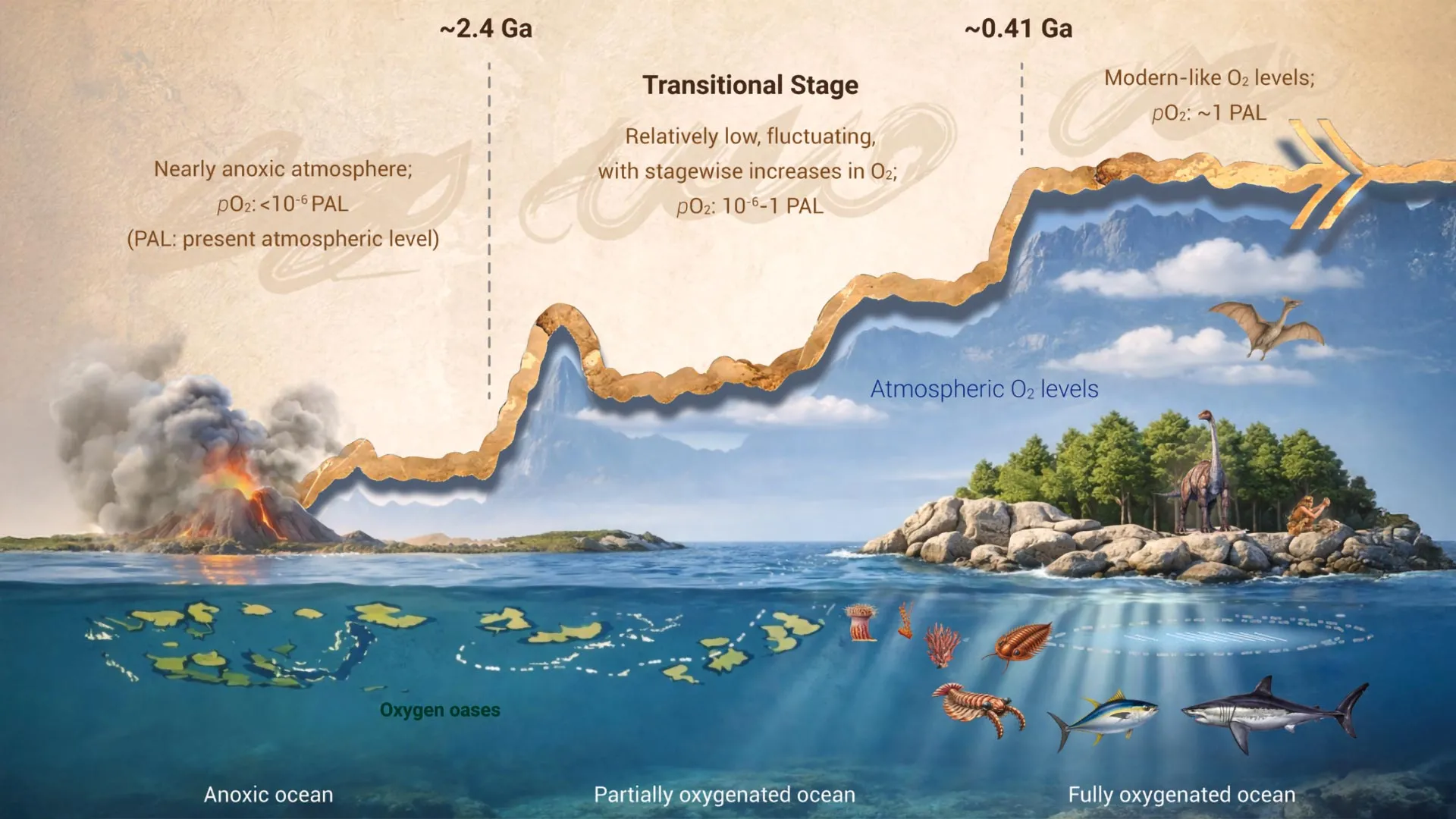
Earth’s atmospheric oxygen levels likely rose in three major stages millions of years earlier than traditional models suggest, according to a study published in The Innovation.
Two geochemists from Chengdu University of Technology, who authored the research, argue that previous timelines relied too heavily on ocean chemistry, which can be misleading.
Scientists have historically reconstructed oxygen history using chemical clues found in ancient ocean sediments. However, factors including biological activity, nutrient availability, and ocean basin geometry mean that seawater chemistry does not always mirror the atmosphere, ScienceDaily reported. To bypass this, the researchers tracked oxygen-17 isotope signatures preserved in sedimentary sulfate.
This isotope signal provides a more direct record of atmospheric conditions because it is influenced by reactions involving ozone, carbon dioxide, and oxygen in the air.
By applying this method, the team identified three distinct periods of atmospheric oxygenation.
The first, the Great Oxidation Event, occurred between 2.4 billion and 2.1 billion years ago. The second increase took place between 1.3 billion and 1.0 billion years ago, while the third occurred between 440 million and 410 million years ago.
These findings suggest that what were previously identified as the Neoproterozoic and Paleozoic oxygenation events were actually delayed responses in the ocean, lagging behind atmospheric changes by roughly 200 million and 30 million years, respectively.
| Oxygenation Stage | Atmospheric Timing | Ocean Response Lag |
|---|---|---|
| Great Oxidation Event | 2.4 – 2.1 Billion Years Ago | Not specified |
| Second Increase | 1.3 – 1.0 Billion Years Ago | ~200 Million Years |
| Third Increase | 440 – 410 Million Years Ago | ~30 Million Years |
Oxygen remained scarce for much of Earth’s history despite these shifts. During the middle Proterozoic, atmospheric levels reached only 0.1% to 1% of modern concentrations, ScienceDaily reported. The absence of charcoal in the geological record until 420 million years ago supports this, as charcoal formation requires oxygen levels roughly three-quarters of what exists today.
The research also reveals that the atmosphere and oceans did not always change in sync. While they increased together over billion-year spans, they occasionally moved in opposite directions over shorter, million-year timescales.
When oxygen entered the oceans, it could react with organic carbon and sulfide, essentially consuming the gas and potentially driving down atmospheric levels.
The study indicates that complex life evolved gradually alongside these fluctuations.
While an oxygen-poor atmosphere once limited the development of organisms, increasing levels eventually supported larger bodies and more active predators. According to the research, the deep ocean did not reach full oxygenation until approximately 410 million years ago, marking the final step in the planet’s long transformation.
Chengdu University of Technology is a national public research university and technology-focused institution co-funded by the Ministry of Education of China, the Ministry of Natural Resources of China, and the Sichuan Provincial People’s Government.
Part of the Double First-Class Construction Initiative, the university holds strong standing in geoscience research, featuring national key disciplines including a first-level national key discipline in Geological Resources and Geological Engineering by 2008 and global placement within the 601-700 band in the 2025 Academic Ranking of World Universities.
Chinese scientists have found that Earth's atmosphere experienced three major oxygen surges over the past 2 billion years as it shifted from an anoxic to an oxygen-rich state, offering fresh insights into the origins of life, its evolution, and the planet's long-term… pic.twitter.com/scllaXbqP1
Related reading
- AI Data Center Power Demand to Double by 2030, Adding Great Britain-Scale Load, IEA Warns
- Apple Pie vs. Pumpkin Pie: Neither Is Better for Blood Sugar, Experts Say
- RBA's Fifth Hike Adds About A$94 a Month on A$600,000; Three Voted to Hold (daybreakwire.com)
- Midlife Vitamin D Linked to Lower Tau Protein Years Later (archyde.com)