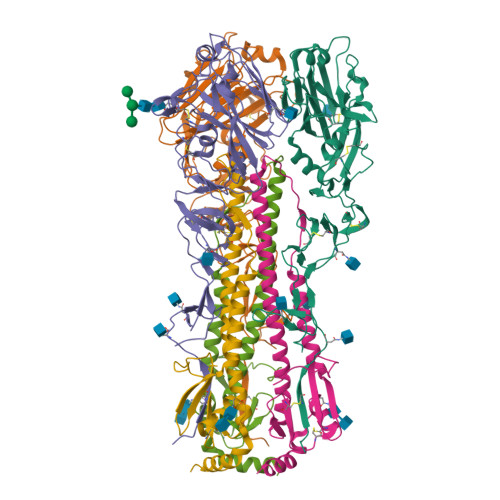
Structural Study Finds H5N1 Minor Variants with Increased Human Receptor Binding
Structural biologists have resolved the atomic architecture of a hemagglutinin variant carrying mutations E190D and Q226H isolated from a human H5N1 case in British Columbia, revealing how minor viral subpopulations alter receptor binding avidity, Nature reported.
- The D190/H226Q variant binds avian-type receptors but the minor E190D/Q226H subpopulation shows increased affinity for human-type receptors.
- Deep sequencing of the clinical specimen identified these variants at frequencies below the consensus detection threshold.
- Glycan array profiling confirms the Q226H substitution drives a measurable shift toward α2,6-linked sialic acid recognition.
British Columbia isolate yields distinct receptor-binding profile
The hemagglutinin (HA) from A/British Columbia/PHL-2032/2024 (H5N1) was crystallized in complex with receptor analogs at the Stanford Synchrotron Radiation Lightsource beamlines 12-1 and 12-2, according to the structural study published in Nature. The deposited structure (PDB 12KW) represents the dominant D190/H226Q variant expressed in Spodoptera frugiperda cells, refined to an R-free of 0.247.
Deep sequencing of the original clinical material, however, revealed minor variant populations carrying E190D and Q226H substitutions at positions 190 and 226 (H3 numbering), the authors reported. These positions sit in the 190-helix and 220-loop of the receptor-binding site, respectively, where they directly coordinate sialic acid linkage specificity.
Minor variants shift binding toward human-type glycans
Glycan array analysis performed at the TSRI Genomics Core facility demonstrated that the consensus D190/H226Q protein maintains strong preference for α2,3-linked sialosides typical of avian hosts. Introduction of the Q226H mutation, either alone or combined with E190D, conferred measurable binding to α2,6-linked glycans predominant in the human upper respiratory tract, the data show.

“The Q226H substitution is a known determinant of human receptor specificity in H2 and H3 pandemic viruses,” the study authors wrote, noting its appearance here in a minor H5N1 subpopulation. The E190D change, while conservative, remodels the 190-helix hydrogen-bond network and synergizes with Q226H to stabilize the human-receptor conformation.
Surveillance implications for pandemic preparedness
The detection of these variants below the consensus threshold shows a limitation of standard sequencing pipelines, which typically report only the dominant genotype.
Funding for the structural and functional work came from the National Institutes of Health, National Institute of Allergy and Infectious Diseases (grant 75N93021C00015), with synchrotron access supported by the U.S. Department of Energy Office of Science. The coordinates and structure factors have been deposited in the Protein Data Bank under accession 12KW, released October 21, 2026.
“Finding Q226H in a human H5N1 isolate, even as a minor variant, is exactly the molecular signature we monitor for because it directly alters the virus’s ability to engage human airway receptors,” said Ian A. Wilson, Hansen Professor of Structural Biology at The Scripps Research Institute and senior author of the study.
Structural basis for altered specificity
The crystal structure shows that His226 forms a direct hydrogen bond with the galactose moiety of the α2,6-linked receptor analog, reorienting the glycosidic linkage into the “umbrella topology” characteristic of human-adapted HAs. Asp190, meanwhile, introduces a salt bridge with Lys222 that rigidifies the 190-helix, reducing the entropic penalty for binding the extended human receptor conformation.
These findings align with historical mutagenesis data from the 1957 H2N2 and 1968 H3N2 pandemic strains, where Q226L (H3 numbering) played a parallel role. The H5 numbering equivalent, Q226H, represents a distinct chemical path to a similar phenotypic outcome — a detail with implications for risk assessment algorithms that currently weight Q226L more heavily.
Nature, founded in the autumn of 1869 by Norman Lockyer and Alexander MacMillan as a public forum for scientific innovations, published the structural study detailing the H5N1 hemagglutinin variant. The British weekly journal operates editorial offices in London, the United States, continental Europe, and Asia under Springer Nature and, as of 2012, claimed an online readership of about three million unique readers per month.
Disclaimer: The information provided in this article is for educational and scientific communication purposes only and does not constitute medical advice. Always consult with a qualified healthcare provider regarding any medical condition, diagnosis, or treatment plan.