
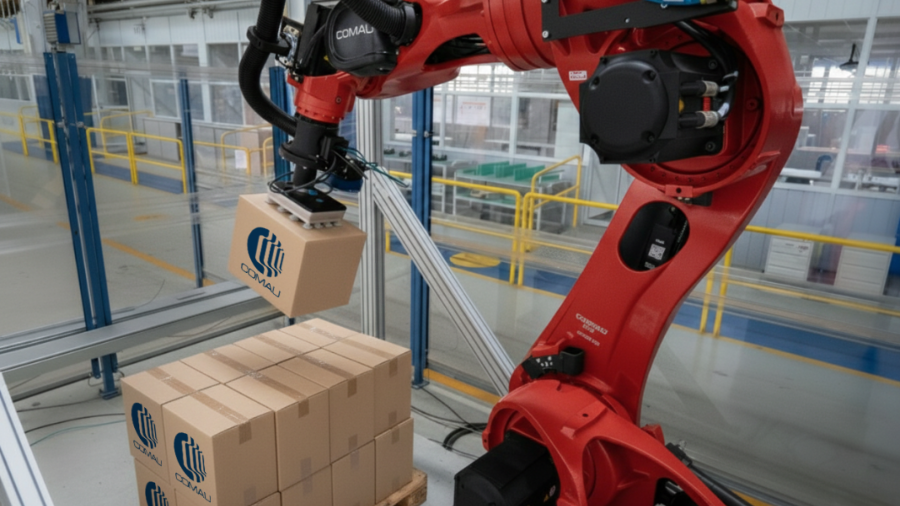
Strategic Partnership for Industrial Automation Solutions
The industrial automation sector is currently obsessed with the “Software-Defined” label, but most of it is high-gloss vaporware. When Aptiv and Comau sign a memorandum of understanding to establish a framework for joint automation solutions, we aren’t just looking at another corporate handshake; we are looking at the potential convergence of automotive-grade signal processing and heavy-duty industrial robotics.
The Tech TL;DR:
- Architectural Shift: Moving from rigid, PLC-centric logic to a flexible, software-defined framework for industrial applications.
- Cross-Pollination: Integration of Aptiv’s expertise in vehicle “nervous systems” (signal/power) with Comau’s robotic hardware.
- Enterprise Impact: Reduction in deployment latency and a shift toward modular, interoperable automation cells.
The core bottleneck in modern factory floors isn’t the mechanical precision of the robotic arm—it’s the middleware. Most industrial environments are still shackled to monolithic legacy stacks where the hardware is tightly coupled to the control logic. This creates a nightmare for CTOs attempting to scale production or pivot product lines, as any significant change requires a complete rewrite of the PLC (Programmable Logic Controller) code and potentially expensive hardware retrofits.
By aligning Aptiv’s capabilities in high-speed data distribution and power electronics with Comau’s automation footprint, the goal is to decouple the “brain” from the “muscle.” This shift mirrors the transition we’ve seen in the automotive world toward Zonal Architectures, where centralized compute modules handle the heavy lifting and localized zones manage the actuators. For an enterprise, this means the ability to push updates to a robotic cell via a CI/CD pipeline rather than manually flashing firmware on a shop floor.
The Software-Defined Manufacturing Stack
To understand why this partnership matters, we have to look at the underlying data orchestration. Traditional automation relies on fieldbus protocols that are reliable but inflexible. The next generation of industrial tech is moving toward Time-Sensitive Networking (TSN) and Data Distribution Service (DDS) standards to ensure deterministic communication over standard Ethernet.
When integrating these systems, the risk of “jitter” or latency spikes can lead to catastrophic mechanical failure or, at the very least, a drop in throughput. This is where the architectural expertise of a firm like Aptiv becomes critical. They aren’t just building robots; they are building the high-bandwidth, low-latency conduits that allow a robot to react to sensor data in real-time without hitting a processing bottleneck.

“The industry is hitting a wall with traditional ladder logic. To achieve true agility, we need to treat the factory floor as a distributed compute cluster. The integration of automotive-grade signal integrity into industrial cells is the only way to solve the deterministic latency problem at scale.”
— Lead Systems Architect, Industrial IoT Consortium
For companies struggling to migrate their legacy infrastructure to this new paradigm, the complexity of the transition often outweighs the perceived benefit. This is why many are currently engaging industrial automation consultants to map out their hardware-to-software abstraction layers before committing to a new vendor ecosystem.
The Tech Stack & Alternatives Matrix
The Aptiv-Comau approach focuses on a vertically integrated, software-defined framework. To calibrate this against the current market, we have to compare it to the fragmented, “best-of-breed” approach and the closed-loop ecosystems of the legacy giants.
| Feature | Aptiv/Comau Framework (Target) | Legacy Closed Ecosystems (e.g., Fanuc/Kuka) | Open-Source/ROS2 Hybrid |
|---|---|---|---|
| Control Logic | Software-Defined / Zonal | Proprietary PLC / Monolithic | Distributed Nodes / Python-C++ |
| Interoperability | High (Framework-based) | Low (Vendor Lock-in) | Very High (Open Standard) |
| Deployment Speed | Rapid (Over-the-Air/CI-CD) | Slow (Manual Site Config) | Moderate (High Dev Overhead) |
| Reliability | Automotive Grade (ASIL) | Industrial Grade | Variable (Community Dependent) |
While ROS2 (Robot Operating System) provides an incredible playground for developers, it often lacks the rigorous safety certifications required for high-tonnage industrial environments. The Aptiv-Comau MOU suggests a middle path: the flexibility of a software-defined stack with the “hardened” reliability of automotive safety standards.
Implementation: Orchestrating the Edge
From a developer’s perspective, the move toward software-defined automation means interacting with the hardware via APIs rather than proprietary binaries. If we assume a transition toward a RESTful or gRPC-based control plane for high-level orchestration, a developer might trigger a cell reconfiguration or a diagnostic sweep using a simple CLI request.
For example, to query the telemetry of a specific robotic actuator within a software-defined zone, the request might look like this:
curl -X GET "https://api.factory-edge.local/v1/zones/zone-alpha/actuators/arm-04/telemetry" -H "Authorization: Bearer ${API_TOKEN}" -H "Content-Type: application/json" -d '{"metrics": ["latency", "thermal_load", "torque_efficiency"]}'This level of transparency allows for real-time observability, enabling predictive maintenance models to trigger before a component fails. Still, opening up the factory floor to API-driven control introduces a massive new attack surface. We are essentially moving from “air-gapped” security to a networked environment where a single compromised credential could potentially halt an entire production line.
This shift makes it imperative for enterprises to move beyond basic firewalls. We are seeing a surge in the deployment of cybersecurity auditors and penetration testers who specialize in Operational Technology (OT) to ensure that the “Software-Defined” dream doesn’t develop into a security nightmare.
The technical challenge now lies in containerization. To deploy these automation frameworks without risking the stability of the entire line, firms are increasingly relying on Kubernetes at the edge (K3s) to manage the lifecycle of the control applications. This allows for “canary deployments” of new robotic behaviors—testing a new movement sequence on one arm before rolling it out to the entire fleet.
the Aptiv and Comau partnership is a bet on the “nervous system” of the factory. If they can successfully port the rigor of automotive signal processing into the chaos of industrial manufacturing, they will move the needle from “automated” to “autonomous.” For the rest of the industry, the choice is simple: evolve the stack or be buried by the technical debt of the 20th century.
As these frameworks move from MOU to production, the demand for specialized software development agencies capable of bridging the gap between C++ embedded systems and cloud-native orchestration will only accelerate.
*Disclaimer: The technical analyses and security protocols detailed in this article are for informational purposes only. Always consult with certified IT and cybersecurity professionals before altering enterprise networks or handling sensitive data.*