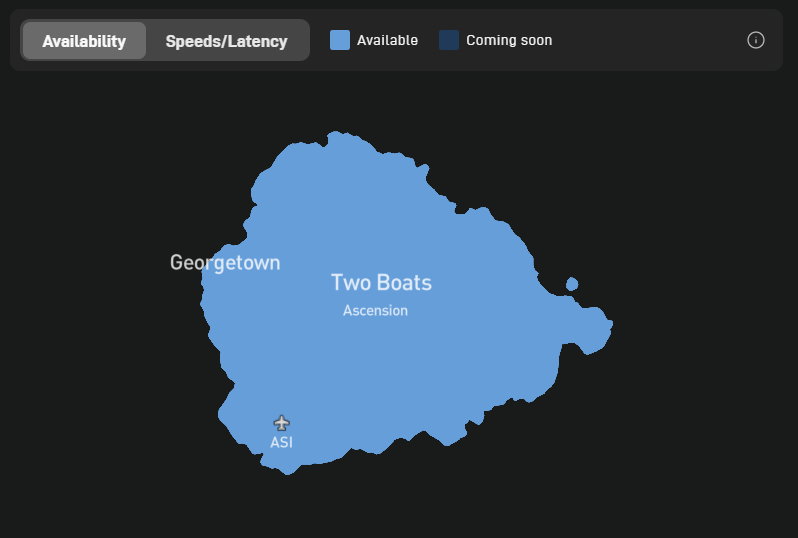
Starlink High-Speed Internet Now Available on Ascension Island
Starlink Activates High-Speed Internet on Ascension Island
Starlink’s high-speed, low-latency satellite internet service is officially live on Ascension Island, according to an official corporate announcement published by the provider via its social media channels on @Starlink. The deployment brings low Earth orbit broadband to the isolated volcanic island in the South Atlantic, closing a critical connectivity gap for residents, local enterprises, and scientific outposts operating in the remote territory.
The Tech TL;DR:
- Network Milestone: Starlink low Earth orbit (LEO) broadband is now operational and accepting service connections on Ascension Island.
- Performance Target: Delivers high-speed, low-latency connectivity designed to replace legacy high-latency geostationary satellite links and expensive marine cables.
- Deployment Scope: Expands the constellation’s geographical coverage footprint into the remote South Atlantic basin.
Architectural Impact on Remote Network Topology
For isolated geographic points like Ascension Island, network backhauling has historically relied on constrained geostationary (GEO) satellites or limited subsea infrastructure. These legacy setups suffer from inherent propagation delays exceeding 600 milliseconds, choking real-time protocols, secure shell (SSH) sessions, and VoIP clarity. By shifting the local loop to LEO constellations operating at altitudes around 550 kilometers, latency drops drastically into the 25 to 50 millisecond range. System administrators configuring local routing tables can now expect performance parity with terrestrial broadband standards, though terrestrial handoffs still require localized gateway earth stations.
When deploying remote satellite arrays into existing local area networks (LANs), infrastructure teams must update firewall rules and manage DHCP scopes carefully to handle dynamic public IP allocations. Below is a standard diagnostic routine utilized by site reliability engineers to verify packet round-trip time and jitter over newly provisioned Starlink terminals:
# Test latency and packet loss to primary gateway over satellite link
ping -c 100 -i 0.2 1.1.1.1

# Monitor active routing table and interface metrics
ip route show dev eth0
traceroute -n 8.8.8.8
Integrating these remote terminals safely into enterprise environments often requires specialized oversight. Organizations scaling operations into newly opened regions frequently partner with enterprise network engineering consultants to ensure proper SD-WAN configuration, redundant failover routing, and zero-trust security postures are established from day one.
Deployment Realities and Ground Station Handshake
The activation on Ascension Island relies on inter-satellite laser links and regional gateway coordination to route data packets efficiently through the broader constellation. According to technical specifications outlined in industry tracking data, user terminals must maintain an unobstructed field of view of the overhead sky to prevent packet drops during satellite handoffs. Each user terminal dynamically adjusts its phased-array antenna to track fast-moving LEO nodes overhead, cycling connections every few minutes without dropping active TCP streams.
Maintaining high availability across isolated network edges also demands rigorous endpoint protection and log management. IT departments deploying hardware to distant regional hubs should coordinate with managed security service providers to monitor remote telemetry, patch management cycles, and intrusion detection systems remotely.
Outlook for South Atlantic Connectivity
The arrival of Starlink on Ascension Island sets a new baseline for remote connectivity infrastructure across isolated oceanic hubs. As satellite density increases and software-defined routing protocols mature, network bottlenecks in geographically isolated zones will continue to shrink. CTOs and systems architects managing decentralized workforces must evaluate how these low-latency LEO networks can augment existing multi-cloud strategies and improve remote site survivability.
Organizations looking to harden their distributed infrastructure against local terrestrial failures should consult with certified IT infrastructure auditors to design resilient, multi-path network architectures.
*Disclaimer: The technical analyses and security protocols detailed in this article are for informational purposes only. Always consult with certified IT and cybersecurity professionals before altering enterprise networks or handling sensitive data.*