Stanford, Byzantine Research Introduce Praxis Witness Encryption for Bitcoin Bridges
Researchers from Stanford University and Byzantine Research introduced a new cryptographic method on November 23 that may enable non-interactive Bitcoin bridges.
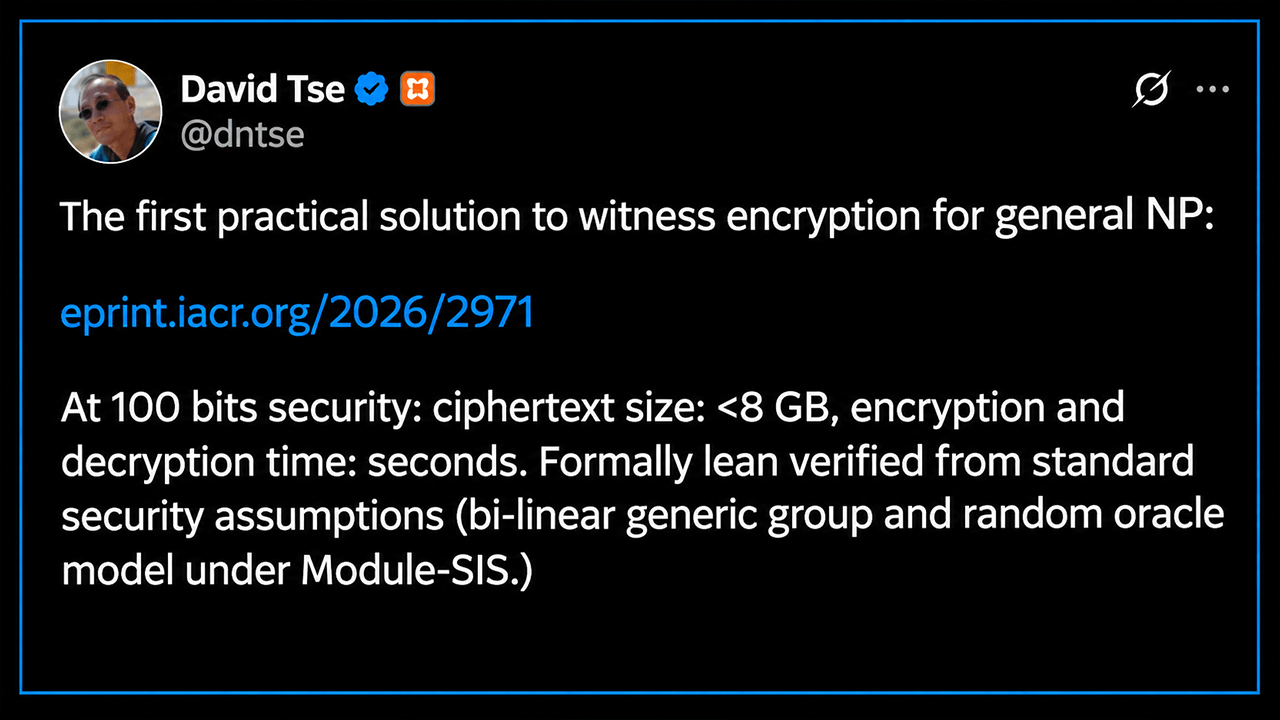
The technique, known as Praxis, aims to solve a 13-year-old challenge in witness encryption by significantly reducing the size of ciphertexts and computational requirements.
David Tse, a professor at Stanford University and co-founder of the Babylon Bitcoin-staking protocol, developed the construction alongside Nikhil Vanjani and Psi Vesely of Byzantine Research, according to Bitcoin News. Their work, titled “Praxis: Practical Witness Encryption for NP,” was published in the International Association for Cryptologic Research (IACR) preprint archive.
The construction allows users to encrypt information based on a mathematical statement rather than a specific key. Anyone possessing a “witness”—a proof that the statement is true—can decrypt the message. This process could allow complex conditions to be enforced on the Bitcoin network without requiring the blockchain to directly verify the underlying computations.
| Metric | Previous Construction | Praxis |
|---|---|---|
| Ciphertext Size | 110 Billion GiB | 7.88 GiB |
| Encryption Operations | Not specified | 20 Billion multiplications |
| Decryption Operations | Not specified | 8.6 Billion multiplications |
The researchers reported that Praxis reduces the size of the ciphertext and the encryption effort by more than ten orders of magnitude compared to earlier models, such as those published by Hair and Sahai in 2026. While the resulting 7.88 GiB ciphertext remains too large for direct integration into Bitcoin transactions, the team said that both encryption and decryption can be performed on a laptop in seconds.
Bitcoin could benefit substantially. Currently, developers use approaches like BitVM—an interactive system that relies on challengers to verify computations—to implement complex applications on Bitcoin. Witness encryption could remove the need for these operators and waiting periods, as the proof is embedded within the encrypted data itself.
“Should the construction withstand independent review, it will fundamentally improve Bitcoin bridges,” said Robin Linus, a developer associated with the Zerosync Association, in a post on X. “Operators will become redundant, and deposits and withdrawals will be non-interactive.”
Despite these gains, the technology faces practical hurdles. Praxis requires a trusted setup; if the secret random number generated during this phase is compromised, proofs could be forged.
The system has not yet undergone formal peer review, and its security parameters require independent verification.
The researchers confirmed that their security proofs rely on the module-SIS assumption and provided machine-checked proofs using the Lean 4 verification system. As the technology matures, it may eventually support cross-chain atomic swaps and private auctions, provided the current technical limitations are addressed.
If this witness encryption construction holds up against independent peer review, it will fundamentally improve Bitcoin bridges. Eliminating the need for operators and making deposits and withdrawals non-interactive. https://t.co/fov9vXytwf
No way! If this is real, Bitcoin might be technologically saved after all lmfao https://t.co/0KAKwsECGa