Stack Internal October release adds Scopes and GitHub connector
Organizations face a growing context gap as 75% of developers spend over 5 hours a week searching for information, and 79% discover critical project context only after tasks have begun, according to the Stack Overflow blog detailing the October release for Stack Internal and Stack Internal Community.
Isolating Knowledge with Scopes
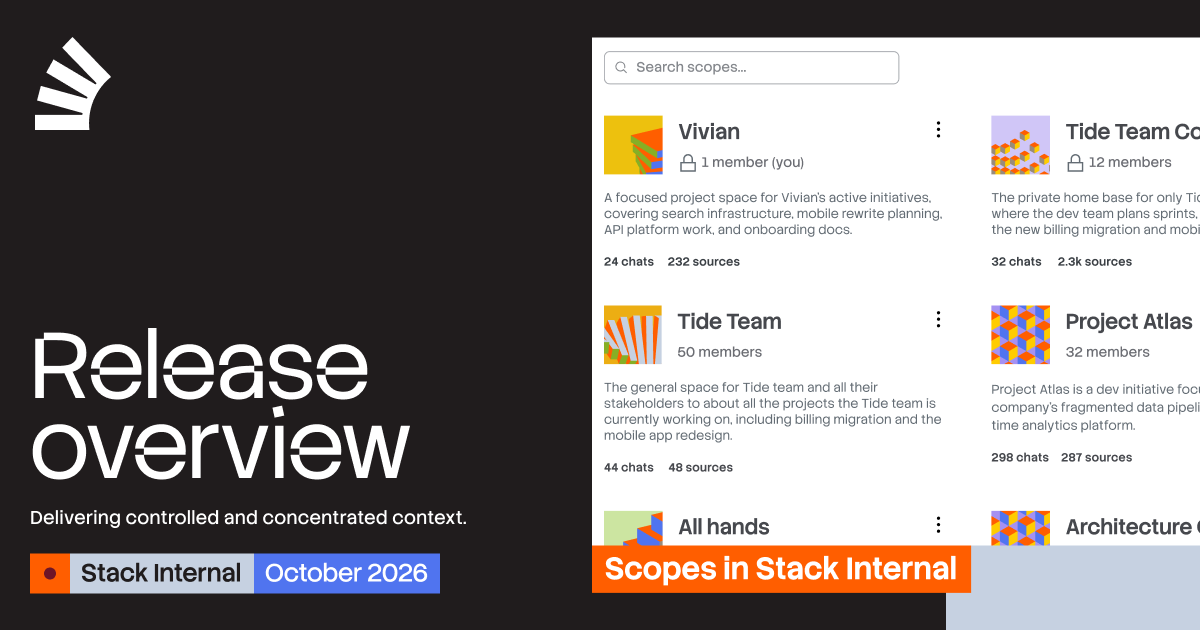
To eliminate static information silos, the October release deploys Scopes, letting engineering teams shape organizational knowledge into permission-governed spaces.
Developers can fluidly switch contexts between different project and department environments, or direct autonomous AI agents to query a designated Scope via a Model Context Protocol (MCP) server. This architectural design prevents information leakage and suppresses noise during critical workflows.
Finding important context shouldn't be a scavenger hunt through old chat threads and scattered repos. With the October release for Stack Internal, we're bringing you Scopes, a new way to create permission-governed spaces so teams and AI agents get focused knowledge without… pic.twitter.com/iwby8wVPWJ
Automating GitHub Ingestion
The platform also incorporates a native GitHub connector designed to ingest engineering knowledge directly from organization-owned repositories.
By pulling in pull requests, repository documentation, and issue discussions, the system captures high-signal decisions without requiring manual upkeep. Crucially, the connector enforces source-level permissions, maintaining repository access controls across both human developers and downstream AI toolchains.
Service Accounts Standardize Identity Management for Enterprise Workflows
Security teams gain standardized identity management through service accounts, replacing personal tokens or shared user logins for connected applications and MCP clients.
Each service account binds to a single workspace with discrete permissions, enabling verifiable audit trails for automated enterprise workflows. Subject matter experts can validate workspace questions directly inside the web UI using the updated Reviews interface, while a dedicated validation API allows teams to sync verified data back into enterprise tools like Confluence.
Closing the Organizational Loop
The updated infrastructure closes the loop on organizational memory by ensuring solutions found in chat sessions write back automatically as reviewed community Q&A. IDEs, Slack, and Microsoft Teams now surface conversational AI summaries backed by visible citations, preventing context drift and hallucinations across daily development tasks.
Disclaimer: The technical analyses and security protocols detailed in this article are for informational purposes only. Always consult with certified IT and cybersecurity professionals before altering enterprise networks or handling sensitive data.