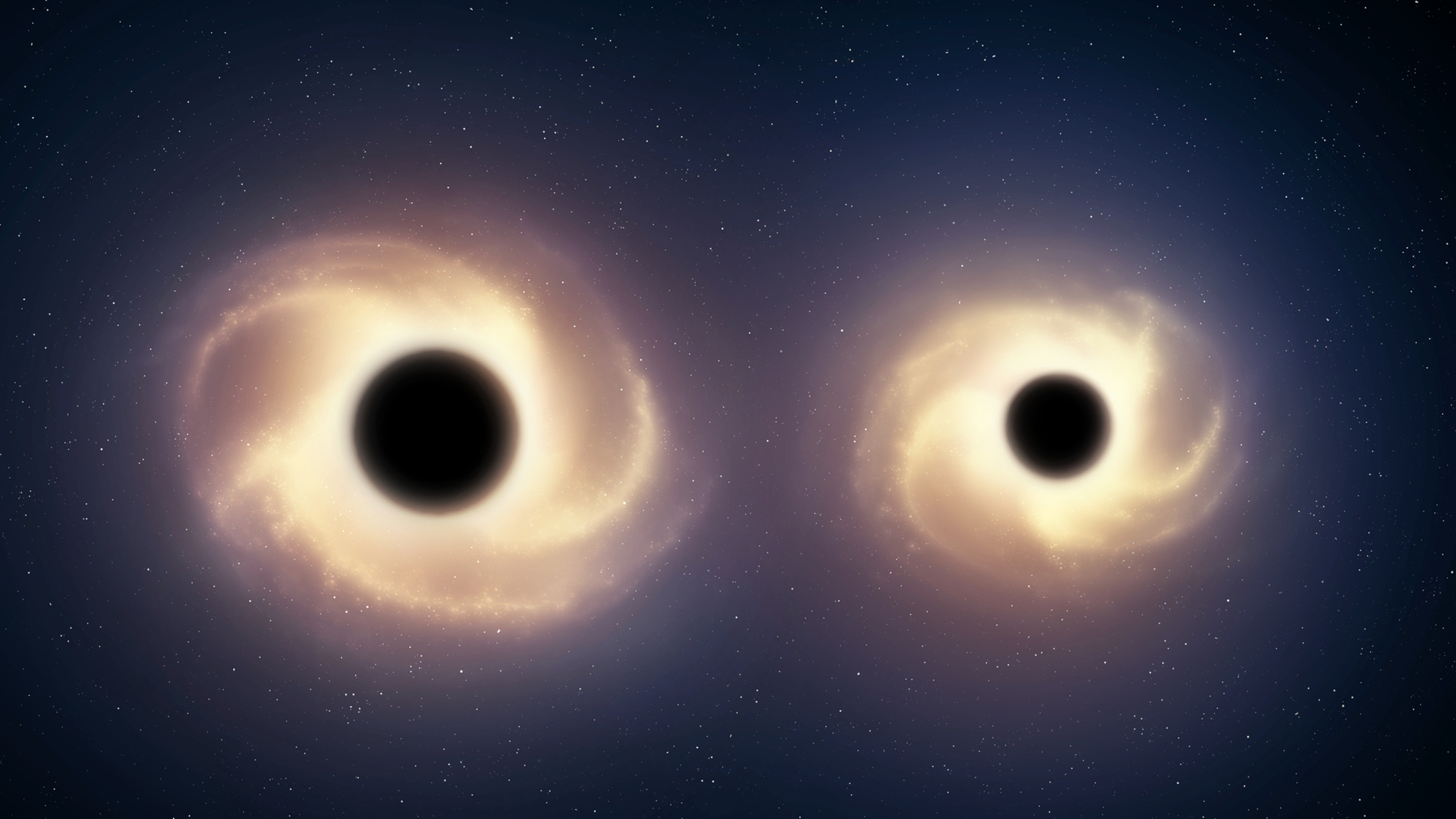
Spinning Black Holes Could Split Like ‘Pair of Pants,’ Study Suggests
A rapidly spinning black hole could theoretically split into smaller fragments, according to a study published Oct. 22 in Physical Review D. The research identifies a narrow loophole in general relativity that would allow an isolated black hole to fragment — a process the authors describe using a “pair-of-pants” topology — but only if the black hole rotates at nearly the maximum speed the theory permits.
“This is why, in four-dimensional general relativity, an isolated black hole in empty space could only split if it spins very close to the maximum rate the theory allows, what we call a near-extremal black hole,” said Manuel Del Piano, a theoretical physicist at the University of Southern Denmark and co-author of the study, in an email to Live Science.
“Loosely speaking, the equator of the horizon is then dragged around at nearly the speed of light.”
The paper, authored by Giacomo Cacciapaglia, Del Piano, Francesco Sannino and Vania Vellucci, used several mathematical modeling methods to test whether a black hole’s event horizon could divide under various cosmological conditions, including classical four-dimensional general relativity, higher-dimensional space-time and modified gravity scenarios. The researchers simplified the dynamics by comparing discrete slices of space-time — static snapshots before and after a hypothetical split — rather than modeling the full evolution.
In standard four-dimensional relativity, they found two fundamental obstacles. First, entropy — which cannot spontaneously decrease — forbids the splitting of a static, non-spinning Schwarzschild black hole because it would violate the second law of thermodynamics and the principle that a black hole’s surface area cannot shrink. Second, kinematics dictates that any fragments would recombine into a single body almost instantly, preventing a permanent split.
The exception arises only for a near-extremal black hole spinning at close to the theoretical limit. In that case, the fragments could be gravitationally slingshotted away from each other before they recombine.

In models with extra dimensions, a black hole’s spin is no longer capped because gravity weakens as dimensions are added; a “black string” stretched across extra dimensions could pinch off into multiple smaller bodies like beads on a string.
In modified gravity theories, fragmentation may be favored by entropy. Another scenario involves a “bumpy horizon” — a shroud of exotic matter acting as a giant quantum entity whose superfluid properties could create vortices that split the black hole.
The resulting fragments would be extraordinarily small. Del Piano said that in one benchmark, a black hole of ten solar masses would favor fragments with a few times the mass of the Great Pyramid of Giza, squeezed into a region smaller than a proton, with heavier parent black holes producing even smaller fragments.
Such “morsels” could help explain black holes with masses too small to form through conventional astrophysical processes. These tiny remnants would be small enough that astronomers could potentially watch them evaporate on observational timescales. The researchers expect smaller objects, such as hypothesized primordial black holes formed shortly after the Big Bang, to be more likely to split than supermassive black holes at the centers of galaxies.
Related work on silent black hole births
A separate study examined 257 black hole mergers and identified a pattern indicating that some black holes may form without a supernova explosion. Instead, massive stars could collapse quietly into black holes, Ivan Farkas reported for Live Science.

Observational Signatures Remain Uncertain and Require Simulations
“Gamma-ray telescopes or gravitational wave observatories may one day offer evidence of a signal associated with the supposed split of a small black hole, but the specifics, including whether this actually occurs, are uncertain,” Del Piano told Live Science.
Manuel Del Piano, a theoretical physicist and postdoctoral researcher in Computational Science at the University of Southern Denmark’s Department of Mathematics and Computer Science, co-authored the study published Oct. 22 in Physical Review D. His research fingerprint is anchored in Black Hole Physics (100%), with significant contributions in General Relativity, Event Horizon Physics, Quantum Gravity, and Charged Black Holes, establishing his expertise in the theoretical frameworks governing black hole behavior explored in the paper.
“As we put it in the paper, a shattered glass has more entropy than an intact one, yet glasses don't shatter on their own. Settling the question requires full dynamical simulations, which is the natural next step,” Del Piano said.
“Understanding precisely what is forbidden, what is merely unlikely, and what becomes possible once the assumptions are relaxed is the central goal of this work,” the researchers wrote in the paper. The findings remain theoretical; no such split has been observed, and the authors stress the claim is preliminary and will require further testing.