
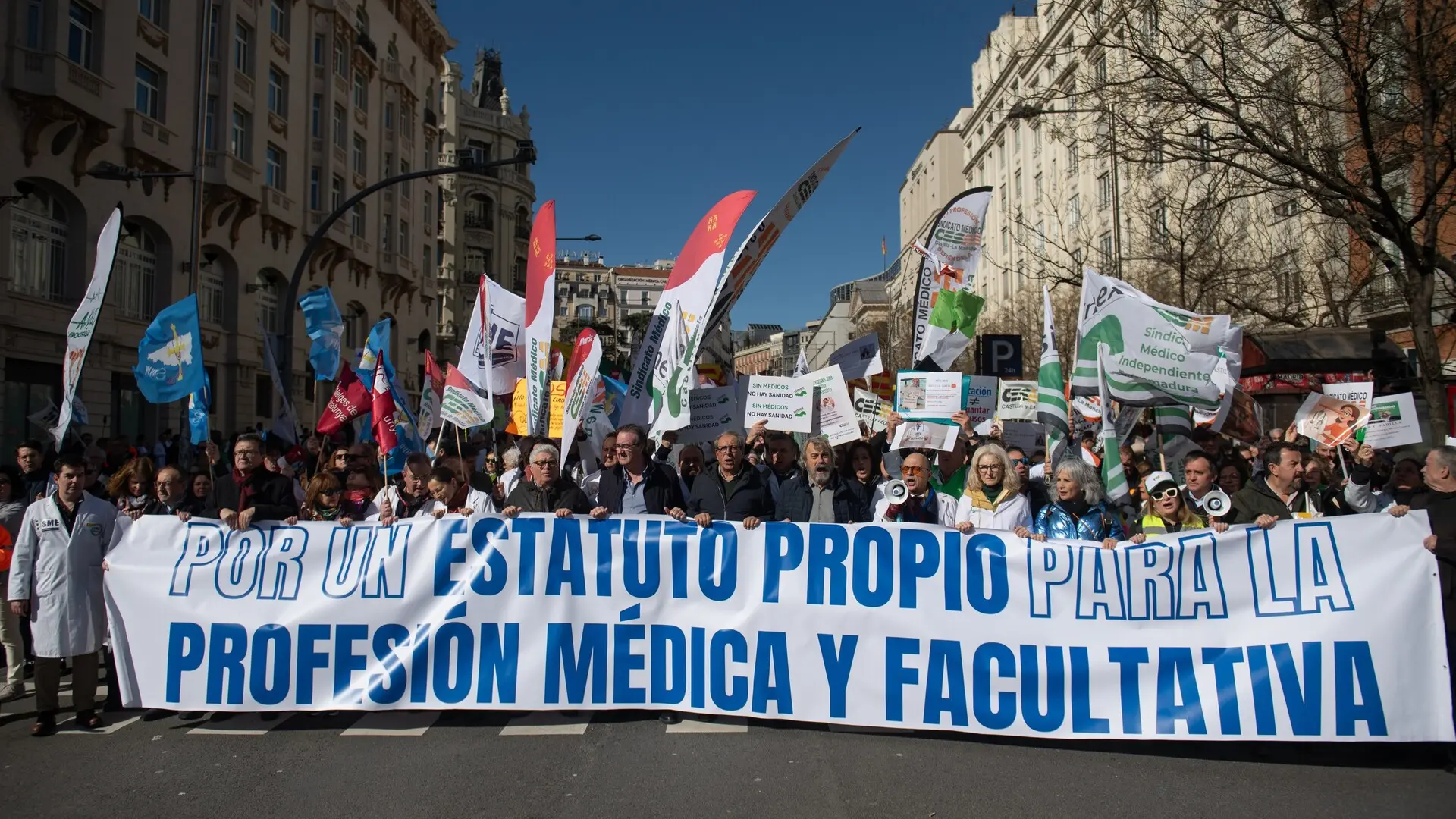
Thousands of doctors marched through central Madrid on Saturday, demanding the resignation of Health Minister Mónica García and a separate professional statute, warning of escalating nationwide strikes if their demands are not met. Approximately 5,000 doctors participated in the demonstration, according to the Government Delegation in Madrid, while organizers claimed a turnout of 8,000.
The protest, which began at the Congress of Deputies and concluded at the Ministry of Health, saw demonstrators chanting slogans such as “Mónica, resign!”, “Mónica attends, Medicine defends itself,” and “Minister, negotiate or return to your practice.” The core demand centers on securing a distinct statute for doctors and medical specialists, independent from the broader framework governing all healthcare personnel within the National Health System (SNS).
Víctor Pedrero, Secretary General of the Spanish Confederation of Medical Unions (CESM), stated that without a dedicated negotiation framework, “the healthcare system will collapse and be left without doctors.” Doctors are seeking a statute that recognizes their unique training, responsibilities, and working conditions, arguing that the current framework fails to adequately address their specific needs.
The doctors are rejecting the recently agreed-upon statute framework negotiated by the Ministry of Health with other unions representing healthcare professionals (SATSE-FSES, CCOO, UGT, and CSIF). They argue that it fails to address key concerns, including workload, guard duty regulations, and recognition of seniority for retirement purposes. The Ministry maintains that the signed statute limits the working week to 45 hours and reduces on-call shifts from 24 to 17 hours.
Ángela Hernández, Secretary General of the Madrid Association of Doctors and Senior Specialists (AMYTS), highlighted concerns about the categorization of medical professionals within the proposed statute. “Just as an aircraft flight attendant is necessary for a flight, but is not qualified to pilot it, a doctor, who has responsibility for patients, should not be categorized the same as a specialized nurse,” she explained. She argued that the current framework inappropriately equates the roles and responsibilities of physicians with those of other healthcare professionals.
The demonstration included doctors from across Spain, including Galicia, the Basque Country, the Balearic Islands, Andalusia, Extremadura, and Castile and León. Many participants brought their families, with signs reading “Fewer on-call hours and more playtime” and “Who takes care of me?” reflecting the impact of doctors’ working conditions on their personal lives.
The six convening unions – CESM, the Andalusian Medical Union (SMA), Metges de Catalunya (MC), AMYTS, the Basque Medical Union (SME), and the Independent Galician Faculty Union (O’MEGA) – have called on the Spanish Congress to reject the new statute framework when it is presented for consideration. Miguel Lázaro, President of CESM, stated that the unions have also appealed to European organizations for support in addressing their concerns.
The unions have announced a series of planned strikes spanning from February to June, scheduled for the weeks of February 16-20, March 16-20, April 27-30, May 18-22, and June 15-19. Demonstrators repeatedly stated their determination to halt the implementation of the current statute, with slogans proclaiming, “This statute we will stop, it’s a rip-off” and “Exploitation kills my vocation.”
The protest comes as the Spanish government, led by Health Minister Mónica García, recently approved a preliminary bill aimed at protecting the public healthcare system from what she termed “speculative interests.” The bill seeks to prioritize direct public management of healthcare services and repeal a 1997 law that allowed for indirect management models. According to García, the new law is a “triumph of civil society” and aims to prevent private companies from profiting from healthcare. However, existing contracts and agreements will remain in effect until their expiration.
Separately, Mónica García has criticized the Madrid regional government for allegedly failing to collect 71 million euros owed by private healthcare groups Quirónsalud and Ribera Salud for treating patients within the public system, according to reporting by elDiario.es. García characterized this as “malversation” and indicated an investigation would be launched.
