Spain Election Debate Ends with Feijóo on Attack, Sánchez Appealing to Voters
Madrid’s only head-to-head election debate ended on Thursday night with Alberto Núñez Feijóo on the attack and Pedro Sánchez appealing to voters in a final-minute plea, ten days before Spain’s general election on November 29.
Feijóo pressed his case as the candidate who knows how to “manage”; Sánchez told Spaniards that in a democracy “the power is yours, it is in your hands.”
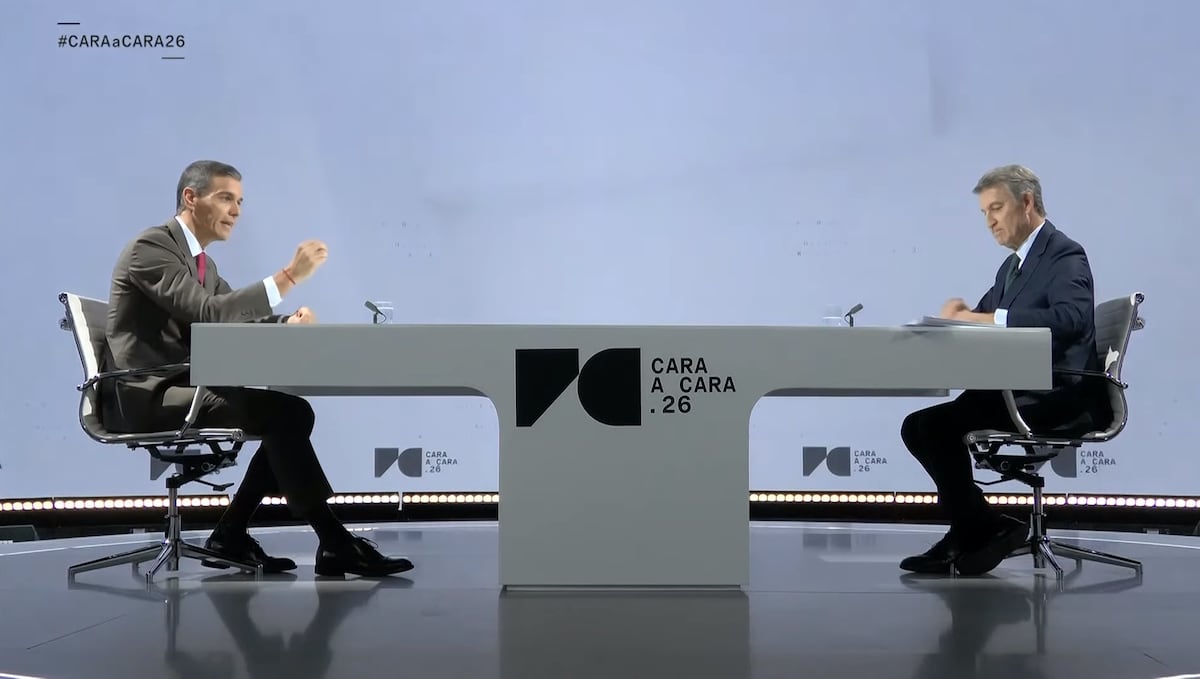
The two men leading the race for the prime minister’s office met at the Television Academy’s studio in Tres Cantos, outside Madrid, after both cleared their campaign schedules to prepare. Feijóo opened the debate by lot; Sánchez closed it.
EL PAÍS reported that the contest was split into five blocks: housing; the economy and taxation; social policy and public services; corruption and democratic renewal; and migration and foreign policy.
The expectation, after 2023, was that debates rarely settle anything. EL PAÍS’s own analysis recalled that Feijóo won that year’s debate and Sánchez won the presidency. This time, the outlet’s provisional scorecard read a draw — but the framing from the two campaigns differed sharply, and La Voz de Galicia saw it differently, describing a president “cornered” and on the defensive for nearly the whole night.
“Yo estoy medio, medio, de acuerdo con usted”. Hasta Sánchez quiere que @NunezFeijoo sea presidente.#CaraACara26 #FeijóoGana #SánchezMiente pic.twitter.com/devOMC3fCV
“Spain deserves a decent president. And he is not it,” Feijóo said in his opening attack. The Popular Party leader hammered corruption cases, the housing record, the Ceuta crisis and rail accidents from the first minute, El Mundo reported, citing recent statements by former Catalan president Carles Puigdemont on investiture pacts.
Feijóo attacks, Sánchez holds calm
The styles could hardly have diverged more. La Voz de Galicia reported that Feijóo interrupted continuously and hammered Sánchez with a barrage of figures that left the Socialist leader little room to respond, at times making it look as though the opposition leader were examining the president’s fitness to govern.
Sánchez chose not to interrupt. EL PAÍS reported that he avoided confrontation to project calm, even when Feijóo raised matters that had personally hurt him, including those affecting his family.
OkDiario described a different picture, saying the early pressure left Sánchez stammering during the housing and economy blocks — a contrast between outlets worth noting, since one read his stillness as composure and the other as being unsettled.

Viewers noticed the restraint too. 20 Minutos reported that Sánchez’s repeated conciliatory phrases — “I half agree with you” and “I agree, Mr. Feijóo” — disoriented some voters following the debate.
Housing claims meet the records
The sharpest factual clash came over housing. Sánchez claimed his government had built “around a million homes over these last eight years, of which 13% are protected.” EL PAÍS checked the numbers against the latest Housing and Land Observatory data: 989,533 homes started, but only 749,987 completed, with 90,005 — 12% of the total — holding final protected-housing status.
“There are more apartments in corruption case files than you have built.”
Feijóo said during the housing block, per El Mundo, which also noted his promise to promote a million homes if he reaches the Moncloa palace.
Sánchez defended his rent controls and admitted the market needed more supply, saying deregulation “will not fix the problem, it will make it worse.” OkDiario reported a heated moment when Feijóo invoked Mari Carmen, an eviction-affected woman he said Sánchez had ignored, before the corruption-file jab.
Sánchez and Feijóo clash over defense spending and pension commitments
On defense, La Voz de Galicia reported a direct dispute: Sánchez asked how Feijóo would raise spending to 5% of GDP without raising taxes on workers; Feijóo answered that it was Sánchez who had signed the 5% commitment, and denied he would cut the welfare state to pay for it. Sánchez countered that Feijóo had cut health spending while leading Galicia’s regional government.
On pensions, Socialist minister Óscar López highlighted Feijóo’s silence when Sánchez asked him to commit to uprating pensions, EL PAÍS reported. Feijóo’s reply: “You don’t even have the votes to pass a budget. Do you really believe anyone in Spain thinks you offer real deals?”
Then came the two closing minutes that framed the night. Feijóo, per Telecinco: “I am not a textbook candidate, I don’t dance at rallies and I don’t like show politics. But I also don’t steal, or lie, or go on vacation when our country is invaded. I believe in politics as service. I know how to pass budgets, manage infrastructure, build hospitals, manage crises. Spain needs change.” He ended, EL PAÍS reported, with “I do deliver.”
Sánchez closed with a mobilization call, warning that his rivals enjoy the backing “of the most powerful man in the world and his cohort of tech-oligarchs.” “In a democracy the power is yours, it is in your hands,” he said, urging voters to cast their ballots “with all your soul” for the Socialists on November 29.
Aquí se ha marcado un tanto, Feijóo. Le ha arrancado a Sánchez un “estoy medio de acuerdo con usted”. Eso, en un cara a cara, es un golazo. https://t.co/q9GLPTniId
Corruption accusations and euthanasia law dispute dominate debate
The corruption block turned personal. Feijóo promised never to pardon anyone convicted of corruption and, per La Voz de Galicia, said children watching should be shielded because the government had done “all kinds of dirty tricks.” Sánchez turned the charge around, accusing Feijóo of wanting to repeal the euthanasia law — an exchange EL PAÍS captured as the block’s defining clash.
On migration, Feijóo pledged to end “massive unconditional regularizations,” while Sánchez defended migration as “a great opportunity,” EL PAÍS reported. On wages, La Voz de Galicia noted Feijóo accused Sánchez of having “sabelotado” — slashed through — Spaniards with taxes, while Sánchez cited the European Commission’s view that Spain will be the big economy creating the most jobs and growing fastest.

The parties’ verdicts after the lights went down
Feijóo returned to the Popular Party’s Génova Street headquarters to chants of “Feijóo to La Moncloa!” set to the Ramones’ “Blitzkrieg Bop.”
“I feel very satisfied, I enjoyed it,” he told supporters, before warning — as EL PAÍS reported — that the campaign is not won: “This is like when you play in the Champions League and you get a good result, but the return leg remains, November 29. There you cannot slip up.”
Sánchez reached the Socialist headquarters on Ferraz Street with a sharper tongue. “First, what a pleasure to be surrounded by educated people,” he began, summing up the debate in four words: “good politics and bad manners.” “I believe that after today’s debate we are one step closer to winning the elections and governing for four more years,” he told militants.
Not everyone on the left was convinced. ERC’s congressional spokesperson Gabriel Rufián wrote on X, in remarks quoted by EL PAÍS: “If Feijóo eats you alive like that in a debate, it’s either that you didn’t prepare it or that you’re badly advised. Or both.” Popular Party officials quickly amplified the message.
What the polls and the calendar say next
The daily 40dB. survey for EL PAÍS and Cadena SER gives Feijóo’s party oxygen in its fight with the Socialists for first place, though no source reported post-debate polling yet. Several outlets, including El Correo, ran reader surveys asking who won — unscientific measures that reflect engagement, not verdicts.
The two candidates meet again in a second debate next week, but both camps insist the decisive date is the election itself. A daily tracking poll and ten days of campaigning across regions from Tenerife — where Feijóo travels Friday, then El Hierro, Valencia’s bullring on Saturday and Murcia on Sunday — will fill the gap between the draw declared Thursday and the verdict due November 29.

For voters weighing the housing numbers, pension pledges and corruption claims aired on Thursday, independent fact-checking organizations and election-monitoring bodies are the practical next stop for verifying each claim against official records before casting a ballot.
Feijóo, born in 1961 in the village of Os Peares in the Province of Ourense, governed Galicia for thirteen years before taking his party’s national helm. A former civil servant who served as secretary general in Galicia’s ministries of agriculture and health and later at the national Ministry of Health, he entered the Parliament of Galicia in 2005 and succeeded Manuel Fraga as regional party leader the following January.
After the PPdeG won a majority in the 2009 Galician election, he became regional president, winning further terms in 2012, 2016 and 2020. He became president of the People’s Party in 2022 as Pablo Casado’s successor, and was appointed government formateur after the 2023 election, though his investiture ultimately failed.
Sánchez said, closing the night the way EL PAÍS recorded it — with power, as he put it, “in your hands.”