SpaceX Starship Reaches Orbit for First Time and Deploys Advanced Starlink Satellites
SpaceX Starship Reaches Orbit for the First Time Before Cutting Flight Short
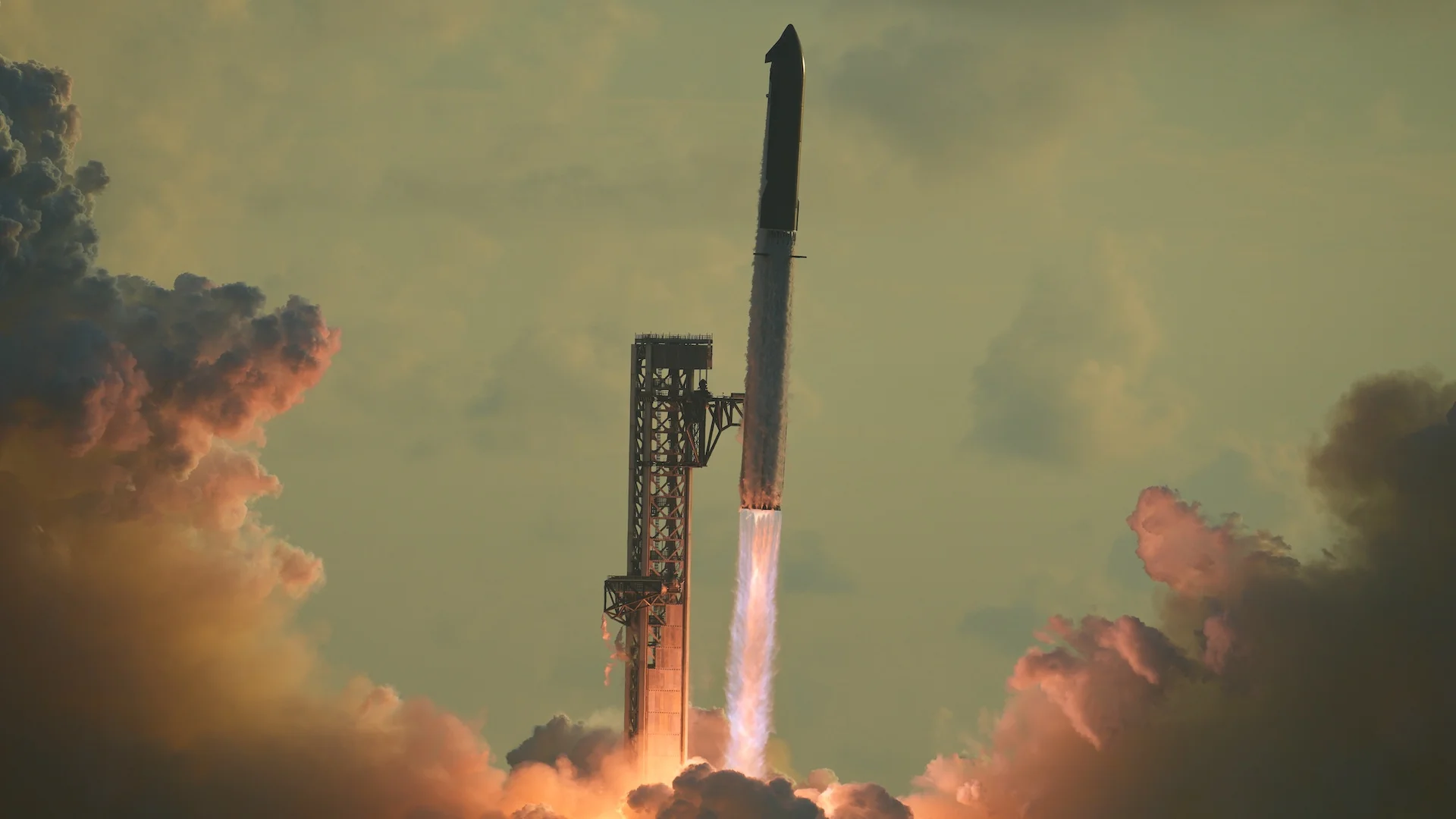
SpaceX launched its Starship rocket into orbit for the first time on Monday, successfully deploying 26 advanced Starlink satellites before cutting the test flight short to ensure safety. The spacecraft reentered Earth’s atmosphere over the Pacific Ocean and splashed down north of Hawaii three hours after lifting off from Starbase in South Texas.
Starship reaches orbit and deploys Starlink satellites
- Orbital Milestone: Starship reached orbit for the first time at roughly 17,500 mph (28,000 kph) at an altitude of 170 miles (275 kilometers), despite experiencing a Raptor engine shutdown during the ascent.
- Payload Deployment: The megarocket successfully dispensed and connected to 26 new third-generation Starlink V3 satellites designed to significantly expand network capacity.
- Curtailed Mission: Flight controllers chose to bring the upper stage down after three hours instead of completing a planned 10-hour, six-lap endurance run, concluding with a splashdown near Hawaii.
Engine Anomalies and Orbital Insertion
The 407-foot (124-meter) megarocket lifted off from South Texas at 8:49 a.m. ET. About two and a half minutes into the flight, the Super Heavy booster separated from the upper stage and performed a controlled splashdown in the Gulf of Mexico. Shortly after upper stage separation, one of the vehicle’s Raptor engines unexpectedly shut down. Flight controllers initially considered standing down from the orbital insertion burn before deciding to proceed after several nail-biting minutes of deliberation. Mission Control announced to cheers that the vehicle was orbital once a single engine successfully ignited to circularize the trajectory.
Payload Delivery and Fleet Expansion
Once established in its orbital path, the spacecraft dispensed 26 upgraded Starlink V3 satellites, joining an existing constellation of 10,000 to 11,000 older units. These third-generation satellites are significantly more powerful than prior iterations, with SpaceX noting that a single full Starship launch of V3 units adds capacity equivalent to 20 Falcon 9 flights carrying V2 mini versions. The newly deployed hardware is scheduled to begin servicing customers within a few weeks.
https://x.com/SpaceX/status/2104354931595423762
Safety Precautions and Early Deorbit Decision
Although the mission was originally designed to span 10 hours and complete six full orbits, flight controllers elected to bring the spacecraft back after just three hours. Founder Elon Musk explained at a business summit that maintaining extreme caution is vital to avoid debris hazards over land, noting that public support could diminish rapidly if a vehicle broke apart prematurely. The upper stage reentered the atmosphere and splashed down safely in a pre-cleared area of the Pacific Ocean. Meanwhile, the Super Heavy booster completed the cleanest simulated landing over water for the V3 configuration to date.
Implications for Artemis and Future Reusability
Achieving orbital flight is a critical prerequisite for certifying Starship for NASA’s Artemis moon program and future Mars transport. The upcoming Artemis III mission involves a triple-launch orbital docking sequence featuring an Orion capsule, Jeff Bezos’ Blue Moon lander, and SpaceX’s Starship. Depending on data gathered from this 14th test flight, SpaceX aims to test catching the hovering spacecraft with giant mechanical arms at the Texas launch pad by year’s end or early next year, pushing toward a fully reusable architecture designed to lower launch costs.
